Surat Sarafa Bazaar
Surat, India · Established 16th century
This site requires authorization to access.
To request access, contact
william.goetzmann@yale.edu
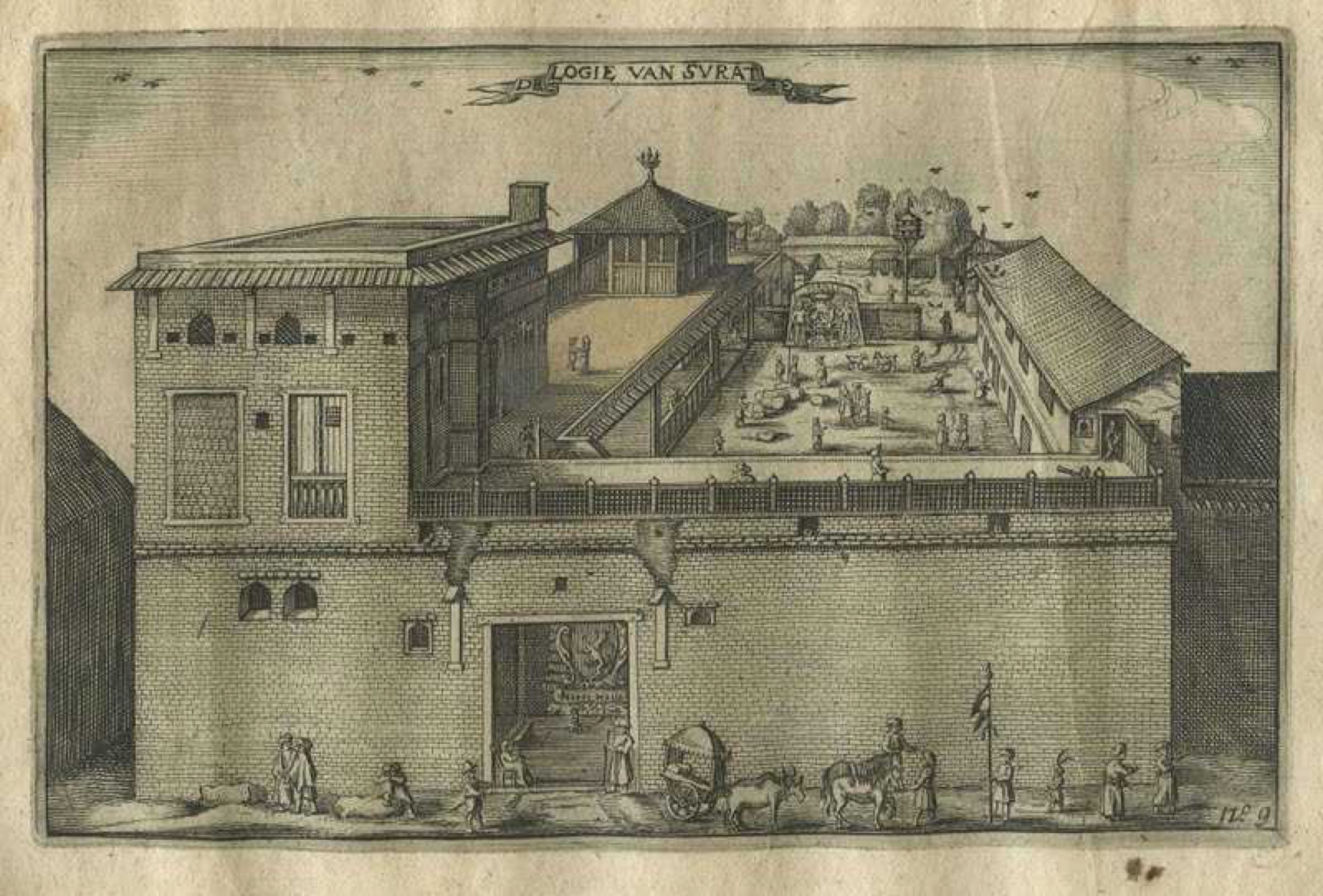
The commercial heart of Mughal Surat was defined by three principal structures: the Surat Castle, the imperial mint, and the dense network of merchant quarters in which the sarafa bazaar occupied a central position. Surat Castle, constructed in 1546 by Safi Agha (honored with the title Khudawand Khan) on orders from Sultan Mahmud III of the Gujarat Sultanate, stands on the southern bank of the Tapi River and covers approximately one acre within an irregular square plan. As documented by the Surat Municipal Corporation's heritage survey, the fort's curtain walls rise approximately eighteen meters, with a thickness of 4.1 meters, reinforced by iron strips and joints sealed with molten lead, and four corner bastions reaching 12.2 meters in height. After Akbar's conquest of Surat in 1573, the fort became the seat of the Mughal mutasaddi (port governor) who oversaw customs revenue and commercial regulation. The European factory district grew up nearby along the riverfront: the English East India Company established its first Indian factory in Surat in 1613, initially as a warehouse and residence compound known as the kothi, following Captain Thomas Best's naval victory over the Portuguese and Jahangir's resulting firman granting trading privileges. A 1751 engraving published in Venice as part of Thomas Salmon's geographic compendium depicts "The Lodge of the English at Suratte" as a walled compound containing a church, residence, armory, and coach-house. The Dutch East India Company (VOC) established its own lodge in 1616, depicted in a celebrated copperplate engraving by Adriaen Matham published in Isaac Commelin's Begin ende Voortgangh (Amsterdam, 1646), based on a drawing made by Pieter van den Broecke during his visit in April 1629. This image, now in the Rijksmuseum (RP-P-OB-75.465), shows a substantial courtyard compound surrounded by arcaded galleries in a hybrid Indo-European style. The sarafa bazaar itself occupied the commercial lanes between the custom house and the mint, where, as the French jeweler Jean-Baptiste Tavernier observed during his visits between 1638 and 1668, a crowded bazaar of those who came to buy and sell cloth lay at the center of the city's financial operations. The broader built environment of merchant Surat was characterized by havelis constructed in the distinctive Gujarati tradition documented by V. S. Pramar in Haveli: Wooden Houses and Mansions of Gujarat (Mapin Publishing, 1989), featuring elaborately carved teak columns, brackets, and frontages whose ornamental complexity reflected the wealth of their Bania and Jain owners. Today, the English and Dutch cemeteries survive as remarkable architectural monuments: the English Cemetery, with over four hundred graves and mausolea adopting Mughal-influenced cupolas and obelisks, preserves the tombs of George Oxenden, first governor of the Bombay Presidency, and Gerald Aungier, his successor. As Susan Stronge documented in her study "The English Cemetery at Surat: Pre-Colonial Cultural Encounters in Western India" (Antiquaries Journal, Cambridge University Press), the earliest tombs adopted Indo-Islamic architectural styles that were only gradually modified by Western features as British political power increased during the eighteenth century.
The visual record of Surat's commercial life is preserved primarily in European engravings and travel illustrations produced between the early seventeenth and mid-eighteenth centuries. The earliest significant depiction is the 1629 copperplate engraving of the VOC lodge ("Logie van Suratte") attributed to Adriaen Matham, based on Pieter van den Broecke's eyewitness drawing, which presents the Dutch factory as a symmetrical courtyard compound with covered galleries, arcaded walkways, and a central garden, rendered in the precise topographic style characteristic of Dutch colonial documentation. This engraving was published in 1646 as part of Isaac Commelin's monumental Begin ende Voortgangh van de Vereenighde Nederlantsche Geoctroyeerde Oost-Indische Compagnie, the official compilation of VOC voyage accounts. Frans Hals's celebrated portrait of Pieter van den Broecke himself (c. 1633, now in the Kenwood House collection, London) depicts the merchant who first established the Dutch lodge at Surat, wearing a lace collar and holding a cane, his weathered features suggesting years of Indian Ocean commerce. The 1751 Venetian engraving of the English lodge provides architectural detail of the EIC compound, while a 1754 Dutch engraved plan offers a bird's-eye topographic view of the fort, city walls, and commercial quarters. The merchant havelis of Surat displayed the characteristic decorative vocabulary of Gujarati woodcarving: finely carved teak columns, beams, and brackets depicting geometric patterns, floral arabesques, and mythological figures, often coated with the black preservative oil distinctive of the region. The competitive monumentality of the European cemeteries also produced notable artistic programs: the mausoleum of Baron Adrian van Reede in the Dutch Cemetery features a double cupola of great size supported on handsome columns, originally ornamented with frescoes, escutcheons, and scriptural passages, deliberately designed to rival the Oxenden tomb in the English Cemetery. As architectural historians have noted, this competitive memorial architecture -- in which Dutch and English merchants adopted Mughal tomb forms to impress upon the natives their importance and power -- represents one of the most striking instances of cross-cultural artistic exchange in colonial India. The broader visual culture of Mughal Surat is further documented in the illustrated manuscripts and miniature paintings produced at regional courts, though few depictions of the sarafa bazaar itself survive in the Mughal miniature tradition.
Surat's commercial supremacy derived from an exceptional conjunction of geography and political economy. Situated approximately twenty kilometers inland on the southern bank of the Tapi (Tapti) River, near its mouth on the Gulf of Khambhat in the Arabian Sea, the city occupied a position that offered navigable access to oceanic trade routes while providing protection from naval attacks and monsoon storms. The Tapi served as the city's harbor: contemporary accounts describe hundreds of ships anchored in the river at any given time, with large ocean-going vessels requiring lighters to transfer cargo between the anchorage at Swally (Suvali), approximately eighteen kilometers downstream, and the city's riverside wharves. As Ashin Das Gupta demonstrated in Indian Merchants and the Decline of Surat, c. 1700-1750 (Franz Steiner Verlag, 1979), the advantages of Surat lay in its overland access to a vast and rich hinterland: terrestrial routes connected the port to the great Mughal cities of Agra, Delhi, Lahore, and Burhanpur, and through them to the markets of Central Asia. The city was organized around a commercial topography in which the castle, positioned on the river's edge at the southwestern corner, commanded both the waterway and the approaches to the commercial quarters. The European factory district clustered along the riverfront near the castle: the English factory, Dutch lodge, and French factory all occupied riverside compounds within easy reach of the custom house. The Reverend John Ovington, who visited in 1689, described the city's circumference as between two and three English miles, "tending somewhat in its position to the form of a semicircle or half moon, because of the winding of the river to which half of it adjoins." Ovington noted that the majority of houses were large, stately, and fair, and that the city's inhabitants were almost all very wealthy. The commercial quarter proper, including the sarafa bazaar, the cloth bazaar, and the custom house, occupied the dense urban core between the castle and the city's landward walls. Ruby Maloni, in Surat: Port of the Mughal Empire (Himalaya Publishing House, 2003), documented how Surat functioned as an entrepot connecting the Indian Ocean maritime world with the Mughal Empire's vast interior: goods arriving by sea were warehoused, taxed at the custom house, and redistributed along overland caravan routes, while products of the hinterland -- textiles, indigo, sugar, opium -- flowed through the port to markets in the Persian Gulf, Red Sea, and Southeast Asia. Lakshmi Subramanian, in Indigenous Capital and Imperial Expansion: Bombay, Surat and the West Coast (Oxford University Press, 1996), traced how this commercial geography was decisively disrupted when the English East India Company transferred its western Indian headquarters from Surat to Bombay in 1687, a shift driven by Bombay's superior deep-water harbor and the increasing insecurity of Surat following Maratha raids and the weakening of Mughal authority.
Surat's emergence as the Mughal Empire's premier port dates from Akbar's conquest of Gujarat in 1573, which brought the city under imperial administration and integrated it into the fiscal and commercial infrastructure of the most powerful state in South Asia. Under Mughal governance, Surat was administered by a mutasaddi (port governor) who controlled customs revenue, supervised the mint, and adjudicated commercial disputes -- a system that Om Prakash analyzed in European Commercial Enterprise in Pre-Colonial India (Cambridge University Press, 1998) as providing the stable institutional framework that attracted both Indian and European merchants. The commercial life of the port was organized through indigenous institutions of remarkable sophistication. The mahajan (merchant guild) regulated trade in specific commodities, fixing rates of exchange and discount and levying fees on transactions, the proceeds of which were spent on communal and religious purposes. The most influential merchant held the hereditary title of nagarsheth, serving as the chief representative of the trading community and the principal intermediary between the merchant class and the Mughal state. The Jain jeweler Shantidas Jhaveri (c. 1580s-1659) received the title of nagarsheth from Emperor Jahangir and served as court jeweler to Shah Jahan, while simultaneously functioning as one of the most important moneylenders to the Dutch East India Company. As Sudev Sheth documented in Bankrolling Empire: Family Fortunes and Political Transformation in Mughal India (Cambridge University Press, 2023), the Jhaveri family across four generations deployed their financial power to shape the fortunes of local rulers, illustrating how indigenous merchants and bankers made and unmade the fortunes of political authorities. The most celebrated of Surat's merchants was Virji Vora (c. 1590-c. 1670s), a Jain trader whose business activities encompassed wholesale trading, moneylending, and banking. English East India Company factory records describe Virji Vora as the richest merchant in the world, with a personal fortune estimated at eight million rupees. A Company letter dated 27 January 1642 identifies him as the "greatest creditor" of the EIC, recording his offer of a loan of 100,000 rupees in "necessitous and calamitous times." By 18 July 1643, English records describe him as "the sole monopolist of all European commodities," whose control over the Surat market was such that the time and price of deals were decided at his will and at his own disposure. Bhimji Parekh (1610-1686), who succeeded to the position of nagarsheth, served as broker for the East India Company and moneylender, amassing a fortune of approximately one million pounds. When Mughal Emperor Aurangzeb's policies of religious persecution became intolerable, Bhimji Parekh organized and led a boycott in which over eight hundred Hindu merchants departed Surat en masse, a commercial strike that proved sufficiently damaging to extract promises of religious tolerance. The city's prosperity was violently disrupted when Shivaji's Maratha forces sacked Surat on 5 January 1664, plundering the city for six days and carrying off treasure estimated at one crore (ten million) rupees, as Jadunath Sarkar documented in his biography Shivaji and His Times (1919). A second Maratha raid in 1670 further destabilized the port. The transfer of the English EIC headquarters to Bombay in 1687 initiated a long commercial decline that Ashin Das Gupta attributed to the near-simultaneous weakening of the three great Islamic empires -- Mughal, Safavid, and Ottoman -- that had sustained Surat's trading networks. The Siddi admirals of the Mughal fleet seized the castle in 1751, and in 1759 the English captured it, establishing effective British administration over a city whose commercial primacy had already passed to Bombay.
The sarrafs (moneychangers and bankers) of Surat's financial quarter conducted operations that placed them at the center of both domestic and international commerce. As Najaf Haider documented in "The Moneychangers (Sarrafs) in Mughal India" (Studies in People's History, 2019), the sarrafs were a unique professional group who served simultaneously as assayers, moneychangers, deposit-takers, lenders, and remitters of funds through bills of exchange. In Surat, their functions were intimately linked to the imperial mint: merchants arriving with foreign coins and bullion from overseas trade would sell their precious metals to sarrafs, who would in turn sell the metal to the mint after fixing exchange rates and collecting commissions. The Surat mint, one of the most important in the Mughal Empire, struck silver rupees and gold mohurs from the vast quantities of bullion that flowed into the port from European and Asian trade. From 1621 until 1800, the English East India Company sent its precious metals to the Surat mint to be coined, as the long queues during peak trading seasons meant merchants were forced to approach private but licensed sarrafs to convert bullion into legal tender. The primary financial instrument was the hundi, a bill of exchange that enabled the transfer of funds across great distances without physically moving currency. Irfan Habib, in The Agrarian System of Mughal India (Oxford University Press, 1963; 3rd ed. 2012), noted that the negotiability of hundis had developed to such a degree that large numbers were simply drawn and honored against other hundis without the intermediation of actual cash payments -- a form of proto-clearing that anticipated modern banking practices. Hundis drawn on Surat circulated throughout the Mughal Empire: merchants buying diamonds at Golconda's mines drew bills on the sarrafs of Surat, where diamond sellers themselves purchased commodities for the return journey. The hundis often incorporated insurance (bima), charged at differential rates based on the value of goods, destination, and mode of transport -- by land, river, or sea. Interest rates available for Surat around 1630 worked out to approximately 9.5 percent per annum. The commodity trade that generated these financial flows was dominated by textiles: Surat was the principal export point for the cotton piece goods, printed calicoes, and silk brocades produced in the weaving centers of Gujarat, as well as the celebrated zari (gold thread) brocades and kinkhab for which the city was named "Zari City" during the Mughal period. Indigo from the hinterland of Rajasthan and Malwa, opium, sugar, and saltpeter flowed through Surat for export, while imports included spices from Southeast Asia, coffee from Yemen, dates and horses from the Persian Gulf, and above all silver bullion from Europe and the Americas. At the end of the seventeenth century, Surat's annual commercial turnover reached sixteen million rupees, of which the European share represented only two million -- approximately one-eighth of the total -- as Om Prakash documented, demonstrating that indigenous Indian merchants dominated the commerce of the port despite the growing European presence. The Gujarati Bania and Jain merchant networks operated through family firms that maintained agents in every major port of the Indian Ocean, from Aden and Mocha to Malacca and Manila, creating a commercial web in which the sarrafs of Surat served as the financial nerve center.
Images will be added as the project develops. Photographs by Larry Ng and from research sources.