Strasbourg Commodity Exchange
Strasbourg, France · Established Medieval
This site requires authorization to access.
To request access, contact
william.goetzmann@yale.edu
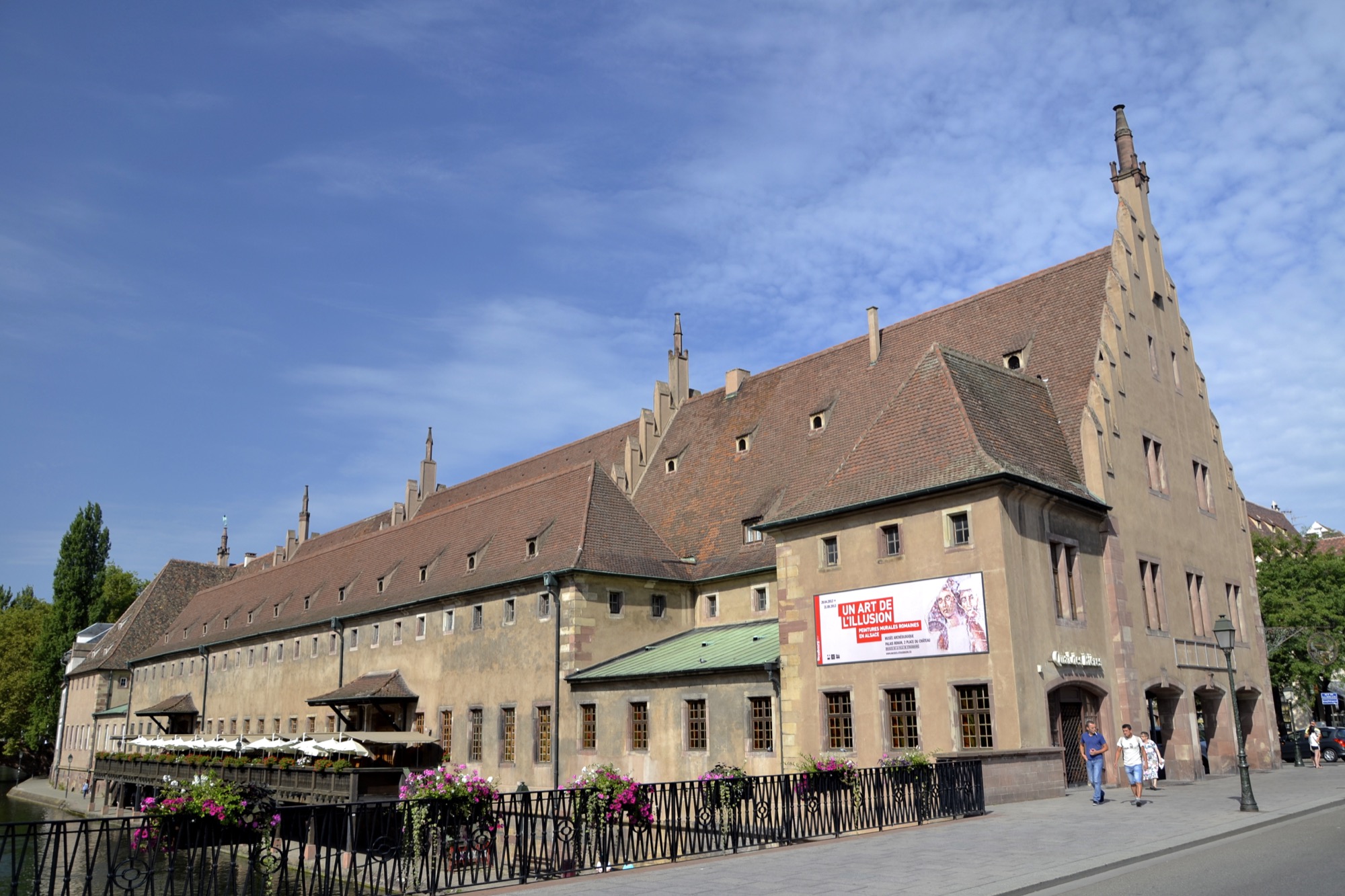
Strasbourg’s principal commercial hall was the Ancienne Douane, or Altes Kaufhaus, erected in 1358 on the banks of the river Ill at the heart of the Grande Île. Commissioned by the city magistrate as a vast two-story warehouse with crenellated gables, the structure served as the central point for receiving, taxing, and redistributing goods transported through the Rhine corridor. The building was enlarged in 1389 to accommodate growing volumes of transit trade, and a monumental landing wharf was added in 1393, equipped with two timber-framed derrick cranes topped by rotating turrets, capable of hoisting loads of up to a ton (see the entry in the French “Base Mérimée” heritage database). As Robert Will documented in his reconstruction study, the medieval fabric featured a massive open hall on the ground floor for customs assessment, with upper chambers reserved for commodity storage and administrative functions. The building was classified as a Monument historique in 1948, though it had been devastated by Allied bombing on 11 August 1944. Will’s meticulous reconstruction (1962–1965), inaugurated by Mayor Pierre Pflimlin in 1966, faithfully replicated the medieval plans while incorporating reinforced concrete, as analyzed by Nicolas Lefort in “L’Ancienne Douane de Strasbourg: Reconstruction et reconversion d’un monument historique” (2022). Nearby stood the Neubau, designed by the architect Hans Schoch and completed in 1585 as the first entirely stone-built Renaissance structure in Strasbourg. Its three-story facade, articulated with superimposed Tuscan, Ionic, and Corinthian pilasters, housed municipal administrative services and eventually the Chamber of Commerce, reflecting the city’s enduring identity as a commercial capital.
The decorative program of Strasbourg’s commercial district drew upon the rich tradition of Rhenish guild symbolism and Alsatian Renaissance ornament. The Ancienne Douane itself presented an austere yet imposing facade of local Vosges sandstone, its crenellated roofline signaling civic authority over trade. The two monumental derrick cranes that flanked the wharf were themselves objects of functional artistry—rectangular timber-frame pavilions crowned with rotating turrets, combining engineering ingenuity with architectural display. Across the commercial quarter, guild signs (Zunftzeichen) marked the premises of the powerful corporations, each bearing heraldic emblems of their trade, as studied by scholars of medieval guild iconography. The nearby Maison Kammerzell, built as a merchant’s house by the cheesemonger Martin Braun in 1589, exemplifies the decorative ambitions of Strasbourg’s commercial class: its three upper stories of half-timbered construction feature seventy-five carved wooden panels depicting sacred and profane subjects—the five senses, the four ages of life, zodiac signs, and scenes from biblical and classical antiquity. As the Strasbourg municipal heritage inventory notes, these carvings “bear eloquent witness to the cultural aspirations of a rich sixteenth-century Strasbourg merchant.” The interior frescoes by Alsatian painter Léo Schnug (1878–1933) added later decorative layers. The Neubau’s classicizing pilasters on Place Gutenberg similarly projected mercantile sophistication, while the guild halls (Zunftstuben) scattered through the commercial streets displayed carved heads representing the trades that governed the city’s political and economic life.
The Ancienne Douane occupied a strategic position on the southern bank of the Ill, where it flows through the Grande Île—the island core of Strasbourg that UNESCO designated a World Heritage Site in 1988. The customs house sat at the nexus of the city’s riverine commercial infrastructure: upstream lay the Quai des Bateliers, the boatmen’s quarter; downstream, the channels of the Ill split into multiple arms feeding the Petite France district, where tanners, millers, and fishermen operated water-powered workshops amid half-timbered houses. As the Port of Strasbourg’s institutional history records, medieval port activity centered on the Ill near the Ancienne Douane, under the dominion of the Corporation de l’Ancre (Corporation of the Anchor), which controlled Rhine navigation as far as Mainz. The building’s riverside terrace afforded direct access to the Pont du Corbeau and the Quai Saint-Nicolas, linking the customs zone to the cathedral quarter and the Place du Marché-aux-Poissons. This dense commercial topography reflected Strasbourg’s unique position at the crossing of the Rhine and the Ill, a geographic advantage that Philippe Dollinger emphasized in his “Histoire de l’Alsace” (1970) as the foundation of the city’s medieval prosperity. The commercial streets—the rue des Bouchers, the rue d’Or—radiated outward from the exchange zone, protected by the city’s fortified enceinte and connected to overland routes running west into France and east into the Empire.
Strasbourg’s commercial prominence arose from its status as a free imperial city (Freie Reichsstadt) of the Holy Roman Empire, a privilege consolidated after the Battle of Oberhausbergen in 1262. The Schwörbrief of 1334 established a guild-based constitution in which the twenty Zünfte (guilds) held two-thirds of council seats, creating what Thomas A. Brady Jr. analyzed in “Ruling Class, Regime and Reformation at Strasbourg, 1520–1555” (Brill, 1978) as a distinctive fusion of mercantile oligarchy and artisanal democracy. The Corporation de l’Ancre, formed in 1331, secured a virtual monopoly over Rhine navigation from Strasbourg to Mainz, compelling all goods to transit through the city’s port—a staple-like arrangement that enriched the municipal treasury and funded the construction of the Ancienne Douane in 1358. An annual fair privilege, granted from 1228, attracted merchants from across the Upper Rhine region, while the city’s right to mint coins and levy tolls sustained its fiscal autonomy. Francis Rapp, in “Réformes et Réformation à Strasbourg” (1975), documented how the guilds’ political and economic power shaped the city’s trajectory through the Reformation era. After Louis XIV’s annexation of Strasbourg in 1681, the city retained significant commercial privileges, and Napoleon Bonaparte’s establishment of a formal commodity market (Bourse de commerce) on 25 August 1801 and a Chamber of Commerce in 1802 institutionalized centuries of trading tradition within the framework of modern French commercial law.
Strasbourg’s exchange handled a diverse portfolio of commodities shaped by its position astride the Rhine corridor. Wine dominated the medieval trade: as Susan Rose documented in “The Wine Trade in Medieval Europe, 1000–1500” (Continuum, 2011), Alsatian wines—including early varieties of Riesling and Traminer—ranked among Europe’s most prized, shipped via the Rhine to Cologne and onward to the Low Countries, Scandinavia, and the Baltic. By the fourteenth century, the Colmar district alone exported an estimated 100,000 hectoliters annually, much of it transiting through Strasbourg’s customs house. Grain constituted the second pillar of trade: as Karl Gunnar Persson demonstrated in “Grain Markets in Europe, 1500–1900” (Cambridge, 1999), Strasbourg’s grain prices showed significant correlation with markets in Utrecht, Bruges, and Leuven, evidencing deep integration into northwestern European price networks. Timber floated downriver from the Vosges and Black Forest supplied construction and shipbuilding across the Rhine lowlands. The Ancienne Douane also processed salt, fish, hops, and cloth—staples of the Upper Rhine economy. Tobacco, introduced to Alsace in the early seventeenth century, became a major commodity after Louis XIV’s annexation; a royal tobacco manufactory established in Strasbourg in 1811 anchored a trade in tobacco, spirits, cotton, sugar, and spices that extended the city’s historic role as an entrepot into the industrial age.
Images will be added as the project develops. Photographs by Larry Ng and from research sources.