Stockholm Stock Exchange (Börshuset)
Stockholm, Sweden · Established 1776
This site requires authorization to access.
To request access, contact
william.goetzmann@yale.edu
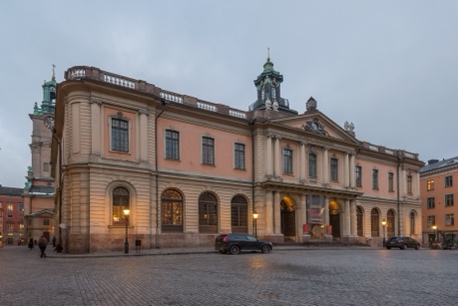
Designed by Erik Palmstedt, the leading Neoclassical architect of the Gustavian court, the Stockholm Stock Exchange Building (Börshuset) was constructed between 1773 and 1778 on the north side of Stortorget in Gamla Stan, replacing a medieval town hall that had stood on the site for several hundred years. The plan of the building, blending French Rococo spatial organization with a restrained Neoclassical exterior, follows a trapezium shape whose rounded corner gracefully widens the flanking alleys of the Old Town. While the symmetrical facade with its Corinthian columns and arched windows is designed much like a private palace, the central pediment and the lantern-style cupola crowning the roofline assert the building's public civic purpose. King Gustav III personally inaugurated the exchange in 1776, even before construction was fully complete, making the Börshuset one of the finest surviving examples of Gustavian architecture in Stockholm.
The interior of the Börshuset is organized around a dramatic contrast between its commercial ground floor, originally the open trading hall, and the grand upper-floor ballroom -- the largest heated interior space in eighteenth-century Stockholm -- which became the ceremonial heart of the building. This great hall (Börssalen) served for decades as the venue for court-attended dances, social games, and royal receptions, and it was in this room that the Swedish Academy has held its annual grand ceremony every year since its founding, attended by members of the Swedish royal family. The building underwent a significant interior restoration in the 1980s that revealed and preserved decorative elements consistent with Palmstedt's Gustavian aesthetic, emphasizing the elegant interplay of classical proportion and restrained ornament characteristic of the period. Today the ground floor houses the Nobel Prize Museum, whose exhibitions share the space with the building's historic architectural fabric.
Stortorget -- 'the Grand Square' -- is the oldest public square in Stockholm, the thirteenth-century nucleus around which the medieval city on the island of Stadsholmen gradually coalesced into what is now known as Gamla Stan (Old Town). The square's most harrowing chapter came on November 7-9, 1520, when Danish King Christian II, days after his coronation at the nearby Storkyrkan cathedral, ordered the execution of some eighty Swedish nobles, clergymen, and burghers in what became known as the Stockholm Bloodbath -- a massacre that ignited Gustav Vasa's rebellion and ultimately dissolved the Kalmar Union, reshaping Scandinavian political history for centuries. Beyond this grim landmark, Stortorget served continuously as the city's central marketplace and civic gathering place; today it is framed by colorful merchant houses and anchored on its north side by the Börshuset, with the Stortorget Well (Stortorgsbrunnen) standing just outside the exchange as a reminder of the square's deep medieval roots.
The Stockholm Stock Exchange was inaugurated in 1776 by King Gustav III as part of his broader campaign to modernize Swedish cultural and commercial institutions, a vision that also led him to found the Swedish Academy in 1786 -- choosing the Börshuset's great ballroom for the Academy's inaugural meeting because it was the largest room in Stockholm that could be heated for winter use. The Academy has occupied the upper floor permanently since 1914, and it is from the Börshuset that the Permanent Secretary emerges each October through the building's iconic wooden door to announce the Nobel Prize in Literature to the assembled world press. Formal securities trading continued in the building until the exchange relocated in 1998, by which time the Stockholms Fondbörs (founded as a modern securities exchange in 1863) had evolved into one of Europe's most technologically advanced markets. The ground floor was subsequently transformed into the Nobel Prize Museum, ensuring that the Börshuset remains a living institution at the intersection of Swedish financial, literary, and cultural history.
In its earliest decades, the Börshuset functioned as a mercantile exchange where Stockholm's merchants negotiated foreign exchange transactions, bills of exchange, and commodity deals tied to Sweden's dominant export trades -- above all bar iron, which by the late eighteenth century comprised roughly three-quarters of total Swedish exports and was shipped in vast quantities to England for conversion into steel. The exchange also facilitated commerce connected to the Swedish East India Company (founded 1731 in Gothenburg), the nation's largest trading venture, whose 132 expeditions to Canton generated shareholder dividends averaging 39 percent annually and whose shares and cargo auctions were major events in Swedish commercial life. As Swedish capital markets matured, formal securities trading was organized at the Stockholms Fondbörs beginning on February 4, 1863, with the exchange handling stocks, government bonds, and fixed-income instruments in the same building where informal mercantile dealing had taken place for nearly a century.