St. Louis Stock Exchange
St. Louis, USA · Established 1899
This site requires authorization to access.
To request access, contact
william.goetzmann@yale.edu
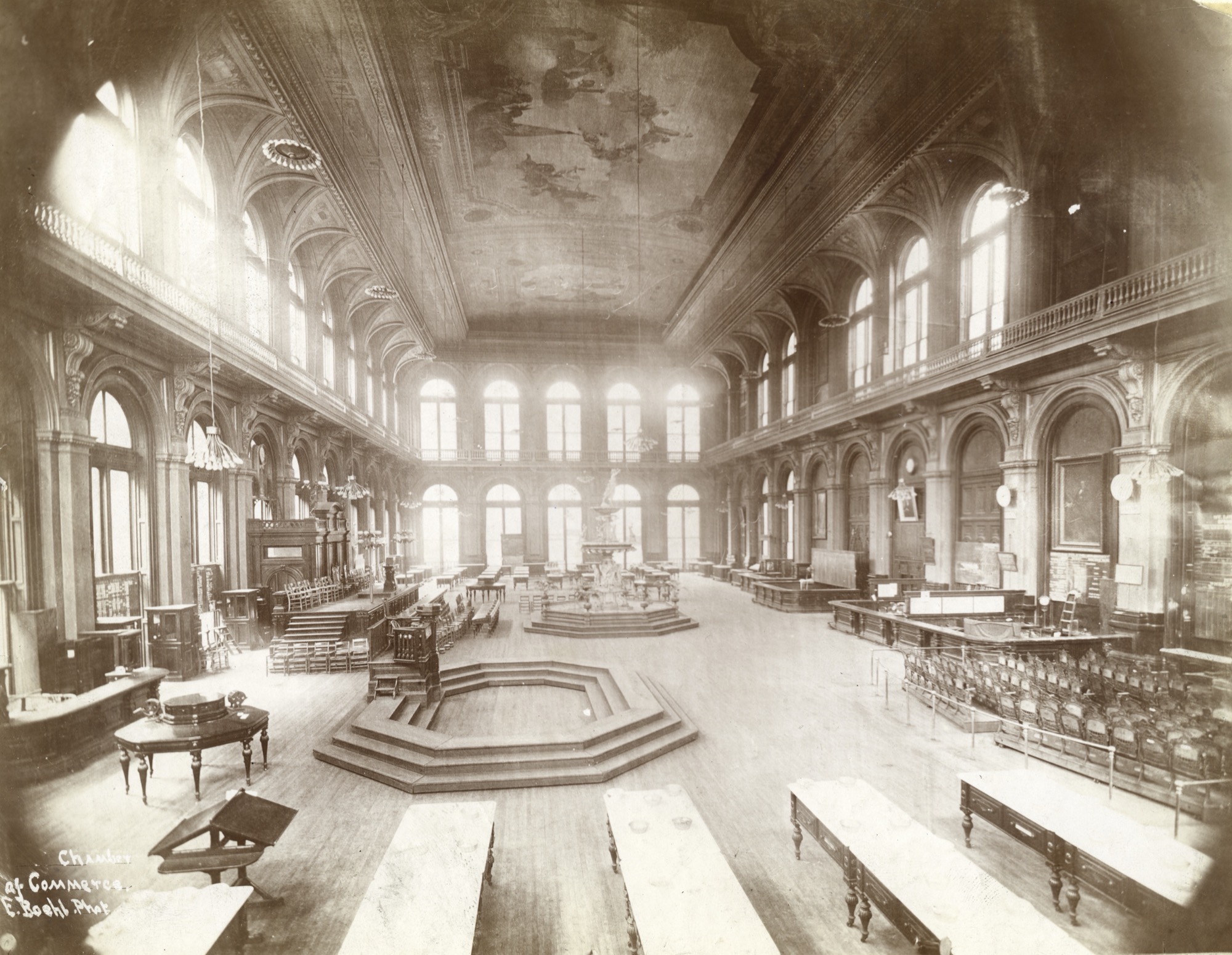
The St. Louis Stock Exchange operated within a financial landscape dominated by the monumental Merchants’ Exchange Building, the grandest commercial structure in the trans-Mississippi West. Erected between 1873 and 1875 at Third and Chestnut Streets, the building was designed by Francis Lee and Thomas B. Annan after a competition won by George Ingham Barnett—the English-born architect widely called the “Dean of St. Louis Architecture”—whose proposal was judged too costly. The resulting three-story limestone edifice measured 235 by 187 feet and incorporated the most celebrated interior in the Midwest: a vast trading hall spanning 235 feet long, 98 feet wide, and 65 feet high, formed by combining the second and third stories beneath an innovative iron truss roof system. Upon completion, this represented the largest unobstructed interior space in the United States, confirmed by its selection to host the 1876 Democratic National Convention—the first major-party convention held west of the Mississippi. The building served as headquarters for the Merchants’ Exchange (the nation’s first commodity trading exchange, predating the Chicago Board of Trade) and housed the St. Louis Stock Exchange after its founding in 1899. As Eric Sandweiss documents in St. Louis: The Evolution of an American Urban Landscape (Temple University Press, 2001), the structure anchored a commercial district along Third Street that defined the city’s financial identity. The Merchants’ Exchange Building was recorded by the Historic American Buildings Survey (HABS MO-1635) before its demolition in 1958 during riverfront clearance for the Jefferson National Expansion Memorial. Charles Van Ravenswaay’s lament that the Exchange and the Eads Bridge were the city’s “last great architectural monuments” of the nineteenth century went unheeded; the site became a parking lot before the Adam’s Mark Hotel rose on the ground.
The decorative program of the Merchants’ Exchange Building expressed, through material opulence, the commercial ambitions of post-Civil War St. Louis. The HABS documentation (HABS MO-1635, Library of Congress) describes an interior fitted with carved walnut woodwork throughout—the rostrum and staircases executed in richly figured hardwood—while brass door fittings and hardware lent a burnished counterpoint to marble-covered tables on the trading floor. The grand trading hall, at 235 feet long and 65 feet high, was a spatial expression of financial confidence: its innovative iron truss roof eliminated intermediate columns, creating a single cavernous volume in which open-outcry trading in grain, tobacco, and livestock could proceed with unimpeded sightlines. As James Neal Primm observes in Lion of the Valley: St. Louis, Missouri, 1764–1980 (Missouri Historical Society Press, 1998), the building was conceived as a civic showcase, its interior designed to communicate the stability of the city’s merchant class. The hall’s immense scale served both practical and symbolic purposes: when the 1876 Democratic National Convention commandeered the space to nominate Samuel J. Tilden, the hall’s capacity to accommodate thousands demonstrated that St. Louis possessed public architecture rivaling Eastern cities. Stock certificates issued by the Merchants’ Exchange featured engraved vignettes of the Eads Bridge and the Exchange building itself, linking the iconography of commerce to the physical structures of trade. When the building was demolished in 1958, its carved walnut panels, brass fittings, and marble elements were sold to salvagers and dispersed—a scattering of decorative fragments that marked the final dissolution of the physical space that had shaped a generation of Midwestern financial activity.
The Merchants’ Exchange Building’s position at Third and Chestnut Streets placed it at the heart of a commercial district owing its existence to the Mississippi River. As Wyatt Winton Belcher demonstrated in The Economic Rivalry Between St. Louis and Chicago, 1850–1880 (Columbia University Press, 1947), St. Louis’s antebellum commercial supremacy rested on its role as a transshipment point where goods arriving by steamboat were sorted and redirected along the Missouri, Ohio, and upper Mississippi corridors. The mercantile district pushed westward from the levee to Fourth Street, which the 1911 Encyclopaedia Britannica identified as the city’s “financial centre.” The Merchants’ Exchange anchored the eastern edge, just blocks from the steamboat wharves and, after 1874, from the Eads Bridge—James Buchanan Eads’s steel-arch span representing the first permanent railroad crossing of the Mississippi. Jeffrey S. Adler’s Yankee Merchants and the Making of the Urban West (Cambridge University Press, 1991) traces how Northeastern capital flowed into St. Louis through merchant networks making the city a “Yankee colony in the West.” The completion of the Eads Bridge was intended to restore St. Louis’s position against Chicago, but the railroads initially boycotted the span, and Chicago’s superior rail connections proved decisive. By the 1890s, the financial district migrated west along Olive Street toward the corridor where Louis Sullivan’s Wainwright Building (1891) signaled a new architectural era. The St. Louis Stock Exchange, founded in 1899, operated within this shifting geography—a district still defined by river and rail proximity but already yielding its national ambitions to Chicago’s emerging dominance.
The St. Louis Stock Exchange was formally organized in 1899, with the brokerage firm A. G. Edwards and Son—founded by Albert Gallatin Edwards in 1887—playing a central role. As the City of St. Louis Preservation Plan documents, the exchange was designed to encourage trading in stocks of local companies. It built upon a longer tradition: the Merchants’ Exchange, founded in 1836 as the St. Louis Chamber of Commerce, had operated as the nation’s first commodity exchange, while the St. Louis Mining and Stock Exchange (1880–1893) briefly channeled capital into Missouri’s lead and zinc ventures before collapsing in the Panic of 1893. The Stock Exchange enjoyed immediate popularity: total transactions reached $16.4 million in 1903 and $10.5 million in 1904, with active trading in shares of Mercantile Trust Company, Boatmen’s Bank, Mechanics’ American National Bank, and industrial firms like American Car and Foundry Company. After World War I, the exchange’s clientele broadened to include individuals of more moderate means. The exchange’s fate was sealed by the consolidation movement sweeping regional American exchanges after World War II. On May 26, 1949, St. Louis members voted twenty-six to eight in favor of merger; on September 15, 1949, the St. Louis Stock Exchange merged with the Chicago, Cleveland, and Minneapolis-St. Paul exchanges to form the Midwest Stock Exchange. As Haskel Benishay analyzed in “Stocks on Midwest Exchange in the Fifties” (Business and Society, 1962), the consolidated exchange sought efficiencies of scale, but the merger effectively ended St. Louis’s independent role in American securities markets.
The securities listed on the St. Louis Stock Exchange reflected the city’s distinctive economic base as a gateway between the agricultural Mississippi Valley and the industrializing nation. Banking and trust company shares dominated early volume: 1904 records indicate trust companies accounted for 18,440 shares valued at $3,567,591, with bank stocks adding 5,698 shares worth $1,548,878. The Mercantile Trust Company, Boatmen’s Savings Institution (which James Neal Primm recounts in Lion of the Valley had become the largest bank in St. Louis by 1900), and the National Bank of Commerce were among the most actively traded. Railroad securities held particular importance given St. Louis’s position as a rail hub: the Missouri Pacific, St. Louis-San Francisco Railway (Frisco), and Wabash Railroad whose bonds and equities circulated on the board. Industrial manufacturers tied to the regional economy included American Car and Foundry Company, Wagner Electric, and Laclede Steel. Brewing stocks reflected St. Louis’s status as the nation’s premier brewing center: Griesedieck-Western Brewery was among the most traded issues, and the broader industry dominated by Anheuser-Busch generated a constellation of supplier and distributor equities. Utility stocks, particularly Laclede Gas Light Company (one of the original twelve Dow Jones Industrial Average components in 1896) and Union Electric, rounded out listings. The Merchants’ Exchange, operating in parallel, continued to trade grain warehouse receipts, tobacco, and livestock contracts, while the earlier Mining and Stock Exchange (1880–1893) had briefly listed lead and zinc mining shares from Missouri’s mineral districts. Together these markets captured the full range of St. Louis’s commercial economy in a portfolio uniquely characteristic of the American interior.
Images will be added as the project develops. Photographs by Larry Ng and from research sources.