Spokane Stock Exchange
Spokane, USA · Established 1897
This site requires authorization to access.
To request access, contact
william.goetzmann@yale.edu
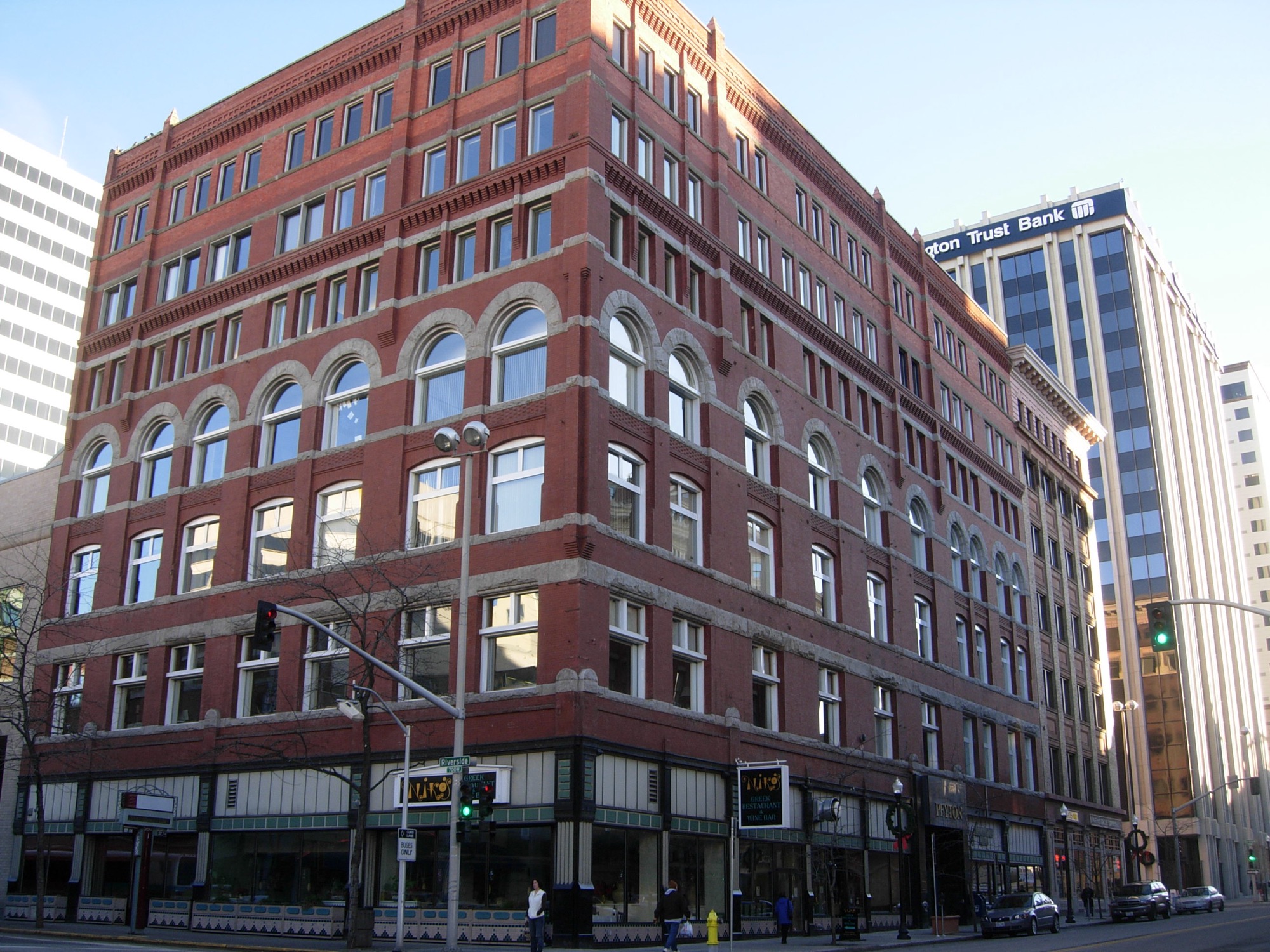
The Spokane Stock Exchange occupied a succession of downtown commercial buildings over its ninety-four-year existence, each reflecting the evolving architectural character of the Inland Empire’s capital city. From 1918 to 1927, the exchange rented ground-floor space in the Paulsen Building on the 400 block of Riverside Avenue, one of Spokane’s most prestigious office addresses. In 1929 it relocated to 725 West Sprague Avenue in the former Eilers Building—subsequently renamed the Standard Stock Exchange Building and later the Radio Central Building—where it remained for over four decades until the structure was razed in 1971 to make way for the Washington Trust Bank tower. The exchange’s most architecturally significant home was the Peyton Building, designed by Kirtland Kelsey Cutter and Karl Gunnar Malmgren in 1898 and listed on the National Register of Historic Places. As Henry Matthews documents in Kirtland Cutter: Architect in the Land of Promise (University of Washington Press, 1998), the original five-story Romanesque Revival structure rose from the surviving exterior walls of the fire-gutted Great Eastern Building, its facades of red brick with rough-hewn stone trim, decorative brick corbeling, arched bays at the fourth floor, pyramidal pinnacles, and large first-floor bays framed by cast-iron piers supplied by Union Iron Works of Spokane. In 1908, Colonel Isaac N. Peyton financed the addition of two stories and a seven-story south annex designed by Robert Sweatt in the Commercial style, featuring blonde brick, unglazed terra cotta spandrel panels, a projecting boxed cornice with dentils and modillions, and Ionic pilasters at the arched entrance bay. The Spokane Stock Exchange occupied the second floor of this composite structure from 1972 to 1987, before making a final move to the Seafirst Financial Center for its last years of operation.
The decorative environment of the Spokane Stock Exchange was defined less by ornamental grandeur than by the austere functional aesthetic of a regional penny-stock market. The exchange’s most distinctive visual element was its chalkboard quotation system—a large slate board on which stock prices were posted by hand, a practice maintained from the exchange’s founding in 1897 until its closure in 1991, long after electronic ticker systems had become standard elsewhere. As the Wall Street Journal observed in its obituary for the exchange, this “horse-and-buggy era technology” was both the institution’s charm and its undoing. The Peyton Building itself, however, offered a richer material context. The NRHP nomination form describes the original 1898 Cutter & Malmgren design as incorporating decorative brick corbeling and patterned brickwork on the upper facades, while the ground floor featured plate-glass windows set between ornamental cast-iron columns. The 1908 Peyton Annex contributed terra cotta spandrel panels, paneled pilasters flanking the storefronts, and an elaborately trimmed arched entrance surround with a cornice and Ionic pilasters—decorative elements drawn from the Classical vocabulary favored in early-twentieth-century commercial architecture. Inside, the building’s corridors and public spaces reflected the restrained but dignified finishes typical of Cutter’s commercial work, as Matthews’s study documents. The stock certificates themselves constituted a distinctive form of commercial art: mining share certificates from Coeur d’Alene district companies frequently featured vignettes of underground workings, ore stamps, and mountain landscapes, visual rhetoric that linked financial instruments to the material reality of extraction.
Spokane’s emergence as the commercial capital of the Inland Empire—the vast tributary region encompassing eastern Washington, northern Idaho, western Montana, and southern British Columbia—was inseparable from the mining wealth flowing from the Coeur d’Alene Mountains eighty miles to the east. As John Fahey demonstrates in Inland Empire: D. C. Corbin and Spokane (University of Washington Press, 1965), railroad magnate Daniel Chase Corbin’s construction of the Spokane Falls and Northern Railway in 1889 and its subsidiaries to Nelson and Rossland, British Columbia, channeled the mineral riches of the region through Spokane, transforming it into the permanent headquarters for mining companies, banks, and supply firms. The Great Spokane Fire of August 4, 1889, which destroyed thirty-two blocks of the wooden downtown, paradoxically accelerated the city’s architectural maturation: as the Spokane Historic Preservation Office documents, over one hundred elaborate brick, masonry, and terra cotta commercial buildings rose in the year immediately following the fire, creating the fireproof financial district along Riverside and Sprague Avenues where the stock exchange would later operate. By the 1890s, Spokane was the railroad and commercial nexus linking the Silver Valley’s lead-silver-zinc mines to smelters and markets. David Stratton’s edited volume Spokane and the Inland Empire (Washington State University Press, 2005) describes how the city’s financial institutions clustered along Riverside Avenue—the Paulsen Building, the Old National Bank, the Hutton Building—forming a compact banking and brokerage district that gave physical expression to Spokane’s role as the mining industry’s financial clearinghouse for the interior Pacific Northwest.
The Spokane Stock Exchange was founded on January 18, 1897, after years of agitation by Spokane businessmen with mining interests. As the HistoryLink encyclopedia records, a particularly influential group dubbed “The Sacred Twenty” sought to “provide an orderly market for mining shares, determine qualifications for Exchange membership, and define the responsibility of brokers toward their clients.” After merging with a rival would-be exchange, the institution opened with thirty-two members and thirty-seven listed stocks of mines in southern British Columbia, northern Idaho’s Silver Valley in the Coeur d’Alene Mining District, and northeastern Washington. Brokerage charges were set at uniform commission rates, and mine owners were required to submit sworn statements regarding the condition of their properties. At its peak, the exchange rivaled the mining exchanges of San Francisco, Denver, Salt Lake City, and Toronto. Geoffrey Poitras, in “Fleecing the Lambs? The Founding and Early Years of the Vancouver Stock Exchange” (BC Studies, 2019), documents that the Vancouver Stock Exchange was founded in 1907 specifically to recapture trade in British Columbia mining shares that had gravitated to Spokane. During the silver boom of the 1960s, the average penny stock on the exchange appreciated 160 times, drawing more than 100,000 investors from all fifty states; Barron’s declared that “speculators in silver stocks have struck it rich in Spokane.” Trading volume peaked at $100 million in the early 1980s during the Hunt brothers’ silver speculation, but by 1985 daily volume had fallen below $50,000. An SEC investigation in 1990, triggered by the admission of dubious operators, and the exchange’s refusal to computerize—federal rules required electronic tie-ins with national quotation services—sealed its fate. The Spokane Stock Exchange closed on May 24, 1991, with only six members remaining, the last regional mining exchange in the United States.
The Spokane Stock Exchange traded almost exclusively in mining stocks—shares of gold, silver, lead, and zinc mining companies operating in the Coeur d’Alene Mining District of northern Idaho, the Kootenay and Rossland districts of southern British Columbia, and the Okanogan and Republic camps of northeastern Washington. As Katherine G. Aiken documents in Idaho’s Bunker Hill: The Rise and Fall of a Great Mining Company, 1885–1981 (University of Oklahoma Press, 2005), the Silver Valley produced over 1.18 billion ounces of silver alongside major quantities of lead and zinc, and Spokane served as the corporate headquarters and financial clearinghouse for this output. The exchange was classified among the nation’s “penny stock” markets—the smallest of seven regional exchanges specializing in shares priced below one dollar. Trading was conducted by open outcry, with prices posted on a chalkboard rather than transmitted electronically, a practice that persisted until the exchange’s closure. The listed companies ranged from established producers such as Hecla Mining Company, incorporated in 1891 and later listed on the New York Curb Exchange in 1915, and the Bunker Hill and Sullivan Mining and Concentrating Company, to highly speculative junior exploration ventures. Mine owners seeking a listing were required to issue sworn property statements, and the exchange directors established strict financial requirements for any issue submitted—early regulatory mechanisms that anticipated later SEC penny-stock disclosure rules codified in the Penny Stock Reform Act of 1990. At its peak in the 1960s silver boom, the exchange attracted over 100,000 investors from across the United States and abroad, but by its final years only forty-five companies remained listed, their shares trading in negligible volumes as precious metals prices declined and electronic markets rendered the chalkboard anachronistic.
Images will be added as the project develops. Photographs by Larry Ng and from research sources.