Singapore Stock Exchange
Singapore, Singapore · Established 1973
This site requires authorization to access.
To request access, contact
william.goetzmann@yale.edu
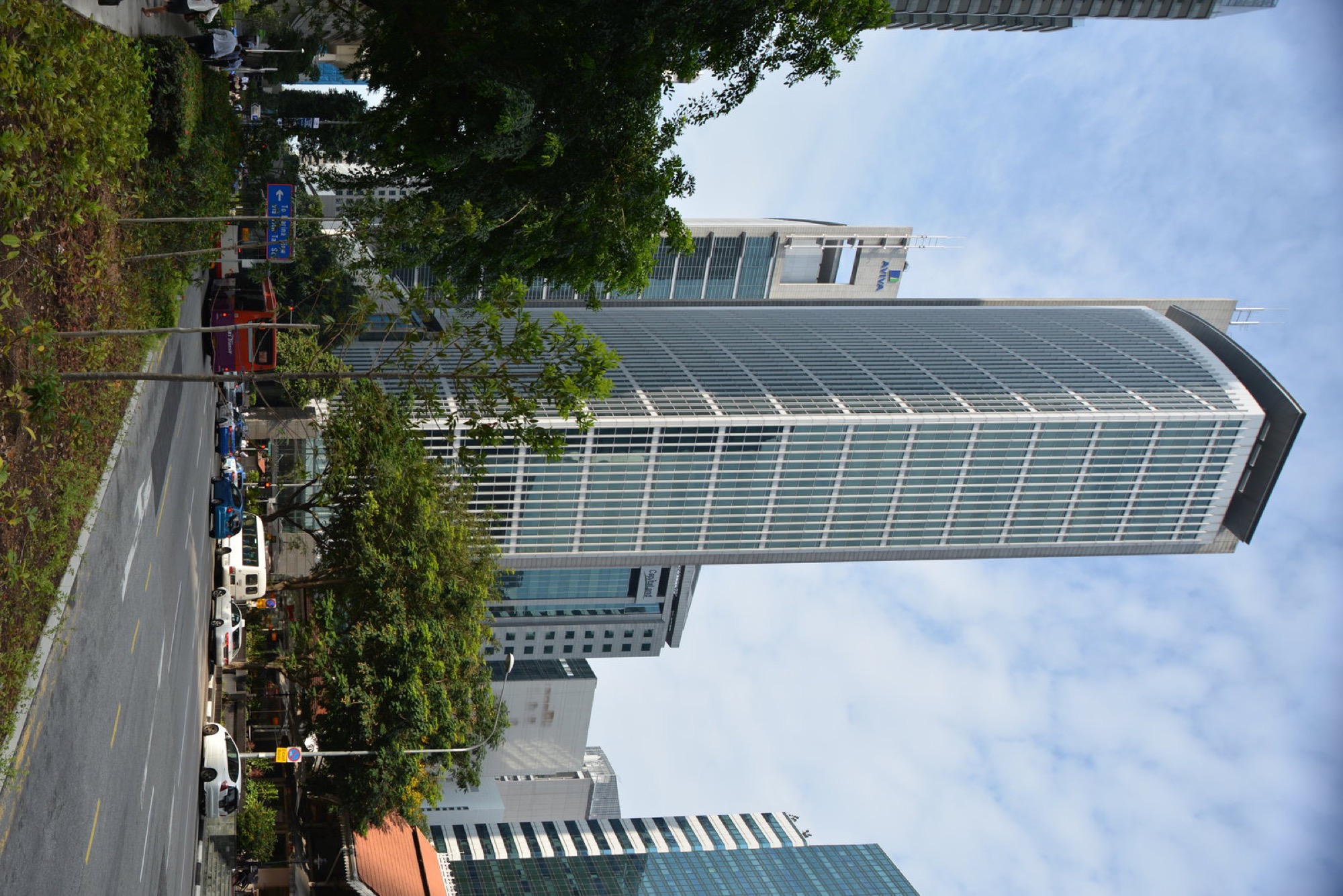
The physical spaces of Singapore’s securities trade evolved from informal colonial-era premises to one of Asia’s most architecturally ambitious financial complexes. In the 1930s, share dealing operated from ad hoc offices near Raffles Place, the commercial square demarcated in Stamford Raffles’s 1822 Town Plan. The Singapore Stockbrokers’ Association, incorporated in 1930, conducted business in modest quarters along the shophouse-lined streets of the emerging financial district. The decisive architectural statement came with the completion of SGX Centre at 2 Shenton Way in 2000–2001, a twin-tower complex designed by Kohn Pedersen Fox Associates with local firm Architects 61 Pte Ltd. The two 29-storey towers, each rising 187 meters, arc gently to afford tenants views over Marina Bay, and rest upon a two-storey podium housing a banking hall and the trading floor. As Brenda S.A. Yeoh and T.C. Chang argue in “Globalising Singapore: Debating Transnational Flows in the City” (Urban Studies, 2001), Singapore’s financial architecture consciously projects cosmopolitan modernity. The SGX Centre’s curtain-wall glass towers stand in deliberate contrast to the nearby Lau Pa Sat, a Victorian cast-iron market hall (1894, by James MacRitchie using prefabricated elements from Walter MacFarlane & Company of Glasgow), gazetted as a national monument in 1973. This juxtaposition—heritage iron-and-timber commerce beside millennium glass-and-steel finance—encapsulates Singapore’s transformation from colonial entrepôt to global financial center within the span of a single urban precinct.
The decorative program of the SGX Centre privileges transparency and communicative design over ornamental tradition. When the exchange’s interior was renovated, designers concluded that the spaces should evoke an open “marketplace” atmosphere (Indesign Live, “SGX: A Stock Exchange For The Future,” 2015). The resulting scheme deploys clear glass and pierced screen walls throughout the trading, broadcasting, and meeting areas, making financial operations visible to visitors ascending the central escalator. Signature motifs extracted from the patterns of stock exchange display boards—the cascading numerals and flickering color fields of real-time market data—were abstracted into decorative elements. At the public marketplace level, a live-feed market screen, a financial bookshop, and a refreshment area create a zone where casual visitors can observe market activity, democratizing the previously closed world of the trading floor. This approach contrasts sharply with the traditional commercial architecture of Singapore’s conserved shophouses along Telok Ayer and Boat Quay, whose ornamental plasterwork, glazed ceramic tiles, and carved timber shutters served a decorative vocabulary rooted in Peranakan and Southern Chinese craft traditions. As documented in Norman Edwards and Peter Keys’s Singapore: A Guide to Buildings, Streets, Places (1988), the shophouse five-foot way once constituted the primary commercial interface of the city; at SGX Centre, that role has been transposed into glass-walled atria and digital display surfaces that render the flow of capital itself as visual spectacle.
The Singapore Exchange occupies a pivotal position within the city-state’s tightly planned Central Business District, at the juncture where colonial mercantile geography gave way to late-twentieth-century financial urbanism. Raffles Place—originally Commercial Square, designated in the 1822 Raffles Town Plan—served as the nucleus of European banking and trading firms, while Boat Quay, curving along the Singapore River, handled seventy-five percent of all shipping by the mid-nineteenth century, its godowns receiving rubber, tin, spices, and textiles from across Southeast Asia. The transformation began in 1970, when the government gazetted the eighty-acre “Golden Shoe” district—a shoe-shaped precinct encompassing Raffles Place, Shenton Way, and Cecil Street—as a zone exempt from rent controls, catalyzing wholesale redevelopment into modern towers. Shenton Way was itself built on reclaimed land from the Telok Ayer reclamation project completed in 1932. The SGX Centre’s location at 2 Shenton Way places it within a corridor flanked by I.M. Pei’s OCBC Centre (1976), Kenzo Tange’s One Raffles Place (1986), and Kisho Kurokawa’s Republic Plaza (1995)—each tower successively claiming the title of Southeast Asia’s tallest building. Singapore’s limited land area of just 733 square kilometers drove vertical intensification of the CBD. The 1989 conservation of 108 shophouses along Boat Quay repurposed the former trading waterfront as a heritage dining precinct, preserving the river’s commercial memory even as the exchange’s functions migrated into digital networks.
Securities trading in Singapore traces its formal origins to the incorporation of the Singapore Stockbrokers’ Association in 1930. A board system linked trading rooms in Singapore and Kuala Lumpur by direct telephone line into a single market when the Malayan Stock Exchange formed on 9 May 1960. The separation of Singapore from Malaysia in 1965 led to a joint Stock Exchange of Malaysia and Singapore (SEMS), but the termination of currency interchangeability on 8 May 1973 forced a split; the Stock Exchange of Singapore (SES) was incorporated on 24 May 1973. As Tan Chwee Huat argues in Financial Markets and Institutions in Singapore (Singapore University Press), the SES became central to Lee Kuan Yew’s vision of Singapore as a financial hub, a strategy reinforced by Dutch economic adviser Albert Winsemius’s promotion of an offshore Asian Dollar Market from 1968 and the establishment of the Monetary Authority of Singapore (MAS) in 1971. The Singapore International Monetary Exchange (SIMEX), launched in September 1984, pioneered the Mutual Offset System with the Chicago Mercantile Exchange—the world’s first international futures clearing link. The Pan-Electric crisis of November 1985, when the marine salvage conglomerate’s collapse under S$450 million in debts forced a three-day market closure, triggered comprehensive regulatory reform, ending SES self-regulation and placing markets under MAS supervision through the Securities Industry Act of 1986. On 1 December 1999, the SES merged with SIMEX and Securities Clearing to form Singapore Exchange Limited (SGX), consolidating equities, derivatives, and clearing under a single demutualized entity.
The securities traded on Singapore’s exchange reflect the city-state’s evolution from colonial commodity entrepôt to diversified financial center. In the pre-war period, the Malayan Stockbrokers’ Association dealt primarily in rubber plantation shares and tin mining stocks—the two commodities that, as Wong Lin Ken demonstrates in “Singapore: Its Growth as an Entrepôt Port, 1819–1941” (Journal of Southeast Asian Studies, 1978), underpinned the Straits Settlements economy. Straits Settlements government bonds and municipal debentures also circulated among European and Asian merchant houses. After independence, the SES listed the shares of Singapore’s leading banks—the Development Bank of Singapore (DBS, founded 1968), Oversea-Chinese Banking Corporation (OCBC, founded 1912), and United Overseas Bank (UOB)—alongside government-linked enterprises such as Singapore Airlines and Singapore Telecommunications (Singtel). The Straits Times Index, the benchmark gauge tracing its lineage to 1966 and reconstituted using FTSE methodology in 2008, tracks the top thirty companies by capitalization. SIMEX’s launch in 1984 introduced Eurodollar interest rate futures and Nikkei 225 index futures through the Mutual Offset System with the CME. SGX now offers Asia’s broadest range of equity index derivatives covering China, India, Japan, and ASEAN markets, as well as crude palm oil futures and iron ore swaps. Singapore’s REIT market, inaugurated in 2002, has grown to approximately forty trusts with a combined market capitalization exceeding S$100 billion, making SGX the largest REIT exchange in Asia outside Japan.
Images will be added as the project develops. Photographs by Larry Ng and from research sources.