Singapore Commodity Exchange (SICOM)
Singapore, Singapore · Established 1984
This site requires authorization to access.
To request access, contact
william.goetzmann@yale.edu
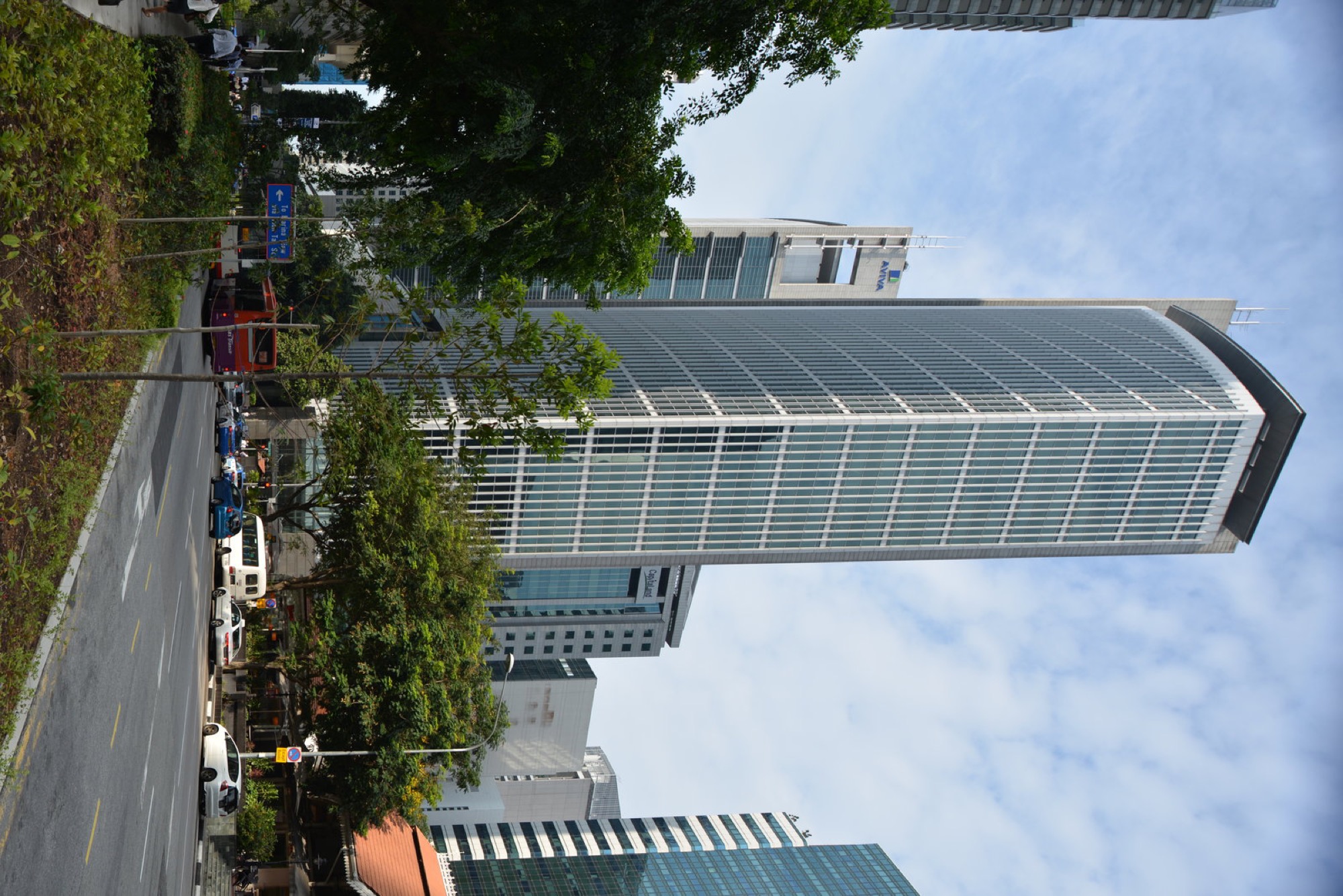
The Singapore Commodity Exchange (SICOM) operated from offices within Singapore’s Central Business District before its absorption into the Singapore Exchange (SGX), whose twin-tower headquarters at 2 and 4 Shenton Way stands as a landmark of millennial modernism. Designed by the internationally acclaimed Kohn Pedersen Fox Associates in collaboration with local firm Architects 61, the SGX Centre towers rise twenty-nine stories to 187 meters, their gently arcing curtain-wall facades oriented to maximize views of Marina Bay. As architectural historian Ho Weng Hin has noted, the completion of SGX Centre One in 2000 and Centre Two in 2001 signaled Singapore’s decisive shift from the brutalist concrete forms that had dominated Shenton Way since the 1970s toward a sleeker vocabulary of glass, steel, and aluminum fins. The Urban Redevelopment Authority observed that the vertical and horizontal fins adorning different sides of the facade “acknowledge subtly the varying rhythms of the city,” mediating between the older financial towers to the north and the reclaimed waterfront to the south. Ground-level colonnaded walkways connect the complex to the adjacent Lau Pa Sat — the Victorian-era cast-iron market hall gazetted as a national monument in 1973 — creating a pedestrian corridor between heritage and high finance. Prior to the SGX Centre’s construction, the site housed the Shing Kwan Building, a commercial tower completed in 1973 on Shenton Way—the road itself having been officially opened in 1951 and named for wartime Governor Sir Shenton Whitelegge Thomas.
The decorative program of the SGX Centre, where SICOM’s operations were ultimately housed, reflects a conscious effort to translate the visual language of financial markets into spatial design. SCA Design, a division of the ONG&ONG Group led by director Ken Yuktasevi, undertook a comprehensive interior refurbishment completed in 2014 that drew its signature motifs directly from the patterns, textures, and scrolling numerals of stock-exchange display boards — transforming the raw data streams of commodity and equity trading into ornamental elements woven through lobbies, corridors, and meeting spaces. A 120-meter urban mural wall along the ground-floor colonnade constitutes the complex’s most prominent public artwork, integrating the towers into Singapore’s broader program of percent-for-art contributions overseen by the National Arts Council. Inside, the design team created what they termed a “marketplace” aesthetic: clear glass and pierced screen walls in trading, control, and broadcasting spaces emphasize transparency as both a functional requirement and a symbolic value for a modern exchange. The IPO area, accessible via an escalator from the entrance lobby, features projected floor signage that evokes the kinetic energy of live market activity. A mezzanine-level marketplace incorporates live-feed screens alongside a financial bookshop and refreshment area, blurring the boundary between commercial transaction and public engagement. This integration of decorative and informational programs echoes what design critic Justin Zhuang, in his study of Singapore’s commercial interiors, has described as the city-state’s particular talent for embedding institutional narratives within corporate architecture.
SICOM’s location within Singapore’s financial core reflects the city-state’s deliberate urban strategy of concentrating exchange and banking functions in a compact, walkable district. Shenton Way, the arterial boulevard where the SGX Centre stands, was opened in 1951 as an extension of the older Raffles Place commercial quarter, itself laid out in the 1822 Raffles Town Plan as Commercial Square. As the National Library Board’s historical survey documents, the government strategically located financial institutions along Shenton Way beginning in the 1970s, with the Development Bank of Singapore Building (1975), the Central Provident Fund Building (1976), and the Monetary Authority of Singapore tower (1987) establishing a corridor of state-linked financial power. The 1970 designation of the eighty-acre “Golden Shoe” district, as described by Kevin Y. L. Tan in his account of Singapore’s financial-centre development, further concentrated banking and commodity-trading operations within walking distance of one another. SGX Centre sits adjacent to the historic Lau Pa Sat (Telok Ayer Market), an 1894 cast-iron market hall designed by Municipal Engineer James MacRitchie, which retained the octagonal form of George Coleman’s earlier market, which was dismantled in 1986 during MRT construction and reassembled in 1992 — a symbolic nexus of old and new marketplaces. To the south lies the Marina Bay reclamation area, whose masterplan by the Lee Kuan Yew School of Public Policy scholars has been studied as a model of financial-district expansion through land creation. W. G. Huff, in The Economic Growth of Singapore (Cambridge University Press, 1994), emphasized that Singapore’s spatial concentration of trading infrastructure was integral to its emergence as Southeast Asia’s leading commercial and financial center.
The Singapore Commodity Exchange traces its institutional lineage to the formation of the Singapore Chamber of Commerce Rubber Association on 20 June 1911, making it one of the oldest surviving commodity-trading bodies from British Malaya. As Wong Lin Ken documented in “Singapore: Its Growth as an Entreprôt Port, 1819–1941” (Journal of Southeast Asian Studies, 1978), rubber rapidly became the colony’s dominant export commodity after Henry Nicholas Ridley’s pioneering cultivation experiments at the Singapore Botanical Garden in the 1890s. The Rubber Association of Singapore (RAS), established formally in 1929, served as the price-discovery center for the regional natural-rubber trade throughout the colonial and postwar periods. In 1992, the Rubber Association of Singapore Commodity Exchange (RASCE) was established to modernize this trading infrastructure, and in 1994 it was renamed the Singapore Commodity Exchange (SICOM), broadening its mandate beyond rubber to encompass coffee, gold, and other commodities. The exchange’s evolution paralleled what Goh Keng Swee, Singapore’s founding Finance Minister, envisioned as the transformation from entreprôt dependence to a diversified financial hub, a trajectory analyzed in Linda Low’s The Political Economy of a City-State (Oxford University Press, 1998). On 30 June 2008, the Singapore Exchange completed its full acquisition of SICOM, integrating commodity derivatives alongside equities, fixed income, and currency products. The merger brought SICOM under the governance of SGX chairman Hsieh Fu Hua, with Jeremy Ang serving as SICOM CEO and the advisory board including commodity investor Jim Rogers and rubber-industry veterans such as Oei Hong Bie and Michael Coleman.
SICOM’s product suite centered on natural rubber futures, which constituted the exchange’s flagship contracts and its primary contribution to global price discovery. The two benchmark contracts — TSR20 (Technically Specified Rubber 20) and RSS3 (Ribbed Smoked Sheet 3) — became the reference prices used by over seventy percent of major tire manufacturers and rubber-product companies worldwide for their physical trading agreements, as documented in SGX’s own market factsheets and in industry analyses published by the International Rubber Study Group. Trading volumes reached a record 1.73 million tonnes in 2013, a thirty-five percent increase over the previous year, reflecting surging demand from China’s manufacturing sector. Beyond rubber, SICOM listed Robusta coffee futures, positioning Singapore alongside London’s ICE exchange and the Tokyo Grain Exchange as a key node in the global coffee-derivatives market. The exchange also offered gold kilo-bar contracts, building on Singapore’s earlier experiments with precious-metals trading through the Gold Exchange of Singapore (1978) and the Singapore International Monetary Exchange (SIMEX, 1984). After the 2008 acquisition by SGX, SICOM’s rubber contracts were integrated into the SGX derivatives platform, which also incorporated iron ore, freight, and foreign-exchange futures to create what Youngho Chang, in his study of energy commodity trading in Singapore for the Economic Research Institute for ASEAN (ERIA, 2013), characterized as a “multi-commodity, multi-asset” derivatives hub serving the Asia-Pacific region. The Monetary Authority of Singapore’s 2012 transfer of commodity-derivatives oversight from the Commodity Trading Act to the Securities and Futures Act further consolidated the regulatory framework governing these instruments.
Images will be added as the project develops. Photographs by Larry Ng and from research sources.