Casa Lonja de Mercaderes (General Archive of the Indies)
Seville, Spain · Established 1583–1598 (built); merchant guild of the Carrera de Indias
This site requires authorization to access.
To request access, contact
william.goetzmann@yale.edu
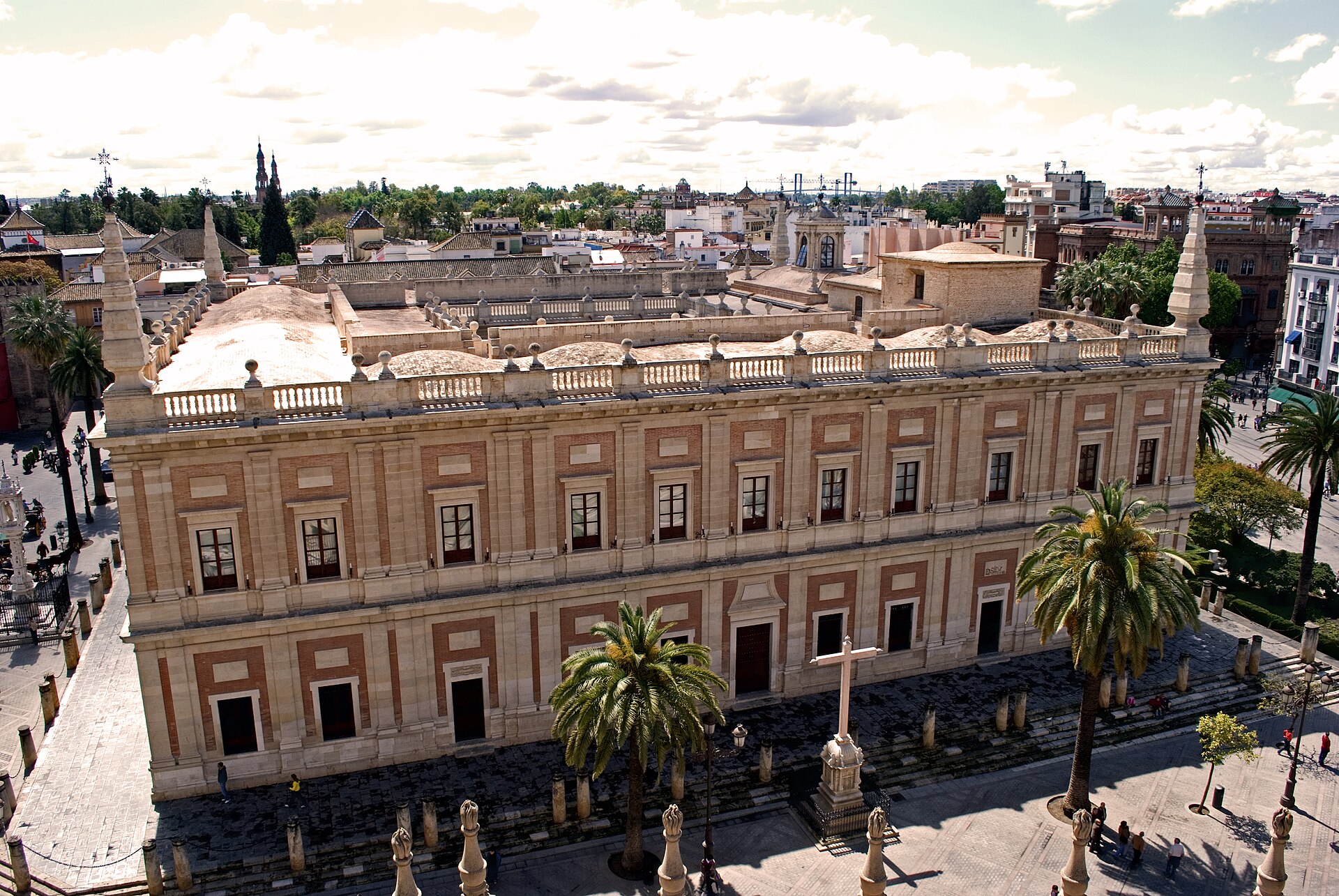
The Casa Lonja de Mercaderes is among the purest surviving monuments of the austere classicism that Juan de Herrera created for Philip II at the Escorial. Philip II, scandalised by the commercial disorder of merchants transacting business on the steps of Seville Cathedral, resolved to give them a dedicated exchange; Herrera, the royal architect, sketched the design in 1572, and after rejecting an alternative scheme by Asensio de Maeda the King gave final approval on 11 July 1582 (see the dossier 'Casa Lonja de mercaderes de Sevilla', Universidad de Almería, IDEIMAND project). Construction began in 1583–84 under the master builder Juan de Mijares working from Herrera's plans, with Alonso de Vandelvira directing the works and, from 1609, Miguel de Zumárraga; the ground floor entered service in 1598, but funding shortfalls stalled the upper floor, which was not completed until 1646 under Pedro Sánchez Falconete. The result is a nearly square block of two storeys arranged around a large central patio that consciously echoes the Patio de los Evangelistas at the Escorial. Each of its four near-identical facades rises on a low stone stylobate and is articulated by flat Tuscan pilasters framing windows set in slightly sunken panels, the whole crowned by a balustrade with rusticated pyramidal obelisks at the corners; as the Wikipedia entry on the General Archive of the Indies notes, 'there is no sculptural decoration, only the discreetly contrasting tonalities of stone and stucco.' A hallmark of the building, much imitated in Seville thereafter, is its bichrome wall surface, in which pale dressed stone for the structural members is set against panels of reddish brick. Zumárraga's most significant departure from Herrera's design was to replace the architect's intended timber roof with masonry barrel vaults on the upper floor, a sophisticated feat of stonecutting that helped fit the building for its eventual role as a fireproof archive.
As befits a monument of Herreran severity, the Casa Lonja was conceived with almost no figural ornament, its aesthetic resting on geometry, proportion and the chromatic play of brick against stone rather than on sculpture or painting. The principal artistic intervention came two centuries after construction, when Charles III converted the building into the General Archive of the Indies and the architect Lucas Cintora inserted a monumental staircase between 1785 and 1787, behind the main entrance on the Avenida de la Constitución; clad in red and greyish-black jaspers and lit from a vaulted lantern overhead, it is the building's single grand decorative gesture. To house the archive's documents, the great rooms of the upper floor were lined with shelving of exceptional quality in mahogany and cedar imported expressly from Cuba, work associated with the sculptor Blas Molner. The upper floor had earlier served, in the later seventeenth century, as the seat of the drawing academy founded by Murillo and Francisco Herrera el Joven, a reminder that the building's cultural afterlife long predated its conversion to an archive.
The Casa Lonja occupies one of the most charged sites in Seville, standing in the monumental heart of the old city between the Cathedral of Santa María de la Sede and the Real Alcázar, the royal palace. This juxtaposition of cathedral, palace and exchange expresses with unusual clarity the entwining of church, crown and commerce that drove Spain's Atlantic empire. The proximity to the cathedral was no accident: the Lonja was built expressly to draw merchants away from the cathedral steps and the Patio de los Naranjos, where they had conducted business since the Middle Ages and where Philip II found their presence unseemly. Today the three buildings together constitute the UNESCO World Heritage ensemble 'Cathedral, Alcázar and Archivo de Indias in Seville', inscribed in 1987 (UNESCO World Heritage List no. 383), and the Casa Lonja is additionally protected under Spanish law as a Bien de Interés Cultural in the category of Monumento. The building faces the Avenida de la Constitución, with the Plaza del Triunfo and its baroque monument at one corner, in the dense ceremonial core of the city to which the wealth of the Indies first flowed.
The institution housed in the Lonja was the Consulado de Cargadores a Indias, the merchant guild founded at Seville in 1543 on the model of the consulado of Burgos. Seville was the sole legal port for Spain's overseas trade across the sixteenth and seventeenth centuries, its commerce regulated by the Casa de la Contratación (established 1503), and the Consulado functioned as the corporate body of the merchants who financed and freighted the Carrera de Indias, the convoyed fleet system linking Spain to its American possessions. The guild enjoyed, in theory, near-monopoly rights over goods shipped to America and exercised its own commercial jurisdiction, adjudicating disputes among merchants. The Consulado used the ground floor of the Lonja for its business until the trade monopoly was transferred to Cádiz, the Casa de la Contratación moving there in 1717 and the Consulado following soon after. With its commercial purpose gone, the building stood underused until 1785, when Charles III, on the initiative of José de Gálvez and the historian Juan Bautista Muñoz, decreed that the scattered documentation of the Spanish empire in the Americas and the Philippines be gathered under one roof, creating the Archivo General de Indias. It remains one of the world's greatest documentary repositories of European colonial history, holding tens of thousands of bundles of records of the Carrera de Indias.
What was 'traded' at the Casa Lonja was, in effect, the commerce of an entire intercontinental empire. The merchants of the Consulado organised and financed the cargoes of the treasure fleets: outbound, European manufactures, wine, oil, textiles and ironwork destined for the colonies; inbound, the American silver of Potosí and Zacatecas together with gold, cochineal, hides, sugar, indigo, tobacco and other colonial staples. Above all, the building stood at the centre of the global silver trade, for the bullion that flowed through Seville financed Spanish power in Europe and, transhipped, ultimately reached markets as far away as China. Business here was less the open outcry of a securities bourse than the negotiation of freight contracts, marine insurance, bills of exchange, partnerships and the credit (often supplied by Genoese and other foreign bankers) that underwrote each sailing of the fleet, alongside the registration and adjudication of cargoes. In this sense the Lonja was the institutional heart of the first true world economy, the place where the commerce of Europe, the Americas and Asia was coordinated, even as much of the practical trade and shipping took place at the riverside quays of the Guadalquivir and, increasingly, at Cádiz.
Images will be added as the project develops. Photographs by Larry Ng and from research sources.