Korea Exchange (KRX) (한국거래소)
Seoul, South Korea · Established 1956
This site requires authorization to access.
To request access, contact
william.goetzmann@yale.edu
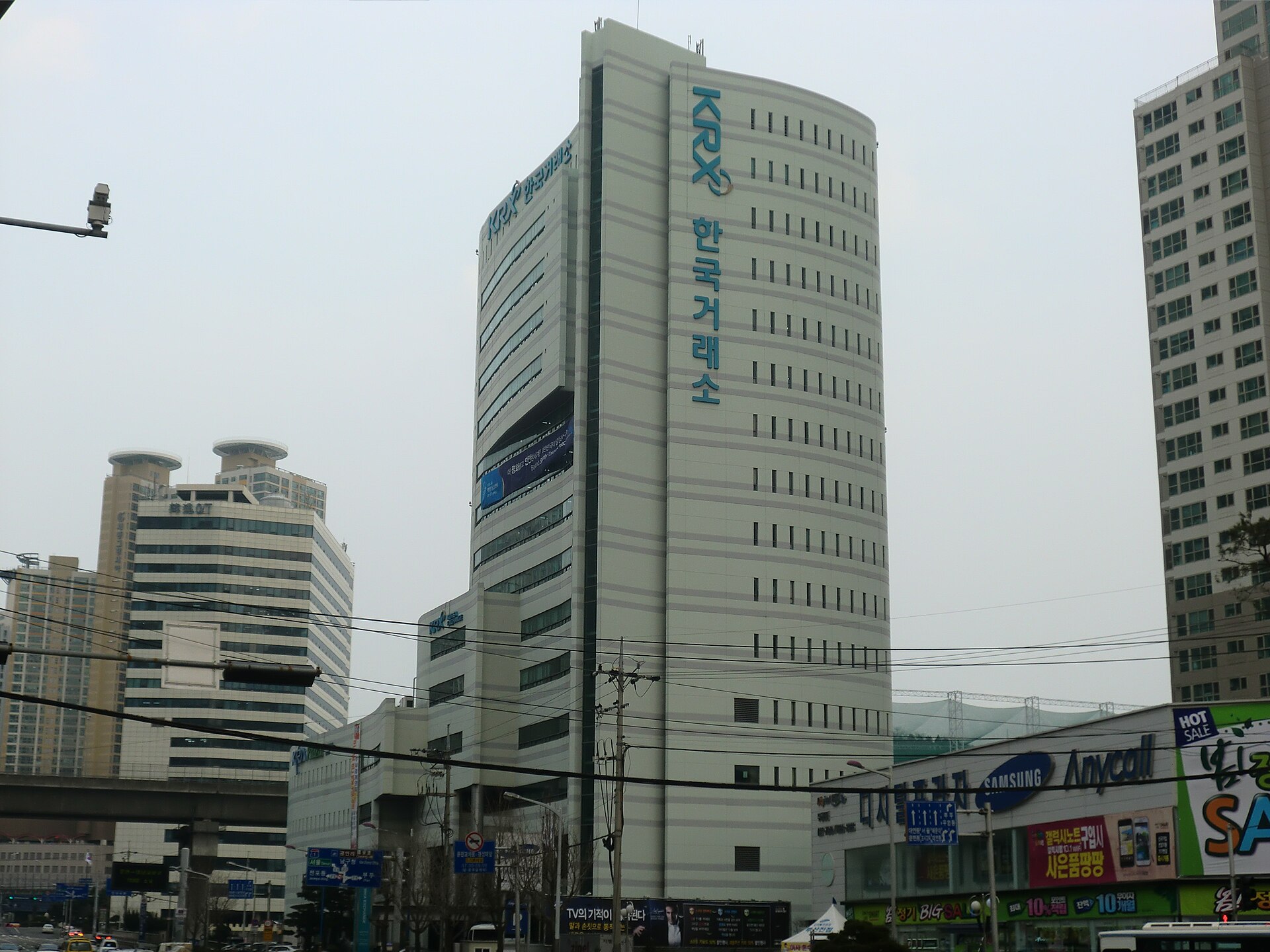
The Korea Exchange’s architectural history spans three major sites across seven decades. When the Daehan Stock Exchange was established in March 1956, trading took place in the Myeongdong district of central Seoul, long the country’s informal financial hub where securities had changed hands since the colonial era. In 1976, groundbreaking began on a purpose-built exchange facility on Yeouido, the island in the Han River that President Park Chung-hee’s government was transforming into a modern sub-center for finance and administration. The stock exchange relocated to Yeouido in July 1979, catalyzing the island’s emergence as Korea’s Wall Street. The Yeouido headquarters, a reinforced-concrete and steel-frame structure of six above-ground floors and one subterranean level, was designed in the functional modernist idiom typical of South Korean institutional architecture of the 1970s. By the 2000s, however, the building no longer met contemporary standards for energy efficiency or workplace comfort. The Seoul firm Design Bono, coordinated by architect Nayeon Kim, undertook a comprehensive envelope redesign, recladding the façade in a sleek curtain-wall system with sustainable elements and reconfiguring interior spaces to promote collaboration. Meanwhile, as part of a national policy to decentralize government institutions, the Korea Exchange’s official headquarters relocated on 30 December 2014 to the Busan International Finance Center (BIFC) in the Munhyeon Financial Complex, Nam-gu, Busan. Designed by the firm HAUD and constructed by Hyundai Engineering & Construction between 2011 and 2014, the BIFC tower rises 63 floors and 289 meters—conceived as a sailboat embarking across the world’s oceans, symbolizing Busan’s maritime identity and aspirations as a Northeast Asian financial hub. The Yeouido facility continues to operate as the exchange’s Seoul office, handling cash-market trading and regulatory oversight, while the Busan headquarters manages derivatives trading and strategic functions.
The decorative program of the Korea Exchange’s commercial spaces is restrained compared with the ornamental traditions of older Western bourses. Outside the Yeouido building, a bronze charging-bull sculpture stands as the exchange’s most recognizable artistic element—echoing the globally ubiquitous symbol of bullish market optimism made famous by Arturo Di Modica’s 1989 installation on Wall Street, yet adapted here with the proportions and patina favored in Korean public statuary. Inside the former trading floor, the aesthetic was defined by the infrastructure of open-outcry commerce—banks of electronic boards, the geometric rhythms of trading posts, and the kinetic spectacle of floor brokers in colored vests—a scene photographed extensively before the floor closed with full electronic automation in 1997. The Design Bono renovation of the Yeouido building introduced contemporary materials and lighting schemes that replaced the utilitarian 1970s interiors with a corporate modernism emphasizing transparency and openness. At the Busan BIFC, the tower’s exterior is itself the primary artistic statement: its curvilinear glass curtain wall and tapered massing evoke maritime sails, while the lobby and public spaces feature polished stone, metal, and glass finishes characteristic of twenty-first-century Asian commercial architecture. The exchange’s visual identity also appears in the KOSPI and KOSDAQ market-data displays that have become a form of public art in their own right, broadcast on enormous electronic screens visible from Yeouido’s streets—a digital descendant of the ticker tape as urban spectacle.
The Korea Exchange’s geography is inseparable from the planned transformation of Yeouido. Before the 1960s, the island in the Han River was an uninhabited sandbar used intermittently as pastureland and, from 1924, as the site of Korea’s first airport. Under the Park Chung-hee regime’s Han River development project, a six-lane bridge linked Yeouido to Yeongdeungpo in 1970, and a comprehensive master plan drawn up in 1971 envisioned the island as a new center for government, finance, and media—part of a broader strategy to relieve congestion in the old downtown and project the modernizing ambitions of the developmental state. The stock exchange’s arrival in 1979 was the decisive catalyst: the Financial Supervisory Service had already moved there in 1978, and the exchange’s presence drew the Federation of Korean Industries, major banks such as Industrial Bank of Korea and Kookmin Bank, and an ecosystem of securities firms to Yeouido, establishing the dense financial cluster that persists today. The International Finance Center Seoul, launched in 2005 as part of the metropolitan government’s plan to position Yeouido as a regional financial hub, added landmark glass towers by Arquitectonica to the skyline. The 2014 relocation of the exchange’s headquarters to Busan reflected a national policy of balanced regional development. Busan, Korea’s second city and a major port opened to international trade in 1876, had long served as the country’s maritime gateway. The Munhyeon Financial Complex was designed to create a dedicated finance cluster anchored by the KRX and the Korea Securities Depository, leveraging Busan’s strategic position on the Korea Strait. From the tower’s upper floors, views encompass Jungang Road, Yongdusan Park, and the vast container terminals of Busan Port—the world’s sixth-busiest—linking the exchange’s work of capital allocation to the physical infrastructure of global trade.
The origins of organized securities trading in Korea trace to the Japanese colonial period. Following the establishment of the Incheon Securities Office in 1896 for trading Japanese government bonds, the Government-General authorized the Gyeongseong (Seoul) Spot Securities Exchange Market in 1920, a period marked by speculative fever that had gripped colonial industry from 1916 before collapsing in 1919. In 1932, the Incheon and Gyeongseong offices merged to form the Chosun Securities Company, which traded primarily Japanese-owned corporate shares until Japan’s defeat in 1945. As Sang-Hyun Song details in “Law and Policy of Securities Regulation in Korea” (Pacific Rim Law and Policy Journal, 1995), the Securities and Exchange Act of 1962 provided the first comprehensive regulatory framework for the post-independence market. The Daehan Stock Exchange, established on 3 March 1956 with just twelve listed companies—including Chohung Bank and Korea Electric Power—was, as the Korea Development Institute’s research notes, initially “akin to a legalized gambling casino,” plagued by speculative bubbles and dominated by three stocks accounting for 93 percent of turnover. The Capital Market Development Act of 1968, together with the Securities Exchange Act, constituted the twin pillars of market regulation, but it was President Park Chung-hee’s export-driven industrialization strategy that compelled chaebols to list publicly, deepening the market through the 1970s and 1980s. The exchange adopted full electronic trading by 1997, closing its physical floor earlier than most global peers. That same year, the Asian financial crisis struck: the KOSPI index, which had peaked near 981 in April 1996, plunged as the Thai baht’s collapse sent contagion through the region. As Ajai Chopra, Kenneth Kang, and colleagues document in the IMF Working Paper “From Crisis to Recovery in Korea” (2001), Korea’s December 1997 agreement with the IMF for SDR 15.5 billion in standby support triggered sweeping reforms—the ceiling on foreign equity ownership was raised from 26 to 100 percent by May 1998, and the financial sector underwent radical restructuring. The KOSDAQ market, launched on 1 July 1996 as Korea’s answer to NASDAQ for small and medium-sized technology enterprises, survived the crisis and became one of the world’s most successful secondary boards. On 27 January 2005, the Korea Stock Exchange, Korea Futures Exchange, and KOSDAQ merged under the Korea Stock and Futures Exchange Act to form the Korea Exchange (KRX), consolidating all trading, clearing, settlement, and market surveillance under a single entity headquartered initially in Seoul and, from 2014, in Busan.
The Korea Exchange operates three principal markets. The KOSPI market, successor to the original Daehan Stock Exchange listing of 1956, hosts over 880 companies and is dominated by the shares of the great chaebol conglomerates—Samsung Electronics, Hyundai Motor, SK Hynix, LG Electronics, and POSCO—whose five parent groups alone account for more than half of total market capitalization, as the Korea Herald reported in 2024. The KOSPI 200 index, a market-capitalization-weighted basket of 200 blue-chip stocks representing roughly 70 percent of total KOSPI value, serves as the benchmark for Korea’s most celebrated derivative product: KOSPI 200 index options, which as Soku Byoun and Hun Park documented in “Arbitrage Opportunities and Efficiency of an Option Market at Its Initial Stage” (Research in Finance, 2009) were launched in 1997 and by the year 2000 ranked as the world’s single most actively traded exchange-listed derivative, with nearly 194 million contracts transacted that year. Retail participation was extraordinarily high until regulators raised contract multipliers and imposed investor-education requirements after 2012, shifting the market toward institutional and foreign participants. The KOSDAQ market, modeled on NASDAQ and launched in 1996, grew from an initial capitalization of 8.6 trillion won to over 370 trillion won with 1,462 listed companies by 2021, specializing in biotechnology, information technology, and other high-growth sectors. Fixed-income products include Korea Treasury Bond (KTB) futures, introduced in February 2008, which as Asian Development Bank research has shown play a leading role in price discovery for government debt, with foreign traders particularly active in the futures leg. The exchange also lists single-stock futures, ETFs, and a range of commodity derivatives. The KRX’s proprietary EXTURE trading system, first deployed in 2009 and upgraded to EXTURE+ in 2014, handles all asset classes with sub-millisecond latency—a technological achievement that has enabled KRX to export its trading infrastructure to exchanges in Malaysia, the Philippines, Thailand, Azerbaijan, and Vietnam.
Images will be added as the project develops. Photographs by Larry Ng and from research sources.