Equinix Financial Hub (Secaucus)
Secaucus, USA · Established c. 2000
This site requires authorization to access.
To request access, contact
william.goetzmann@yale.edu
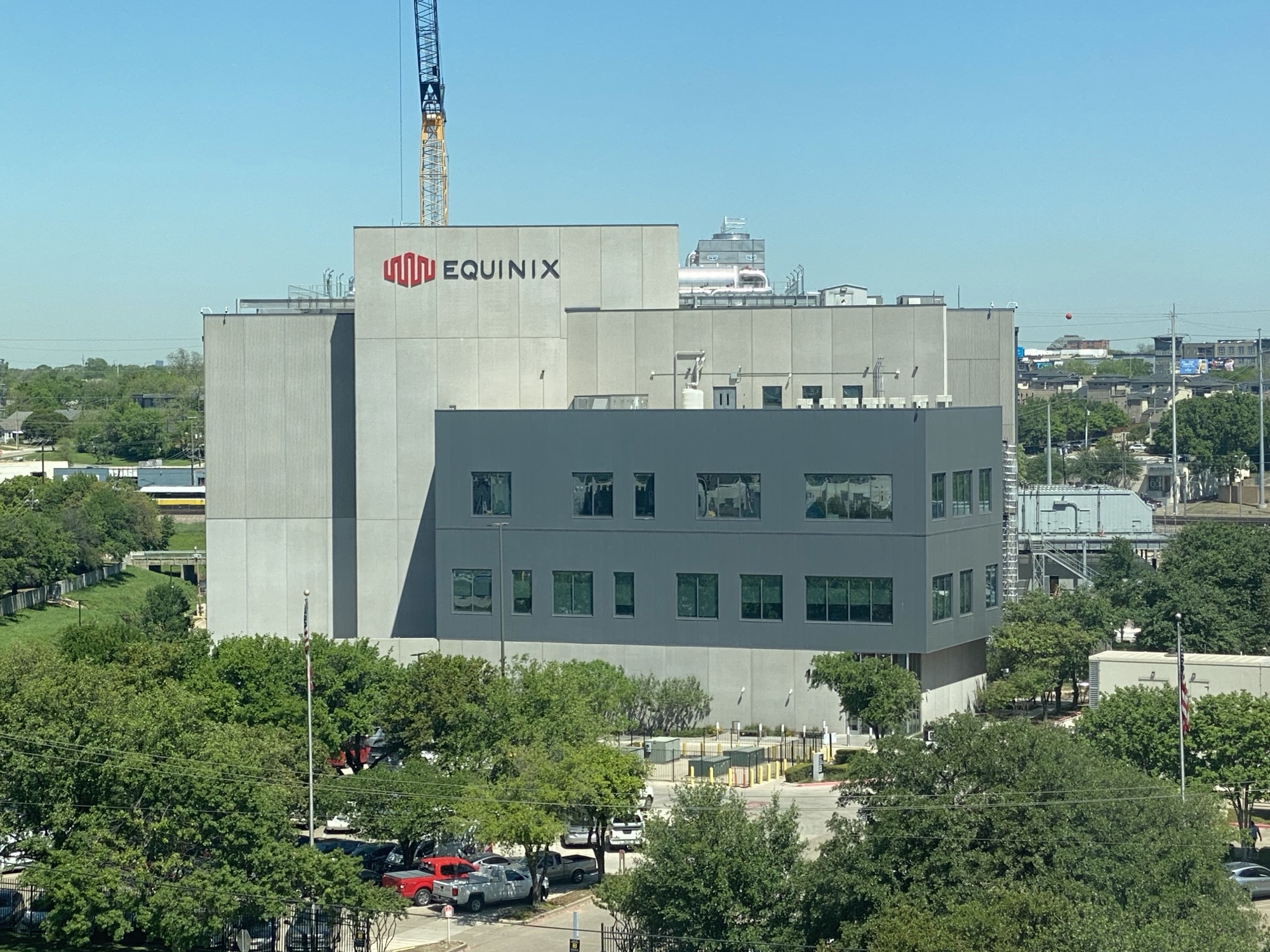
The Equinix Secaucus campus comprises two principal facilities: NY4, at 755 Secaucus Road, encompassing approximately 339,000 square feet with some 152,000 square feet of raised-floor colocation space and access to roughly 24 megawatts of power; and NY5, at 800 Secaucus Road, a two-story steel-and-concrete structure of approximately 275,000 square feet with 108,000 square feet of colocation space and 10 megawatts of power capacity. Together with the smaller NY2 and NY6 facilities nearby, the Secaucus cluster constitutes one of the most critical nodes in the global financial system. The buildings are architecturally unremarkable from the outside — low-rise commercial structures along a suburban New Jersey road, indistinguishable from warehouses or light-industrial facilities. Their significance lies entirely within. Equinix was founded in June 1998 by Jay Adelson and Al Avery, both former facilities managers at Digital Equipment Corporation, who recognized the need for carrier-neutral interconnection points where any network provider could exchange traffic on equal terms. The company’s initial public offering on NASDAQ in August 2000 raised approximately $270 million, and despite near-collapse during the dot-com bust, Equinix survived to become the world’s largest data center operator, with over 260 facilities in 33 countries and a market capitalization exceeding $80 billion. In 2015, Equinix converted to a real estate investment trust (REIT) after receiving a favorable private letter ruling from the IRS, making the physical infrastructure of electronic finance itself an investable real estate vehicle — a remarkable recursion in which the container of capital markets became a capital markets instrument. The interior architecture is governed by engineering imperatives that serve a function analogous to the spatial fairness of a physical trading floor. As Donald MacKenzie documents in Trading at the Speed of Light (Princeton University Press, 2021), colocation providers must ensure equal-length cross-connect cables between colocated servers and exchange matching engines, so that no participant gains a speed advantage from physical proximity within the facility. The result is a rigorously symmetrical interior: identical locked cages housing server racks, color-coded fiber-optic patch panels, redundant power feeds, precision cooling systems maintaining temperatures between 68 and 77 degrees Fahrenheit, and biometric security including mantraps, 24/7 guards, and pervasive CCTV surveillance. The concept of the carrier-neutral facility — open to any tenant willing to pay, with standardized connectivity available to all — bears a structural resemblance to the medieval fondaco or caravanserai, the neutral commercial compound where merchants of different nationalities could lodge, store goods, and transact business under the protection of the host authority.
The visual culture of the Equinix Secaucus complex represents the most radical departure in the entire history of exchange architecture: there is essentially no visual program intended for human eyes. Where the Amsterdam Beurs of Hendrik de Keyser (1611) bore sculptural allegories of Mercury and Minerva, and where the Palais Brongniart in Paris presented a Corinthian colonnade proclaiming the dignity of commerce, the data center offers only the industrial sublime of server racks behind locked cage doors, their blinking LEDs the sole visual signal of the trillions of dollars flowing through fiber-optic cables. The aesthetic, such as it is, belongs to what the architectural critic Reyner Banham called “the architecture of the well-tempered environment” — a space designed not for human habitation but for the thermal and electrical requirements of machines. Yet the data center has generated its own visual culture, one that exists primarily on screens rather than walls. Equinix’s customer portal provides real-time dashboards displaying power consumption, network utilization, temperature maps, and cross-connect inventories — the contemporary equivalent of the ticker tape that once gave physical form to market information. Network topology diagrams, with their nodes and edges representing routers, switches, and fiber paths, constitute a genuinely new form of cartography: the map of a marketplace that exists in logical rather than physical space. The dark pools that operate from within these facilities — venues like Goldman Sachs’s Sigma X2, Morgan Stanley’s MS Pool, and the various alternative trading systems registered under SEC Regulation ATS — have no public-facing visual interface whatsoever. Their “darkness” is both informational (pre-trade quotes are not displayed) and aesthetic (there is nothing to see). This represents a complete inversion of the centuries-old tradition in which exchanges deployed elaborate architectural and artistic programs to project legitimacy, transparency, and civic virtue. The contrast is sharpest with the NASDAQ MarketSite in Times Square, just twelve miles to the east, where a seven-story cylindrical LED display broadcasts stock prices and corporate logos to passing pedestrians — pure spectacle for a marketplace that has no physical trading floor. As Scott Patterson observes in Dark Pools: The Rise of the Machine Traders and the Rigging of the U.S. Stock Market (Crown Business, 2012), the migration of trading from visible, human-occupied floors to invisible, machine-occupied data centers constitutes one of the most profound transformations in the material culture of capitalism. The only “art” that matters inside the data center is the craft of cable management: the satisfying order of neatly bundled fiber runs, the color-coded patch panels that distinguish production from backup circuits, the precise labeling systems that allow technicians to trace any connection in a facility housing thousands of cross-connects.
Secaucus occupies a liminal geography in the financial topology of the northeastern United States: it sits directly across the Hudson River from Manhattan, approximately five miles west of Midtown, yet belongs to a fundamentally different landscape of highways, marshlands, and light-industrial parks. The town straddles the New Jersey Turnpike and Interstate 95, the arterial corridor that since the mid-twentieth century has channeled commerce between New York and the rest of the continent. It was precisely this combination of proximity to Manhattan’s financial workforce, abundant fiber-optic routes from the New York metropolitan backbone, relatively inexpensive real estate, and reliable power from Public Service Electric and Gas (PSEG) that made Secaucus the densest cluster of financial data centers in the world. The Equinix campus sits within a broader constellation of financial infrastructure nodes along the New Jersey corridor. Thirty miles to the northwest, in Mahwah, the New York Stock Exchange operates its own proprietary data center — the facility to which NYSE’s matching engine migrated when it left its historic home at 11 Wall Street. Twenty-five miles to the southwest, in Carteret, Nasdaq operates its primary data center. Five miles to the southeast, in Weehawken, IEX — the exchange made famous by Michael Lewis’s Flash Boys (W. W. Norton, 2014) — deliberately located its matching engine with 38 miles of coiled fiber-optic cable introducing a 350-microsecond delay to neutralize high-frequency trading advantages. As MacKenzie demonstrates in “Material Signals: A Historical Sociology of High-Frequency Trading” (American Journal of Sociology, 2018), the physical geography of these facilities is not incidental but constitutive: the speed of light through fiber optic cable — roughly two-thirds of its vacuum speed, or about one foot per nanosecond — means that every meter of cable and every mile between facilities translates into microseconds of latency that determine who wins and who loses in the race to execute trades. What makes the Equinix Secaucus campus distinctive within this geography is its role as a neutral, multi-tenant facility. Unlike Mahwah (owned by NYSE’s parent company ICE) or Carteret (owned by Nasdaq), the Secaucus facilities host competing exchanges, dark pools, and trading firms under a single roof — or more precisely, within a single network fabric. The CBOE’s four equities exchanges (BZX, BYX, EDGX, EDGA) run their matching engines here alongside dozens of alternative trading systems and hundreds of proprietary trading firms. The SEC’s Regulation National Market System (Reg NMS, 2005) requires that orders be routed to whichever venue offers the National Best Bid and Offer (NBBO), creating a web of mandatory interconnection among these physically proximate but organizationally distinct venues. The result is a landscape in which the concept of “exchange as tenant” has replaced “exchange as edifice” — a transformation as significant as the shift from open-outcry trading floors to electronic order books.
The institutional history of the Equinix Secaucus financial hub is inseparable from the broader transformation of American equity market structure that began with the SEC’s adoption of Regulation ATS (Alternative Trading System) in 1998, which established a framework for electronic trading venues to register as broker-dealers rather than as exchanges, dramatically lowering barriers to entry and enabling the proliferation of new trading platforms. Equinix itself was founded in June 1998 by Jay Adelson and Al Avery with the mission of creating carrier-neutral colocation facilities; its IPO on NASDAQ in August 2000 raised $270 million, though the company nearly perished in the dot-com crash that followed. The Secaucus campus evolved into a financial trading hub gradually during the early 2000s as electronic communication networks (ECNs) and early algorithmic trading firms recognized the advantages of colocating their servers in close physical proximity to one another and to the network interconnection points that Equinix provided. A pivotal moment came with the founding of BATS Global Markets in June 2005 by Dave Cummings, a computer programmer and owner of Tradebot Systems in Kansas City, Missouri. As Patterson chronicles in Dark Pools (2012), BATS — originally an acronym for Better Alternative Trading System — began as a twelve-person operation in a Kansas City storefront but migrated its matching engine to the New Jersey corridor to reduce latency. Direct Edge, another electronic exchange, operated from Equinix’s NY4 facility in Secaucus. When BATS and Direct Edge merged in 2014, the combined entity’s four exchange venues (BZX, BYX, EDGX, EDGA) consolidated at the Secaucus campus. In 2017, CBOE Holdings acquired BATS Global Markets for $3.2 billion, making the Chicago-based options exchange operator the owner of the Secaucus-hosted equities platforms. The parallel rise of dark pools transformed the Secaucus campus into a venue for a substantial share of all U.S. equity trading conducted away from lit exchanges. The SEC’s landmark enforcement actions of 2016 against two major dark pool operators revealed the scale and complexity of these operations: Barclays agreed to pay $70 million to settle charges that it had misrepresented how its LX dark pool handled high-frequency trading, while Credit Suisse paid $84.3 million over its CrossFinder dark pool’s use of illegal sub-penny pricing and misleading disclosures. In 2014, the SEC adopted Regulation Systems Compliance and Integrity (Reg SCI), requiring exchanges and significant alternative trading systems to maintain robust technological infrastructure — a regulatory acknowledgment that the physical and digital systems housed in facilities like Equinix’s Secaucus campus had become systemically important. The Equinix REIT conversion in January 2015, following a favorable IRS private letter ruling, transformed the company’s data centers — including the Secaucus financial hub — into qualified real estate assets, enabling the company to avoid corporate income tax by distributing at least 90 percent of taxable income to shareholders. As Sal Arnuk and Joseph Saluzzi argue in Broken Markets (FT Press, 2012), the fragmentation of trading across multiple electronic venues housed in facilities like Secaucus, combined with the speed advantages available to colocated traders, fundamentally altered the balance of power in American equity markets.
The Equinix Secaucus campus is arguably the single most concentrated locus of financial trading activity on Earth, measured by the diversity and volume of instruments that flow through its facilities. The CBOE’s four equities exchanges — BZX, BYX, EDGX, and EDGA, inherited from the BATS/Direct Edge lineage — operate their matching engines from the NY5 facility at 800 Secaucus Road. Together these venues handle a significant share of all U.S. listed equity volume. CBOE’s options platforms, including trading in the VIX (the CBOE Volatility Index, often called Wall Street’s “fear gauge”) and SPX index options, also route through the Secaucus infrastructure. The facility hosts an extensive ecosystem of alternative trading systems (ATSs) registered under SEC Regulation ATS, commonly known as dark pools. These venues — operated by major broker-dealers including Goldman Sachs (Sigma X2), Morgan Stanley (MS Pool), and others — execute trades without displaying pre-trade quotations, allowing institutional investors to move large blocks of shares without revealing their intentions to the broader market. Off-exchange and dark pool trading collectively accounts for approximately 40 to 50 percent of all U.S. equity volume in recent years, as documented by the Congressional Research Service report Dark Pools in Equity Trading: Policy Concerns and Recent Developments (R43739, updated 2014). Wholesale market makers — most prominently Citadel Securities and Virtu Financial — operate from colocation facilities in the New Jersey corridor, internalizing a vast share of retail order flow routed to them by online brokerages under payment-for-order-flow (PFOF) arrangements. Citadel Securities alone handles approximately 40 percent of all U.S. retail equity orders. Exchange-traded funds (ETFs) and options on ETFs constitute another major category of instruments traded through Secaucus-based infrastructure. The fragmentation of trading across these multiple venues is a direct consequence of SEC Regulation NMS (2005), whose Order Protection Rule (Rule 611) requires brokers to route orders to whichever venue displays the National Best Bid and Offer (NBBO). As Eric Budish, Peter Cramton, and John Shim demonstrate in “The High-Frequency Trading Arms Race: Frequent Batch Auctions as a Market Design Response” (Quarterly Journal of Economics, 2015), the continuous limit order book market design creates fleeting arbitrage opportunities that reward speed, driving trading firms to colocate their servers as close as physically possible to exchange matching engines — which is precisely what the Equinix Secaucus campus enables. A single equity trade initiated by a retail investor may, within milliseconds, touch multiple venues housed in the same facility: routed by a broker to a wholesale market maker, checked against the NBBO across lit exchanges, potentially matched in a dark pool, and reported to the consolidated tape — all without leaving the Secaucus campus. The concept of “best execution” that Reg NMS codifies has thus been transformed from a spatial metaphor (the best price on a trading floor) into a computational reality (the best price across a network of colocated servers), and the Equinix Secaucus complex is the physical site where that transformation is most densely realized.
Images will be added as the project develops. Photographs by Larry Ng and from research sources.