Seattle Stock Exchange
Seattle, USA · Established 1900
This site requires authorization to access.
To request access, contact
william.goetzmann@yale.edu
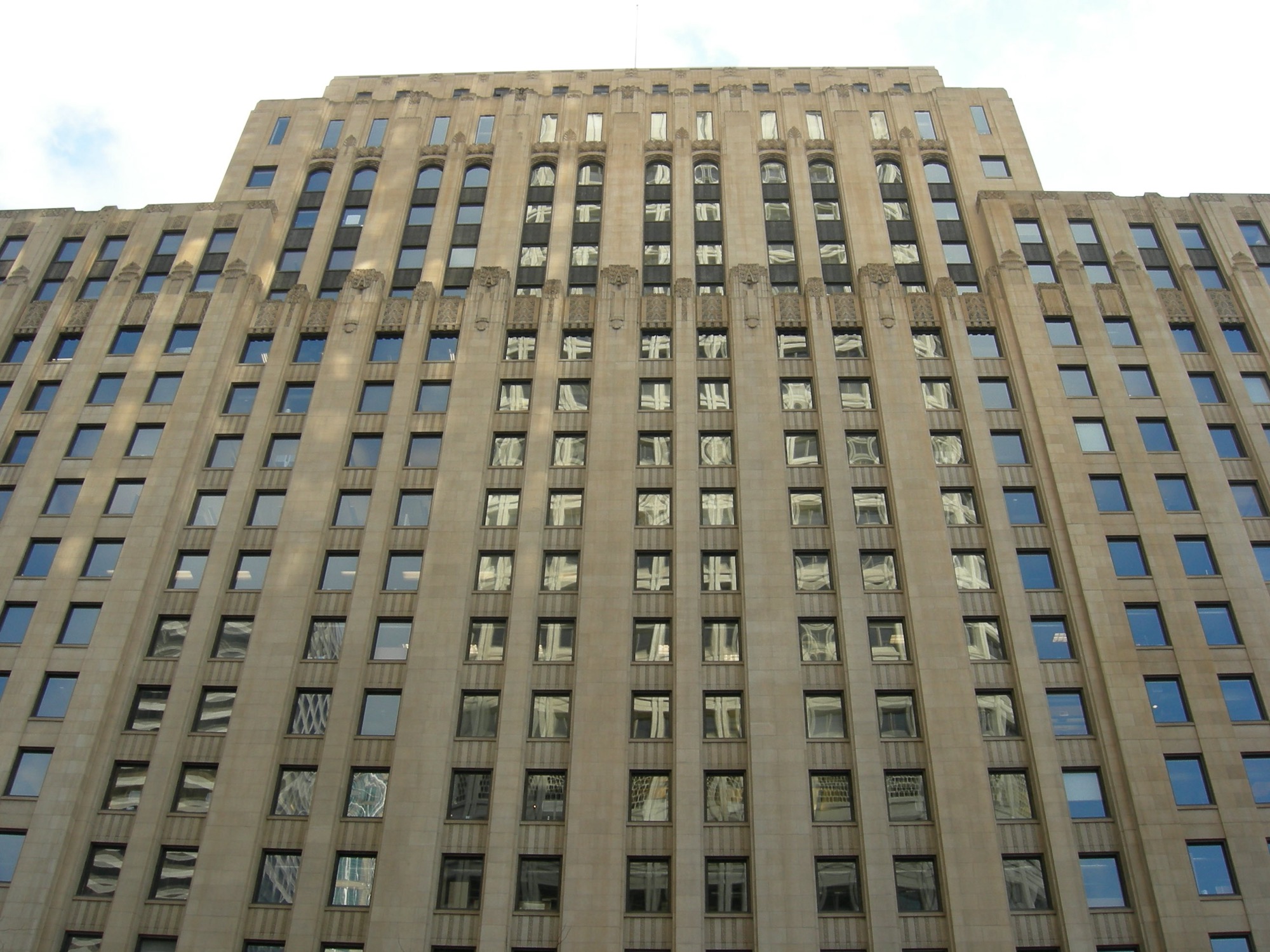
The Seattle Stock Exchange found its permanent home in the Exchange Building, a twenty-three-story Art Deco skyscraper completed in 1930 at 821 Second Avenue in downtown Seattle. Designed by John Graham Sr. and Francis W. Grant of John Graham & Associates, the tower rose 279 feet on a reinforced-concrete frame that was, upon completion, the second-tallest such structure in the United States (Grant Hildebrand, “John Graham, Sr.,” in Shaping Seattle Architecture, University of Washington Press, 1994). Hildebrand has called it “perhaps Graham’s finest work.” The base is clad in polished Morton gneiss—a 3.5-billion-year-old metamorphic stone quarried in Morton, Minnesota, which geologist David B. Williams describes as “the oldest rock any normal person would ever see” (Williams, Stories in Stone: Travels Through Urban Geology, Walker & Company, 2009). Above the gneiss, the façade transitions to ochre-colored Romanite stone, and the vertical massing employs stepped setbacks characteristic of the era’s zoning-envelope aesthetics. At the time of its May 1930 opening, the Exchange Building was “designed to house more stock and mercantile exchanges than any building in the United States,” accommodating both the Seattle Stock Exchange and the Seattle Curb and Mining Exchange alongside commodity trading floors for grain, produce, and other Pacific Northwest staples (Woodbridge and Montgomery, Guide to Architecture in Washington State, 1980). Designated a Seattle Landmark in 1990, both lobbies and the exterior remain protected by the Landmarks Preservation Board.
The Exchange Building’s interior decorative program ranks among the most distinctive Art Deco ensembles in the Pacific Northwest, fusing international modernist motifs with imagery rooted in regional culture and commerce. The Second Avenue lobby’s gilt-plaster ceiling features diamond and triangle reliefs that one Seattle Times critic compared to “King Tut’s treasury”—an effect heightened by curving black marble walls and cast-bronze elevator bays whose grilles display geometric abstraction (Seattle Times, “Art Deco Seattle Skyscrapers Inspired by the Nature of the Pacific NW,” 2017). The incised bronze panels and low-relief plaster patterns weave together references to Northwest Coast Indigenous feather and textile designs, stylized evergreen trees and water imagery, and motifs drawn from Mayan, Asian, and Pacific Oceanic cultures—a syncretic vocabulary unique to Seattle’s interwar skyscrapers. Wheat sheaves, grape clusters, and tulips festoon virtually every fixture, from the stained-glass fanlights above the Marion Street entrance to the original bronze U.S. Mail letter boxes that remain in service today. These agricultural and horticultural emblems directly referenced the commodities traded within the building’s exchange floors, linking decorative art to financial function. Dark marble pilasters frame the elevator alcoves, and carved wooden telephone booths survive as rare period artifacts. The First Avenue lobby echoes these themes with “countless European-influenced details” that complement the Pacific Rim iconography found on the Second Avenue side (Ressler Tesh Architecture, “Seattle’s Historic Exchange Building,” 2019).
The Exchange Building anchors the southwest corner of Second Avenue and Marion Street, placing the Seattle Stock Exchange at the heart of a financial corridor that had migrated northward from Pioneer Square in the early twentieth century. By the 1920s, Second Avenue had become Seattle’s “financial row”: the Dexter Horton Building (1924), also by John Graham Sr., stood two blocks south at Second and Cherry, while the Bank of California Building (1924) rose at 815 Second Avenue next door (HistoryLink.org, “Seattle Neighborhoods: Downtown Seattle,” 2001). The Exchange Building was the last major office tower erected in downtown Seattle before the Great Depression halted construction; no comparable structure appeared until the Norton Building in 1959 (Jeffrey Karl Ochsner, ed., Shaping Seattle Architecture, 2014). The site’s proximity to Elliott Bay’s waterfront wharves, the railroad terminals along the tideflats, and the Pike Place Market (established 1907) embedded the exchange within the logistical infrastructure of Pacific Northwest trade. Seattle’s role as the principal outfitting port for the 1897 Klondike Gold Rush had already transformed it into a regional financial gateway: bank clearings soared from $36 million in 1897 to over $100 million by 1899 (National Park Service, Klondike Gold Rush Seattle Unit, “History & Culture”). That speculative energy persisted into the 1920s, fueling demand for a purpose-built exchange complex that could consolidate the city’s fragmented securities and commodities markets under one roof.
The Seattle Stock Exchange commenced operations on March 14, 1927, during a period of exuberant speculation that had swept the nation’s regional securities markets. In the 1920s more than fifty regional auction exchanges traded alongside the New York Stock Exchange, capitalizing on local industries and investor enthusiasm (SEC Historical Society, “Transformation & Regulation: Equities Market Structure, 1934–2018”). The Exchange Building opened in May 1930, just months after the October 1929 crash, making it, as architectural historian Jeffrey Karl Ochsner observed, an enterprise launched at “a very inopportune time” (Ochsner, ed., Shaping Seattle Architecture, University of Washington Press, 2014). Nonetheless, the exchange listed locally significant equities—Carnation Company, Dexter Horton National Bank, Seattle National Bank, Fisher Flouring Mill, and Puget Sound Power & Light—as well as bonds of the W. E. Boeing Company, Seattle Times Company, and Puget Sound Navigation Company. On October 1, 1935, the Seattle Stock Exchange absorbed the Seattle Curb and Mining Exchange, a smaller venue focused on speculative mining stocks tied to Washington and Alaska mineral resources. Following passage of the Securities Exchange Act of 1934, the SEC registered twenty-four national exchanges and granted temporary exemptions to nineteen others; the resulting regulatory burden accelerated consolidation among smaller venues. The Seattle Stock Exchange was among ten regional exchanges that closed after SEC oversight intensified, ceasing operations on October 1, 1942, amid wartime economic reorganization. Its closure left the Pacific Northwest without a major securities exchange until the Spokane Stock Exchange’s modest continuation through 1991 (HistoryLink.org, “Spokane Stock Exchange,” File 8883).
The Seattle Stock Exchange operated as a regional auction market listing both equity securities and fixed-income instruments drawn from the Pacific Northwest’s distinctive economic base. Equity listings in the late 1920s and early 1930s included Carnation Company (the Evaporated Milk firm founded in Kent, Washington), Fisher Flouring Mill Company, Van de Kamp’s Holland Dutch Bakeries, Dexter Horton National Bank, and Seattle National Bank—reflecting the region’s strengths in food processing, milling, and commercial banking. Utility stocks such as Puget Sound Power & Light provided exposure to the region’s expanding hydroelectric infrastructure. The bond market featured issues from the W. E. Boeing Company, Seattle Times Company, the Northern Life Tower (now Seattle Tower), Puget Sound Navigation Company, and the Olympic Hotel—revealing a local capital market that financed aviation, media, real estate, and maritime transport. After the 1935 merger with the Seattle Curb and Mining Exchange, the consolidated exchange also handled speculative mining shares linked to copper, gold, and silver operations in Washington, Idaho, and Alaska, much as the Spokane Stock Exchange had done since 1897 (HistoryLink.org, “Spokane Stock Exchange Opens,” File 8884). The Exchange Building itself housed commodity trading floors for grain, butter, eggs, and produce—staples of the agricultural hinterland that flowed through Seattle’s rail and port facilities. This dual structure—securities exchange above, commodity pits below—made the building a comprehensive marketplace for Pacific Northwest capital formation, bridging the gap between agrarian commodity flows and industrial equity finance during the interwar period.
Images will be added as the project develops. Photographs by Larry Ng and from research sources.