Savannah Cotton Exchange
Savannah, USA · Established 1876
This site requires authorization to access.
To request access, contact
william.goetzmann@yale.edu
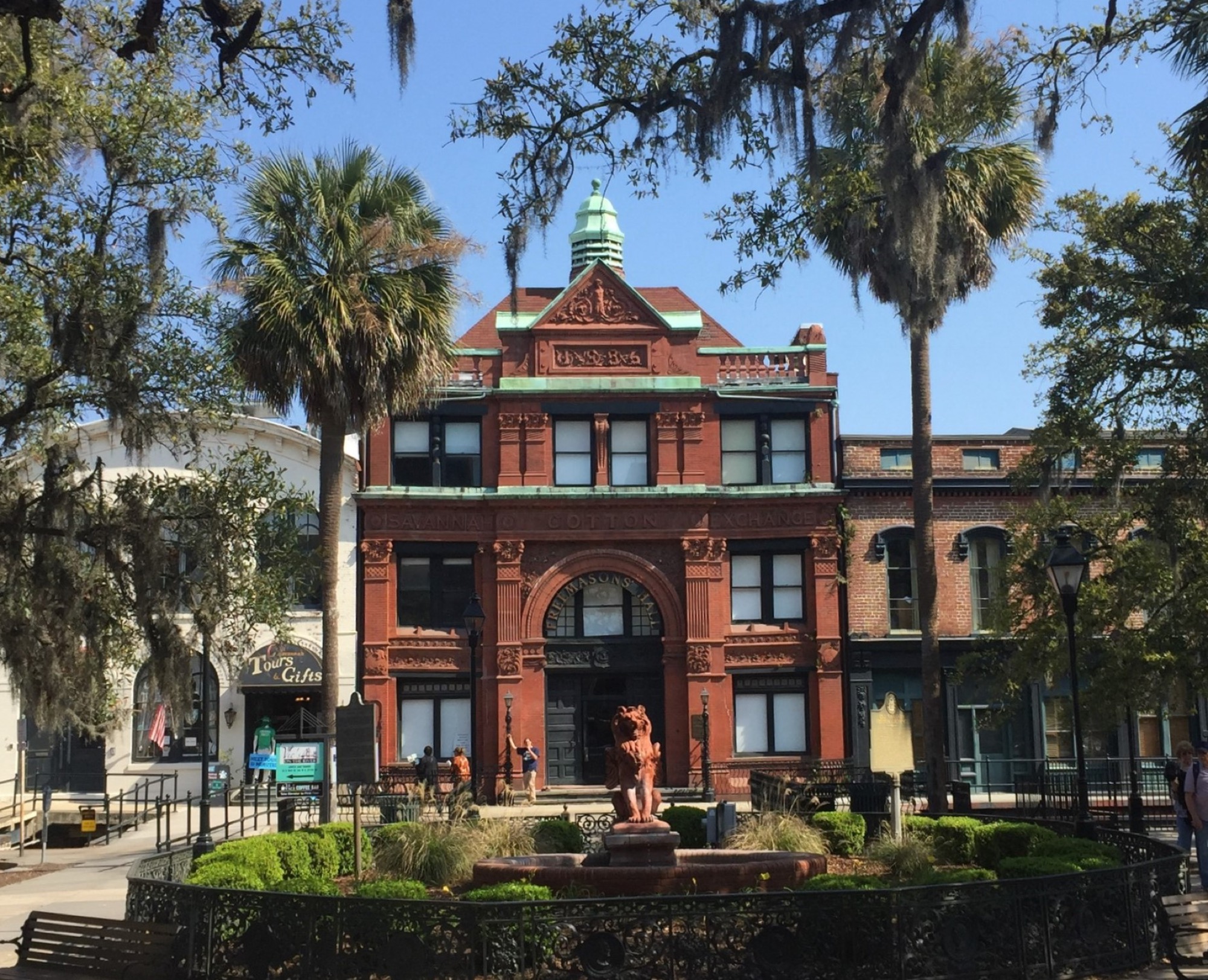
The Savannah Cotton Exchange at 100 East Bay Street stands as one of the most inventive commercial buildings of the American Gilded Age. Completed in 1887 to designs by Boston architect William Gibbons Preston (1842–1910), the structure won a competition that attracted eleven entrants, as documented in the Historic American Buildings Survey (HABS GA-1194) at the Library of Congress. Preston, a Harvard graduate and École des Beaux-Arts alumnus who served as first vice-president of the American Institute of Architects, was already renowned for his Richardsonian Romanesque work in New England. His Savannah commission introduced the bold Romanesque Revival vocabulary to the city, employing richly textured red brick, elaborate terra cotta panels, a steep triangular gable, and copper-clad ventilator finials. The Society of Architectural Historians’ SAH Archipedia entry describes the design as exhibiting “stout classical proportions, bold reddish color brick and terra-cotta details.” The building’s most remarkable engineering feat is its construction entirely over the Drayton Street ramp: cast-iron columns carry the 9,300-square-foot structure above the roadway, allowing cotton wagons to pass directly beneath to the river wharves below. The interior trading hall retains its original thirty-foot ceilings, elaborate hand-carved woodwork, a traders’ balcony, and what has been called the largest stained-glass window made for a commercial building of its era, prominently inscribed with the word “Cotton.” Bas-relief terra cotta globes at the building’s outer edges proclaim the worldwide reach of Savannah’s cotton trade. Rated “Exceptional” by the Historic Savannah Foundation Survey, the Exchange was listed on the National Register of Historic Places (NRIS 66000277) as part of the Savannah Historic District designated in 1966. Solomon’s Masonic Lodge No. 1 has occupied the building since 1976, preserving Preston’s masterwork largely intact.
The decorative program of the Savannah Cotton Exchange constitutes one of the most elaborate artistic ensembles on any American commercial building of the 1880s. Preston employed terra cotta as his primary ornamental medium, wrapping the red brick facade in panels depicting cotton bolls, botanical motifs, and bas-relief globes that symbolized the international scope of Savannah’s cotton trade. The SAH Archipedia notes these “bas-relief representations of the world at the building’s outer edges declare the scope of the city’s cotton trade.” The building’s most celebrated sculptural element is the terra cotta Winged Lion Fountain, installed in 1889 and also designed by Preston. Standing approximately five feet two inches tall on a five-foot-six-inch base, the seated griffin gazes outward over a brick basin, a single stream of water issuing from its mouth. The figure may reference the winged Lion of Saint Mark, the ancient symbol of Venice—one of history’s great trading centers—thereby linking Savannah’s cotton commerce to a centuries-old mercantile tradition. Surrounding the fountain is an ornamental cast-iron fence bearing medallion portraits of notable statesmen and literary figures, originally installed at the Barclay-Wetter House before being relocated to the Exchange grounds. Inside, the trading hall’s colossal stained-glass window dominates the main hall, its panes spelling out “COTTON” in ornate lettering above the view of the Savannah River. Hand-carved woodwork, elaborate iron balcony railings, and Romanesque arched detailing complete an interior that the Georgia Historical Society has recognized as one of the state’s finest surviving Victorian commercial interiors.
The Savannah Cotton Exchange occupies a commanding position atop the Yamacraw Bluff, the same high ground where James Edward Oglethorpe founded the Georgia colony in 1733. Thomas D. Wilson’s study The Oglethorpe Plan: Enlightenment Design in Savannah and Beyond (University of Virginia Press, 2012) describes how the original ward system—a grid of repeating squares measuring roughly 600 by 540 feet—organized civic and commercial life around central open spaces. By the nineteenth century the bluff’s northern edge had become the epicenter of Savannah’s cotton economy. Factor’s Row, a collection of multi-story red brick warehouses, lined the slope between Bay Street at the bluff’s crest and River Street forty feet below at the waterline. Cotton factors maintained their offices on the upper floors facing Bay Street, while bales were stored in the lower levels for direct loading onto vessels. The connecting walkways and iron bridges known as Factor’s Walk, built above the ballast-stone retaining wall constructed by stonemason Michael Cash beginning in 1854, provided a covered passage between the offices and the wharves. The Cotton Exchange building itself was positioned so that Drayton Street’s ramp could pass directly beneath it, funneling wagon traffic down the bluff to the docks. Walter J. Fraser Jr.’s Savannah in the Old South (University of Georgia Press, 2003) documents how this compact geography—bluff, warehouses, exchange, and river—constituted an integrated commercial system linking the Georgia interior to Atlantic and European markets.
The Savannah Cotton Exchange was organized in 1872 by a consortium of local cotton financiers and formally incorporated in 1876, though it did not occupy its iconic building until 1887. Its founding reflected Savannah’s remarkable post-Civil War recovery: by the late 1870s, cotton shipments had returned to antebellum levels, and Savannah ranked first among Atlantic cotton seaports and second in the world, with over two million bales passing through its docks annually. The city’s cotton heritage reached back to 1793, when Eli Whitney, a guest at Catharine Greene’s Mulberry Grove plantation near Savannah, devised his cotton gin—a machine that could process fifty pounds of upland cotton daily, as documented by the New Georgia Encyclopedia. Whitney’s invention transformed short-staple upland cotton into a profitable crop, and Georgia’s cotton acreage expanded explosively through the antebellum decades. Harold D. Woodman’s King Cotton and His Retainers: Financing and Marketing the Cotton Crop of the South, 1800–1925 (University Press of Kentucky, 1968) describes how factors based in seaport cities like Savannah served as “royal retainers, providing important services to the throne” rather than exploitative middlemen. The Exchange gave these factors an institutional home where cotton grades could be standardized and disputes arbitrated. By the century’s end, however, factorage was declining as railroads enabled planters to sell at interior markets. The boll weevil’s arrival in Georgia in 1915 devastated cotton production, reducing acreage from a peak of 5.2 million in 1914 to 2.6 million by 1923. The Savannah Cotton Exchange ceased operations in 1951, its functions superseded by the futures markets of the New York Cotton Exchange and by federal classification under the USDA’s Universal Cotton Standards, established in 1923.
The Savannah Cotton Exchange handled two fundamentally different varieties of cotton. Sea Island cotton (Gossypium barbadense), cultivated on Georgia’s coastal barrier islands, produced a long-staple fiber of 1.5 to 2.5 inches with a silky texture prized for fine-count textiles and silk blends. As the Dataw Historic Foundation’s research on Sea Island cotton (1790–1920) documents, this premium variety commanded prices roughly double those of upland cotton. Upland cotton (Gossypium hirsutum), the crop transformed by Whitney’s gin, had a shorter, coarser staple suited to bulk fabrics but was far more productive in volume. The factoring system dominated Savannah’s cotton commerce. As Woodman explains in King Cotton and His Retainers (1968), factors received cotton on consignment, stored it in the bluff warehouses, and sold it at the optimal moment, earning a standard commission of 2.5 percent. They also supplied planters with provisions, tools, and clothing on credit at 8 percent annual interest, effectively serving as bankers to the plantation economy. Cotton prices set at Savannah influenced and were influenced by the New York Cotton Exchange, founded in 1870 to develop the cotton futures market, as Kenneth J. Lipartito and Joseph A. Pratt discuss in their studies of commodity exchange development. Beyond cotton, Savannah was the world’s largest market for naval stores. From the 1890s through World War II, turpentine and rosin extracted from Georgia’s longleaf pine forests were shipped in vast quantities from Savannah’s docks, and the port continued to set the world price of naval stores until 1950.
Images will be added as the project develops. Photographs by Larry Ng and from research sources.