São Paulo Coffee Exchange
São Paulo, Brazil · Established 1917
This site requires authorization to access.
To request access, contact
william.goetzmann@yale.edu
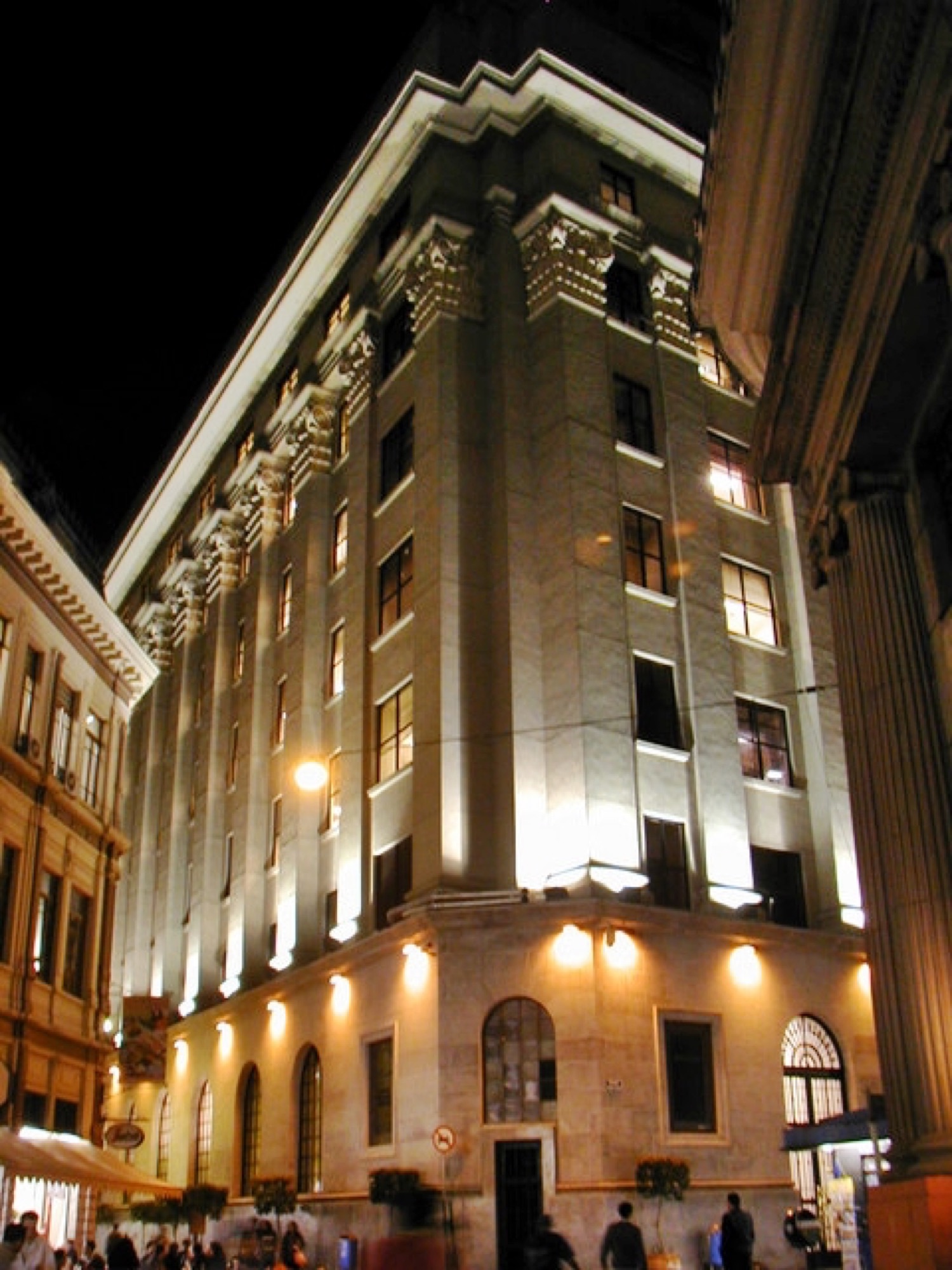
The Palácio da Bolsa Oficial de Café, located at Rua Quinze de Novembro 95 in the historic center of Santos, was designed by the French architects Jules Mosbeux and Ernest Chaneux, with construction executed between 1920 and 1922 by the Companhia Construtora de Santos, the pioneering civil engineering firm founded by Roberto Simonsen, later celebrated as the patron of Brazilian industry. As documented in the architectural survey hosted by the Universidade de São Paulo’s Arquitetura Italiana research project (IAU-USP, 2020), the building exemplifies eclectic architecture with pronounced neo-baroque influences, its facades featuring a base of red granite enriched with sculptural elements, broken pediments, and volutes that evoke Italian Renaissance composition. The structure covers approximately 6,000 square meters and contains more than 200 doors and windows, crowned by copper cupolas and a forty-meter clock tower that became a defining landmark of the Santos waterfront. Construction employed reinforced concrete with ceramic brick walls, iron structural elements, ceramic tile roofing, and the distinctive copper dome. The palace was inaugurated on September 7, 1922, timed to coincide with the centenary of Brazilian independence, and the ceremony concluded the commemorative events in São Paulo state under Governor Washington Luís. Approximately 250 workers, many of Italian origin or descent, contributed to the project, reflecting the immigrant labor force that transformed the Santos cityscape. After the exchange ceased operations in the 1970s, the building fell into disrepair until architect Samuel Kruschin of Oficina R was selected to lead a comprehensive restoration beginning in 1997. The palace reopened in 1998 as the Museu do Café, and in 2009 it was listed by IPHAN (Instituto do Patrimônio Histórico e Artístico Nacional) as a national heritage site—the first eclectic-style building in Brazil to receive this federal designation. It also holds state-level protection from CONDEPHAAT and municipal protection from CONDEPASA.
The artistic program of the Bolsa Oficial de Café represents one of the most ambitious decorative ensembles in early twentieth-century Brazilian civic architecture. The centerpiece of the main trading hall is a monumental oil painting by Benedicto Calixto de Jesus (1853–1927), titled A Fundação de Santos, which occupies an entire wall of the Sala do Pregão and depicts the legendary founding of the port city. Two additional large canvases by Calixto portray Santos in 1822 and 1922, bracketing the century of independence. As described in the Google Arts and Culture exhibition on Calixto’s “Progress Discourse and Paulista Identity” (Museu do Café, 2020), these paintings constructed a visual narrative linking the coffee elite to the pioneering bandeirantes as builders of a nation led by São Paulo. The ceiling of the trading hall features an extraordinary stained-glass composition titled A Epopeia dos Bandeirantes, designed by Calixto and fabricated by the Casa Conrado studio in São Paulo, one of Brazil’s earliest stained-glass workshops. This work, among the first stained-glass artworks with a distinctly Brazilian theme, represents three cycles of Paulista history: the conquest of the sertão by the bandeirantes, the development of agriculture, and the rise of trade and industry, with allegorical figures and symbolic pennants celebrating coffee, the port, and regional prosperity. The building’s sculptural program was executed by the Belgian sculptor Adrien Henri Vital van Emelen (1868–1943) and the Italian sculptor Antonio Sartorio. Van Emelen, who emigrated to Brazil in 1920 at the invitation of the abbot of the São Bento monastery, was commissioned in May 1922 by Roberto Simonsen to carve four monumental figures, each 4.5 meters in height, positioned atop the clock tower at over forty meters, facing the cardinal directions (Patrimônio Belga no Brasil, “Estátuas da Bolsa de Café,” 2020). The decorative gesso elements throughout the interior were executed by the Sociedade Artes Decorativas, the polychromatic marble flooring by the Marmorarias Carrara Tomagnini, and the iron gates and grilles by the firms of Irmãos Moneta and Frederico Puccinelli.
Santos emerged as the world’s preeminent coffee port in the final decades of the nineteenth century, overtaking Rio de Janeiro in the 1890s as the primary conduit for Brazilian coffee exports. As César Honorato and Luiz Cláudio Ribeiro document in their chapter “The Emergence of Santos as a Coffee Port, 1869–1914” in Atlantic Ports and the First Globalisation (Palgrave Macmillan, 2014), the port’s transformation was inseparable from the capitalist modernization of coffee production, railroads, and port operations in São Paulo state. British-engineered railways connecting the highland coffee fazendas to the coast, beginning with the São Paulo Railway in the 1860s, funneled production through Santos, where the Companhia Docas de Santos had begun modernizing the harbor in 1890, replacing unstable wooden piers with a modern linear quay first used in 1892. By 1900, Santos handled more coffee exports than any other port in the world, and by 1913 approximately 42 percent of the city’s population was foreign-born, drawn by the commercial opportunities of the coffee trade. The Bolsa Oficial de Café occupied a central position on Rua Quinze de Novembro, the main commercial artery of Santos’s historic center, surrounded by the offices of the 152 distinct export houses that operated between 1893 and 1913, along with banking institutions, brokerage firms, and the vast coffee warehouses that lined the port district. The construction of the Palácio da Bolsa in this district was itself an assertion of Paulista commercial supremacy, its copper domes and forty-meter clock tower visible from the harbor and serving as an architectural counterpart to the port infrastructure that made Santos the gateway to the global coffee market.
The Bolsa Oficial de Café was established in 1914 as an autonomous entity linked to the São Paulo state Secretariat of Finance, created to regulate coffee commerce in the Santos marketplace by establishing daily quotations for sales and forward operations. It began effective operations in 1917 alongside the Câmara Sindical dos Corretores de Café (Coffee Brokers’ Syndical Chamber), initially housed in a small office on Rua XV de Novembro. As Steven Topik demonstrates in The Political Economy of the Brazilian State, 1889–1930 (University of Texas Press, 1987), the institution was a product of the interventionist posture of the São Paulo state government during the Old Republic, when the coffee oligarchy wielded disproportionate political influence. The exchange’s creation followed the landmark Taubaté Convention of 1906, in which the governors of São Paulo, Minas Gerais, and Rio de Janeiro agreed to the first coffee valorization scheme—a program of government purchases of surplus coffee to support prices—analyzed in Thomas H. Holloway’s The Brazilian Coffee Valorization of 1906: Regional Politics and Economic Dependence (State Historical Society of Wisconsin, 1975) and earlier by Lincoln Hutchinson in “Coffee ‘Valorization’ in Brazil” (Quarterly Journal of Economics, 1909). Mauricio Font’s Coffee, Contention, and Change in the Making of Modern Brazil (Basil Blackwell, 1990) challenged the established view that the São Paulo coffee planters unilaterally dominated state politics, revealing instead a more contested terrain of elite interests. The exchange moved into its purpose-built palace in 1922 and functioned as the central institution for Brazilian coffee pricing until the 1950s, when the era of active trading sessions in the Sala do Pregão came to a close. The institution gradually curtailed its activities through the 1960s and was formally dissolved by the state governor in April 1986. After the building’s restoration, the Museu do Café opened in 1998 to preserve the history of the coffee trade and its central role in Brazilian economic development.
The Bolsa Oficial de Café served as the primary price-setting institution for Brazilian coffee, which by the early twentieth century accounted for roughly three-quarters of global supply. As Robert Bates documents in Open-Economy Politics: The Political Economy of the World Coffee Trade (Princeton University Press, 1997), Brazil’s dominance gave its pricing institutions outsized influence on world markets. Trading took place in the Sala do Pregão (auction hall), where 81 chairs of fine imbuia and jacaranda wood were arranged in a circular layout reflecting the hierarchy of the exchange: eleven principal seats for the president and secretaries at the center, with seventy surrounding positions for the official brokers (corretores). Producers and exporters observed proceedings from the mezzanine. Only official brokers, titled directly by the state after meeting stringent bureaucratic requirements and posting a cash surety, were permitted to trade on the floor; they could not serve as attorneys for any particular firm, ensuring nominal impartiality. At the close of each session, the average price of coffee transacted that day was posted on a blackboard and formalized through cash settlement, establishing the benchmark quotation for Santos coffee. The exchange also guaranteed grain quality and verified stocks, providing grading services that evaluated beans by origin, defect count, size, and cup quality. As described in William Gervase Clarence-Smith and Steven Topik’s edited volume The Global Coffee Economy in Africa, Asia, and Latin America, 1500–1989 (Cambridge University Press, 2003), Santos coffee—the trade designation for beans exported through the port—became synonymous with Brazilian arabica of reliable commercial grade. The Brazilian Official Classification system, formalized over time and eventually standardized by the federal government in 2002, had its origins in the cupping and grading practices initiated by the Bolsa beginning in 1917. Antonio Delfim Netto’s doctoral thesis O Problema do Café no Brasil (University of São Paulo, 1959) provided an influential economic analysis of the structural challenges facing Brazilian coffee pricing, including the tension between valorization programs designed to support prices and the overproduction they encouraged—a tension that contributed to the catastrophic destruction of surplus stocks during the 1930s.
Images will be added as the project develops. Photographs by Larry Ng and from research sources.