Official Coffee Exchange (Bolsa Oficial de Café / Palácio do Café)
Santos, Brazil · Established 1914 (exchange); building inaugurated 1922
This site requires authorization to access.
To request access, contact
william.goetzmann@yale.edu
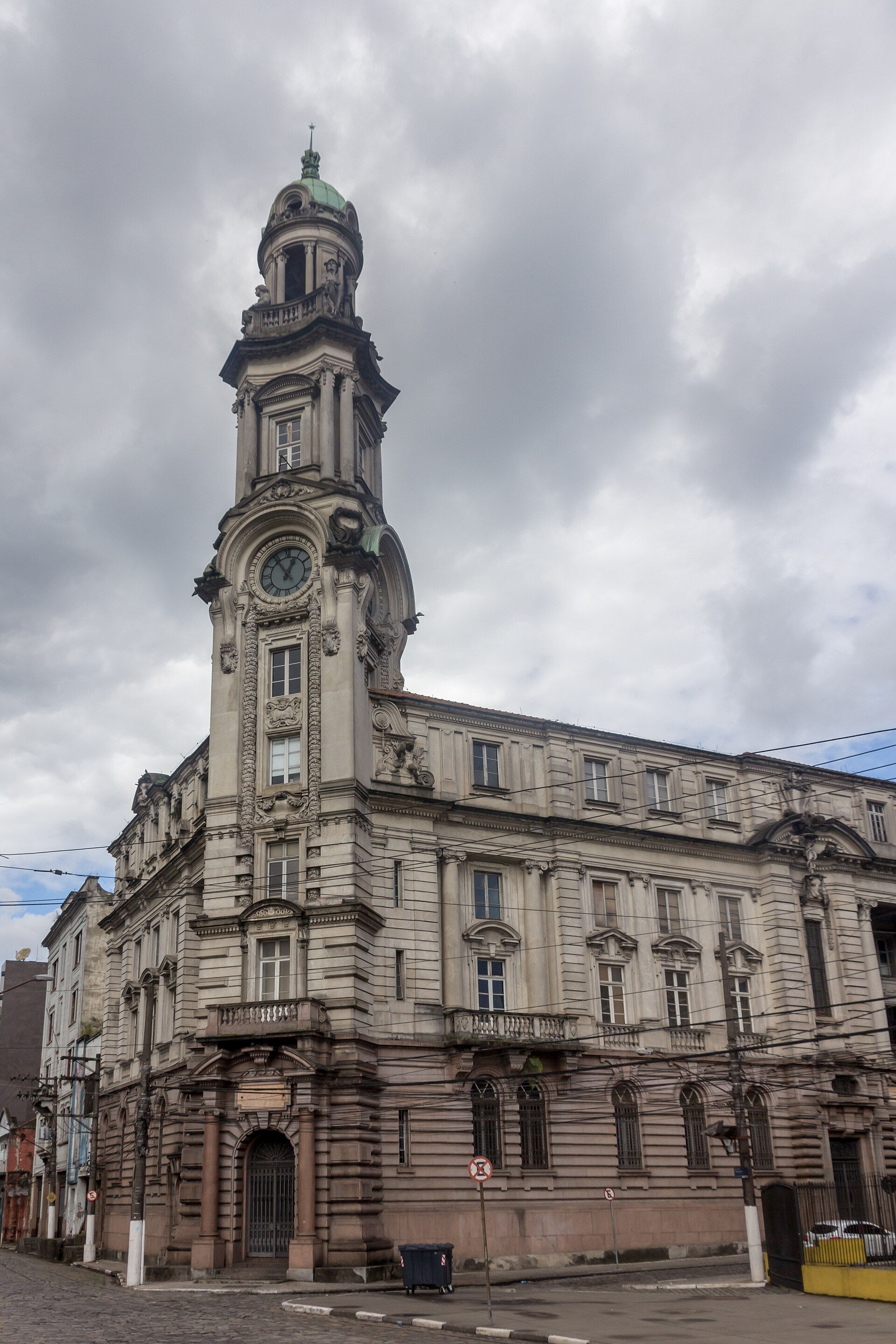
The Palácio do Café, seat of Santos's Official Coffee Exchange, was built by the Companhia Construtora de Santos -- the engineering firm of industrialist Roberto Simonsen -- between 1920 and its inauguration on 7 September 1922, deliberately timed to the centenary of Brazilian independence. The design, commissioned in 1920, is attributed to the architects Jules Mosbeux and Ernest Chaneux and executed in the exuberant Eclecticism (estilo eclético) then favoured by the coffee oligarchy, marrying Renaissance and Baroque-revival motifs with the technical ambition of a modern reinforced commercial palace. Its facades, finished in high-quality materials including granite columns, marble cladding and a profusion of stained glass, are dominated by a 40-metre clock tower roofed in copper domes that quickly became a landmark of the Santos waterfront skyline; the tower is crowned by four monumental allegorical figures, or 'genies,' carved by the Belgian sculptor Adrian Van Emelen, who emigrated to Brazil in the early 1920s expressly for such commissions (Museu da Imigração, 'Artes e ofícios: imigrantes artífices na construção do Palácio da Bolsa Oficial de Café, 1920-1922'). The building was the first example of the eclectic style to be listed (tombado) by Brazil's national heritage institute, IPHAN, registered under Process 1514-T-03 in both the Fine Arts and Historical Books in 2009-2012 (IPHAN, via ipatrimônio).
Where many exchange buildings keep their ornament to a single emblematic statue, the Palácio do Café is unusually rich in monumental art, much of it the work of immigrant craftsmen from Italy, Belgium, France, Germany and Spain who had established marble, metalworking and sculpture workshops in the booming coffee economy of São Paulo state. The dominant artistic ensemble is the painting cycle that the Santos-born artist Benedito Calixto (1853-1927) produced for the great trading hall, the Salão do Pregão: a central triptych imagining Brás Cubas reading the founding charter of the Vila de Santos, flanked by lateral panels that contrast the appearance of Santos in 1822 with the modern coffee port of 1922, together with the works 'O Porto de Santos em 1822' and 'O Porto de Santos em 1922' (museudocafe.org.br, 'Calixto'). Overhead, a stained-glass skylight executed by the Casa Conrado studio after Calixto's design celebrated the epic of the bandeirantes, integrating images of exploration, agriculture, the port and coffee into a nationalist visual programme (Museu da Imigração, 2020). The Calixto panels were extensively restored from 2012 under Prof. Márcia Rizzo after decades of humidity damage.
The exchange stands in the historic centre of Santos, on Rua Quinze de Novembro at the corner of Rua Frei Gaspar, beside Praça Visconde de Mauá, only a few hundred metres from the quays of what was then the busiest coffee-exporting harbour on earth. Santos, on the Atlantic coast of São Paulo state, served as the maritime outlet for the vast coffee plantations of the interior planalto, linked to the city of São Paulo and the fazendas by the British-built São Paulo Railway over the Serra do Mar escarpment. Siting the monumental Bolsa in the dense commercial quarter near the waterfront placed it at the literal and symbolic centre of the coffee trade, among the export houses, banks, brokerages and warehouses whose business it regulated. The building remains a defining monument of the old centre and, since the 1990s, an anchor of the district's heritage-led revitalisation as the home of the Museu do Café.
The Bolsa Oficial de Café was created by São Paulo state law no. 1.416 of 14 July 1914 to centralise, organise and supervise the trading of coffee in the world's leading coffee market, and it began operating on 28 April 1917 in rented rooms on the Rua do Comércio before moving into its purpose-built palace in 1922. Its founding belonged to a wider state strategy of intervention in the coffee economy that had begun with the price-support 'valorisation' scheme of 1906, designed to manage the chronic overproduction of Brazilian coffee (see M. Holloway, 'The Brazilian Coffee Valorization of 1906', and the standard accounts of Brazilian economic history). The exchange concentrated price formation and brokerage for Santos coffee through its public outcry sessions (pregão) until trading wound down in the mid-twentieth century; the building later passed to public ownership and, after restoration, reopened in 1998 as the Museu do Café, which now interprets the history of the bean and the institution that once governed its commerce.
What was traded here was green (unroasted) coffee, graded and priced for export -- above all the standard 'Santos' coffees whose quotation, in the decades before the New York 'C' contract of 1968, effectively set the floor price for green Arabica in world markets. Brazil in this period supplied the majority of the world's coffee, and Santos was its principal port, so that prices established in the Bolsa's trading room rippled through the global market. Business was conducted by open-outcry auction among licensed brokers in the Salão do Pregão, where samples were classified by type and quality and sales were registered under the exchange's official supervision, lending the Santos quotation the authority of a state-sanctioned benchmark. Beyond spot sales of physical coffee, the institution provided the registration, arbitration and price-publication machinery that knit together the planters of the interior, the export houses of the port and the importers of Europe and North America.
Images will be added as the project develops. Photographs by Larry Ng and from research sources.