Santiago Stock Exchange (Bolsa de Comercio de Santiago)
Santiago, Chile · Established 1893
This site requires authorization to access.
To request access, contact
william.goetzmann@yale.edu
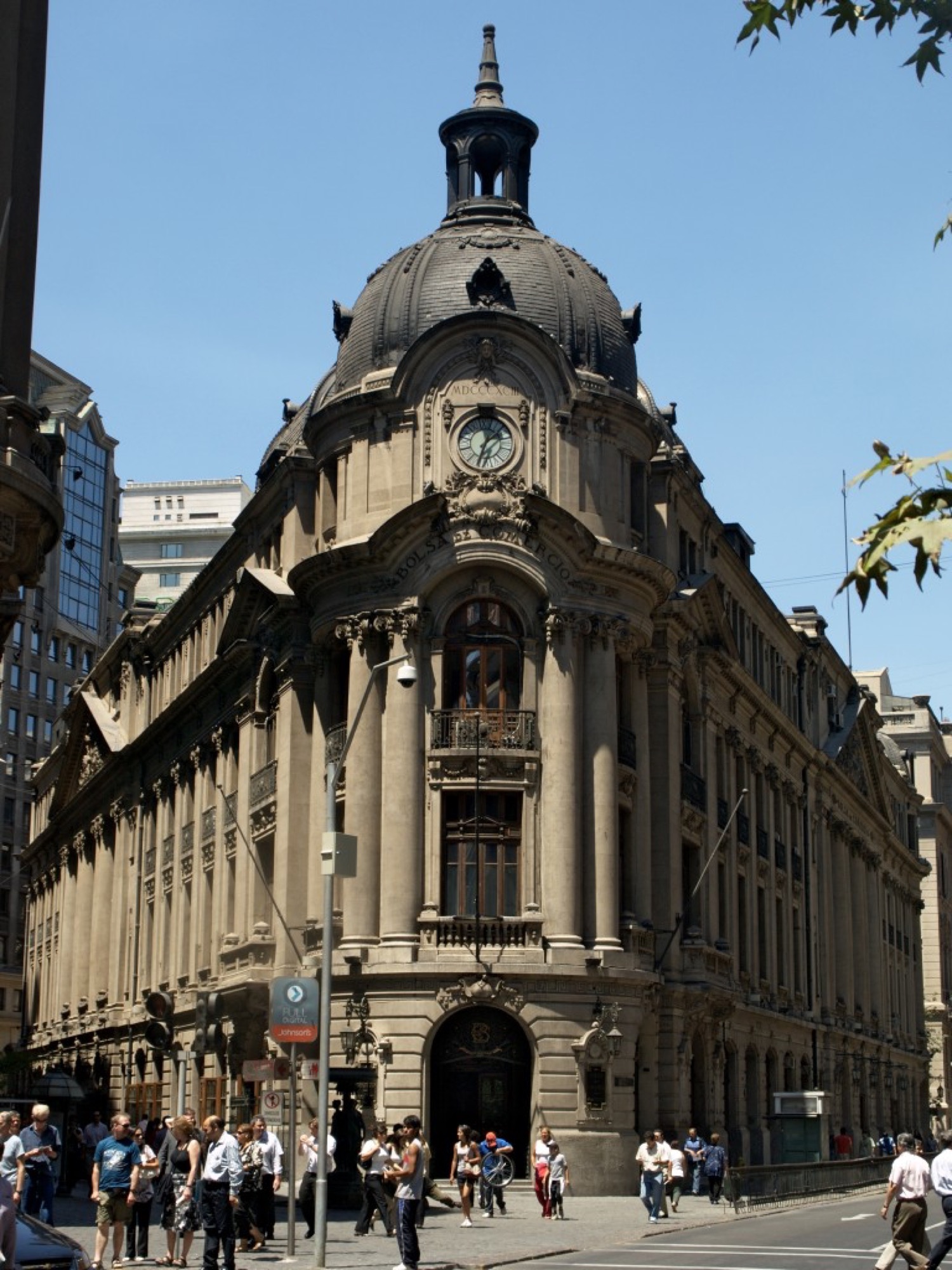
The Bolsa de Comercio de Santiago stands at the triangular intersection of Calle La Bolsa, Calle Bandera, and Calle Nueva York—three diagonal streets carved from land that belonged to the Augustinian nuns, who subdivided their convent property beginning in 1912. The architect Émile Jécquier (1866–1949), educated at the École des Beaux-Arts in Paris, won the commission after establishing his reputation with the Palacio de Bellas Artes (1905–1910) and the Palacio de los Tribunales de Justicia. Construction began in 1913 under engineer Roberto Torretti; the building was inaugurated on December 25, 1917. As the Consejo de Monumentos Nacionales records, Jécquier conceived a four-story structure in a French Renaissance vocabulary enriched by neoclassical detailing—Corinthian columns articulating the marble-clad facade, tall arched windows on the piano nobile, and rusticated stonework at ground level. The most striking feature is the protruding circular body at the corner entrance, crowned by a dome modeled on Jules Hardouin-Mansart’s chapel at the Hôtel des Invalides. As regional heritage surveys note, the Bolsa was the third metal-frame building erected in Santiago, following the Comercial Edwards building and Gath y Chaves department store—a testament to imported European iron-construction techniques during Chile’s nitrate-era boom. The ground floor is dominated by the Sala de Rueda, the circular trading hall where brokers conducted open-outcry trading. The building sustained damage in the 1985 earthquake and was subsequently restored. Declared a Monumento Histórico in 1981, with the surrounding Barrio La Bolsa designated a Zona Típica in 1989, recognizing what Simon Collier and William Sater, in A History of Chile, 1808–2002 (Cambridge University Press, 2004), describe as the city’s premier financial quarter.
The decorative program of the Bolsa de Comercio synthesizes French academic classicism with allegories of Chilean productive labor. The centerpiece of the Sala de Rueda is a monumental oil-on-canvas mural by Pedro Subercaseaux Errázuriz (1880–1956), the Chilean painter trained at the Académie Julian in Paris. Measuring 6.9 by 5.5 meters, the painting presents an alegoría al trabajo—an allegory of labor—depicting sailboats, yoked oxen, and white-robed female figures personifying industry, agriculture, and maritime commerce, the three pillars of the Chilean export economy at the 1917 inauguration. Subercaseaux, whom the Biblioteca Nacional identifies as “el pintor de la historia de Chile,” was already renowned for monumental canvases of national historical scenes. A twentieth-century restoration led by conservator Alexander Stempel confirmed the exceptional quality of Subercaseaux’s technique. Beyond the mural, Jécquier’s architectural ornament establishes a classical vocabulary of Corinthian capitals, dentil cornices, and acanthus-scroll moldings consistent with his Beaux-Arts training. The dome’s interior, illuminated by its glazed cupola, bathes the trading floor in natural light—a deliberate choice linking the transparency of the physical space to idealized market transparency. As William Goetzmann argues in Money Changes Everything (Princeton University Press, 2016), the architectural theatricality of exchange buildings served to legitimize financial activity by associating it with the grandeur of state and religious architecture. Jécquier’s Bolsa, with its Invalides-inspired dome and allegorical painting program, exemplifies precisely this function.
The Bolsa de Comercio occupies a distinctive triangular block approximately four blocks south of the Plaza de Armas—the colonial grid’s founding square, laid out by Pedro de Valdivia in 1541. The immediate surroundings form the Barrio La Bolsa, a cluster of diagonal streets that break dramatically with the orthogonal colonial plan, the result of the 1912 Augustinian convent subdivision that introduced oblique sight-lines more evocative of a Parisian passage than a Latin American grid city. As the Consejo de Monumentos Nacionales documents, the barrio developed rapidly after the Bolsa’s 1917 inauguration: Alberto Cruz Montt’s Palacio Ariztía (1921, regarded as Santiago’s first skyscraper), the La Mundial insurance building (1923), and the Club de la Unión (1925) created a homogeneous ensemble of French-influenced commercial architecture. Two blocks south lies the Barrio Cívico, redesigned between 1929 and 1932 by the Viennese urban planner Karl Heinrich Brunner around the Palacio de La Moneda—the former royal mint built by Joaquín Toesca in 1784, repurposed as the presidential palace from 1848. Brunner’s plan, described in Karl Brunner en Chile: Urbanismo Revisitado (Universidad de Chile, 2015), established an axis of governmental authority that the Bolsa’s financial quarter complemented. By the late twentieth century, Santiago’s primary financial center migrated eastward to “Sanhattan”—the high-rise district in Las Condes and Providencia. Chile’s reputation as South America’s most stable economy, examined by Sebastián Edwards in The Chile Project (Princeton University Press, 2023), owes much to the institutional framework anchored in this civic-financial corridor.
The Bolsa de Comercio de Santiago was founded on November 27, 1893, during Chile’s nitrate boom—the period when, as Markos Mamalakis demonstrates in The Growth and Structure of the Chilean Economy (Yale University Press, 1976), export duties on saltpeter provided roughly half of government revenue. The exchange initially listed approximately 320 corporations, mostly mining ventures. The 1929 crash struck Chile with devastating force; the League of Nations identified Chile as the nation worst affected, with exports plummeting from $279 million in 1929 to $35 million by 1932, and nitrate production falling to twelve percent of its 1929 peak. The election of Salvador Allende in 1970 brought a socialist program including unanimous congressional ratification of copper nationalization on July 11, 1971—analyzed by Sebastián Edwards in his NBER working paper on copper nationalization—which, combined with price controls and land reform, caused private investment to collapse. Following the 1973 military coup, the “Chicago Boys”—Chilean economists trained at the University of Chicago under Milton Friedman and Arnold Harberger—implemented sweeping neoliberal reforms, as Ricardo Ffrench-Davis documents in Economic Reforms in Chile (Palgrave Macmillan, 2010). In 1981, Labor Minister José Piñera created the AFP pension system, mandating workers invest ten percent of wages in privately managed accounts—a reform channeling enormous capital pools into the Santiago exchange. Francisco González and Mounu Prem, in “Privatization and Business Groups” (Explorations in Economic History, 2020), show the privatization process simultaneously created new business conglomerates dominating listings for decades. The Bolsa today lists over 200 domestic issuers with market capitalization approaching $200 billion.
From its 1893 founding, the Bolsa’s listings mirrored the successive commodity cycles defining Chilean economic history. The original securities were overwhelmingly mining ventures tied to the nitrate industry: as Collier and Sater note in A History of Chile (Cambridge, 2004), saltpeter alone accounted for over seventy percent of exports by 1913. The collapse of the synthetic-nitrate-vulnerable industry after 1929 gave way to copper dominance—today Chile produces approximately twenty-eight percent of the world’s copper. The state copper giant Codelco does not trade on the Bolsa (wholly state-owned), but Antofagasta plc, Sociedad Química y Minera de Chile (SQM, now a major lithium producer), and numerous mid-tier miners provide substantial resource-sector capitalization. Beyond mining, modern listings reflect Chile’s diversified export economy: Empresas CMPC (forestry and pulp), Empresas Copec (forestry, energy, fisheries), and Viña Concha y Toro—the world’s largest exporter of South American wine, the first winery to list on the NYSE. The banking sector, led by Banco de Chile, Banco Santander Chile, and BCI, constitutes the exchange’s largest sector by capitalization. Perhaps most distinctive is the AFP pension system’s influence: as José Piñera documented in “Empowering Workers” (Cato Journal, 1995), the mandatory private pension accounts created a permanent domestic institutional investor base with assets exceeding $150 billion, channeled into equities, government bonds, corporate debt, and infrastructure instruments—the engine that transformed the Bolsa from a commodity-speculation venue into a modern, institutionally driven capital market.
Images will be added as the project develops. Photographs by Larry Ng and from research sources.