National Stock Exchange
San José, Costa Rica · Established 1976
This site requires authorization to access.
To request access, contact
william.goetzmann@yale.edu
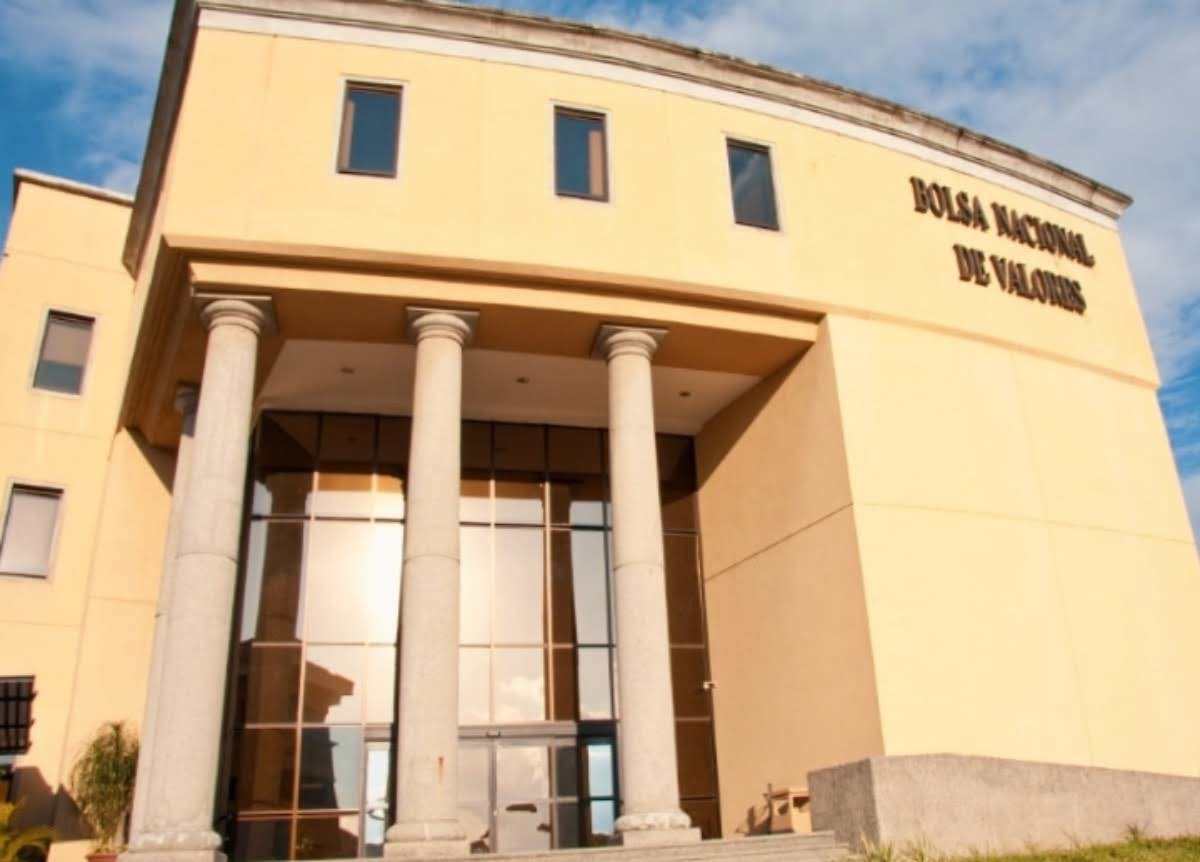
The Bolsa Nacional de Valores (BNV) of Costa Rica has occupied several physical premises over its five decades of operation. Its earliest sessions, beginning on August 19, 1976, were conducted in modest institutional quarters in downtown San José, reflecting the utilitarian architectural sensibility that characterized much of Central American public-sector construction during the import-substitution era. As the exchange matured, it relocated to purpose-built office space, and its current headquarters sit within the Parque Empresarial Forum I complex in Lindora, Santa Ana—a western suburb of the capital. Forum I, developed by Urban Partners, comprises seventeen independent low-rise office buildings connected by landscaped gardens, artificial lakes, and pedestrian promenades across some 23,000 square meters. As noted in project documentation by Grupo Do It Costa Rica, the campus is “distinguished by its elegant colonial architecture,” a stylistic choice that sets it apart from Forum II’s adjacent high-tech contemporary towers designed by Lacayo Arquitectos. The BNV’s quarters within this complex feature the redundant power systems, fiber-optic connectivity, and controlled-access security infrastructure demanded by modern securities trading, yet the campus’s hacienda-inspired aesthetic—terracotta accents, colonnaded walkways, and generous courtyard plantings—evokes Costa Rica’s agrarian heritage. This architectural duality mirrors the exchange’s own trajectory from a state-directed initiative of the 1970s development era to a privately held, technology-driven marketplace operating within a landscaped corporate campus more reminiscent of Silicon Valley than of a traditional Latin American bolsa.
The decorative program of the Bolsa Nacional de Valores has historically reflected the institution’s functional priorities rather than the monumental artistic ambitions found in older Latin American exchanges. Unlike the Beaux-Arts murals and allegorical sculpture that adorn the Bolsa de Comercio in Buenos Aires or the Bolsa de Valores de São Paulo, the BNV’s spaces have been characterized by the restrained corporate modernism typical of late-twentieth-century financial offices. The Forum I campus where the exchange is now headquartered integrates visual interest through landscape architecture rather than fine art: water features, tropical plantings, and open-air corridors serve as the primary aesthetic elements. Within trading and administrative areas, digital display infrastructure—real-time price boards, electronic tickers, and data visualization screens—constitutes the dominant visual vocabulary, a pattern common to post-1990s electronic exchanges worldwide. The BNV’s institutional identity draws on Costa Rica’s broader national iconography of environmental stewardship, reflected in the exchange’s adoption of green-bond standards based on the International Capital Market Association’s Green Bond Principles, as documented by the Sustainable Stock Exchanges Initiative. The BNV’s promotional materials and digital interfaces incorporate imagery of Costa Rica’s biodiversity—a branding strategy that links financial activity to the country’s global reputation for ecological conservation. Nearby, the Banco Central de Costa Rica’s downtown headquarters houses the Pre-Columbian Gold Museum (Museo del Oro Precolombino) and the Numismatics Museum, institutions whose collections of gold figurines, colonial coinage, and early Republican banknotes provide a rich material history of monetary exchange in the isthmus—artifacts that contextualize the BNV’s modern role within a millennia-long tradition of value transfer in Costa Rican territory.
The Bolsa Nacional de Valores’ current location in the Parque Empresarial Forum I complex in Santa Ana reflects a broader pattern of corporate decentralization from San José’s historic core. The traditional financial district occupies the casco central—the downtown districts of El Carmen, Merced, Hospital, and Catedral—where the Banco Central de Costa Rica, the Banco Nacional (whose 22-story tower, completed in 1982, was once the country’s tallest building), and government ministries cluster around the Plaza de la Cultura. Paseo Colón, the city’s principal east-west thoroughfare extending 2.5 kilometers from downtown to Parque La Sabana, served for decades as San José’s commercial spine, lined with mid-century offices and retail establishments. Beginning in the 2000s, however, multinational corporations and financial-services firms migrated westward along the Route 27 highway corridor to Santa Ana and Escazú, drawn by modern Class A office parks, proximity to Juan Santamaría International Airport (eleven kilometers away), and the suburban amenities described by the Council on Tall Buildings and Urban Habitat in its coverage of the Torres Paseo Colón development. The BNV’s move to Forum I placed the exchange within what urban planners and real estate analysts have termed San José’s “Golden Mile”—a corridor of gated communities, international schools, and corporate campuses. As the Costa Rican Investment Promotion Agency (CINDE) has documented, Forum II adjacent to Forum I operates as a designated Free Trade Zone hosting technology and shared-services firms. This westward shift has created a polycentric metropolitan geography in which the BNV sits at the nexus of Costa Rica’s emerging knowledge economy rather than its historical commercial center.
The founding of the Bolsa Nacional de Valores is inseparable from Costa Rica’s distinctive path of state-led development. In September 1970, a group of businesspeople organized through the Cámara Nacional de Finanzas, Inversiones y Crédito (CANAFIC) established the exchange as a corporate entity, but the project stalled for lack of capital and infrastructure. In 1974, the Corporación Costarricense de Desarrollo (CODESA)—a state development corporation created during José Figueres Ferrer’s third presidency to advance import-substitution industrialization—acquired all outstanding shares and contracted advisory services from the Organization of American States to conduct feasibility studies. The exchange held its first trading session on August 19, 1976, executing a transaction of ¢225,000, and was officially inaugurated on September 29 of that year. As Lecuona and Momayezi document in “Privatization in Costa Rica: Political and Economic Impact” (International Journal on World Peace, 2001), CODESA’s expansion of the state’s role from regulator to producer proved financially unsustainable. The 1980s debt crisis devastated Costa Rica’s economy—inflation reached 109 percent in 1982, as noted in IMF retrospectives—prompting structural adjustment programs with the World Bank in 1985 and 1989. The Ley Reguladora del Mercado de Valores (Law No. 7201, 1990) created the Comisión Nacional de Valores, providing the first comprehensive regulatory framework. In 1993, under President Rafael Ángel Calderón Fournier, CODESA’s 40 percent stake was sold to private investors, completing the exchange’s transition from state enterprise to privately held institution. A sweeping reform in 1997 (Law No. 7732) established the Superintendencia General de Valores (SUGEVAL) under the Consejo Nacional de Supervisión del Sistema Financiero (CONASSIF), strengthening investor protection and market transparency. In 2018, the BNV became the first Central American exchange to join the United Nations Sustainable Stock Exchanges Initiative.
The Costa Rican securities market, as assessed by the IMF’s 2018 Financial Sector Stability Review (Country Report No. 18/80) and the OECD’s Corporate Governance in Costa Rica (2020), is heavily dominated by sovereign-debt instruments. Government issuance on the domestic market has at times exceeded 15 percent of GDP, with the Ministerio de Hacienda and the Banco Central de Costa Rica (BCCR) serving as principal issuers. Trading on the BNV encompasses government bonds in both colón and dollar denominations, Central Bank stabilization bonds (Bonos de Estabilización Monetaria), and public-institution paper. Repurchase agreements (recompras or “repos”) constitute a substantial share of daily transaction volume, functioning as the primary money-market instrument. Corporate bonds exist but represent a thin market; equity listings are even more limited—the OECD noted that with only ten listed companies, several of which experience no trading activity in a given year, the equity market lacks the size and liquidity to attract significant institutional participation. Rodrigo Bolaños Zamora’s Inter-American Development Bank report, Costa Rica: The Next Stage—Reform without Volatility (2011), characterized the country’s financial markets as “underdeveloped,” with structurally weak public finances and limited corporate financing channels. In 2007, the BNV launched the Mercado Alternativo para Acciones (MAPA), a venture-capital-oriented platform enabling small and medium enterprises to raise equity through private stock offerings—a mechanism through which, as LAVCA reported, the Parque Tec incubator’s InvertUP vehicle raised up to US$3 million from retail and institutional investors. More recently, the exchange has pioneered green-bond standards aligned with the International Capital Market Association’s Green Bond Principles; Banco Nacional de Costa Rica issued Central America’s first green bond in 2016, and in 2024 the Ministry of Finance launched a “Programa de Creadores de Mercado” (Market Makers Program) to improve sovereign-debt liquidity.
Images will be added as the project develops. Photographs by Larry Ng and from research sources.