San Francisco Stock and Bond Exchange
San Francisco, USA · Established 1882
This site requires authorization to access.
To request access, contact
william.goetzmann@yale.edu
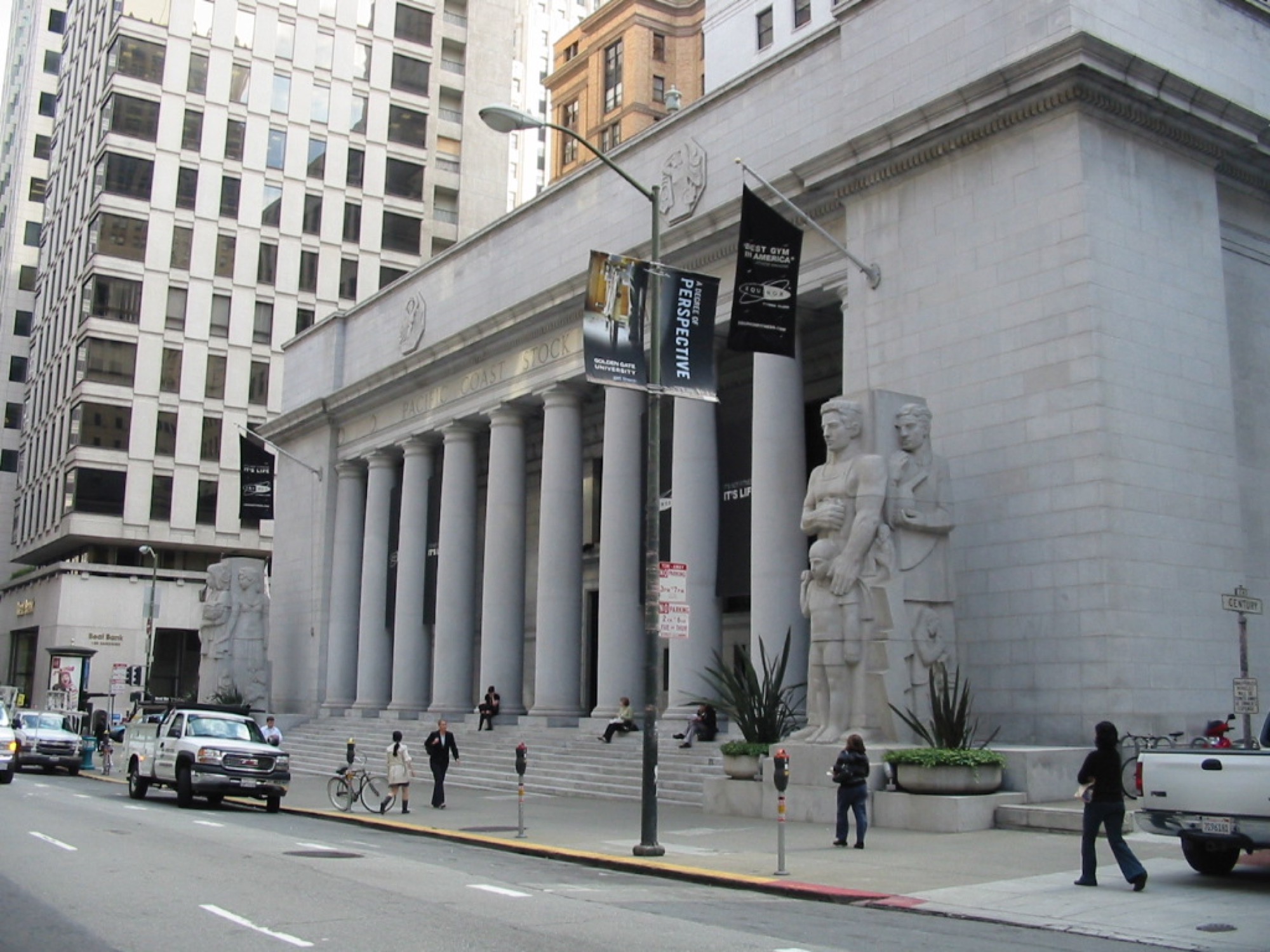
The San Francisco Stock and Bond Exchange occupied a succession of increasingly ambitious premises that tracked the city’s ascent as the financial capital of the American West. Founded in September 1882, its nineteen charter members first gathered in the basement of Wohl & Rollitz at 403 California Street, in the old Fireman’s Fund Insurance Building, before relocating to a modest room at 312 California Street where, as a 1955 retrospective published by the San Francisco Museum notes, brokers “paid $7.50 a month for the privilege of shouting bids from either side of a room.” Trading sessions, mediated by a caller seated in the center, sometimes lasted only fifteen minutes. By the early twentieth century the exchange had outgrown these improvised quarters. The 1906 earthquake and fire devastated the Financial District, destroying most commercial structures within the California–Montgomery corridor, though as Kerry A. Odell and Marc D. Weidenmier demonstrate in “Real Shock, Monetary Aftershock: The 1906 San Francisco Earthquake and the Panic of 1907” (Journal of Economic History, 2004), financial operations recovered with remarkable speed—banks reopened within six weeks and clearings soon exceeded pre-quake levels. The exchange’s definitive architectural statement came in 1930 when the firm of Miller & Pflueger—architects James Rupert Miller and Timothy Ludwig Pflueger—remodeled the former United States Sub-Treasury building at 301 Pine Street into the new San Francisco Stock Exchange trading hall. The original 1915 structure, designed by J. Milton Dyer in the neoclassical style, featured ten Tuscan columns and a granite staircase entrance. As Therese Poletti documents in Art Deco San Francisco: The Architecture of Timothy Pflueger (Princeton Architectural Press, 2008), Pflueger preserved the classical facade while innovatively inserting two Art Deco medallions inside the entablature—a deliberate modernist disruption of the conservative Tuscan order. Adjacent to the trading hall, Miller & Pflueger designed the eleven-story Stock Exchange Tower at 155 Sansome Street (1930), which housed brokerage offices and the Pacific Stock Exchange Luncheon Club on the upper floors. Interior architecture was directed by Michael Goodman, whose elevator doors featured images executed in five metals—silver, Monel, copper, bronze, and brass—by English craftsman Harry Dixon. The exchange operated at 301 Pine Street until its trading floor closed in 2002; the building was subsequently converted by Equinox Fitness, while the Stock Exchange Tower at 155 Sansome became the City Club of San Francisco. The earlier Mining Exchange building at 350 Bush Street, designed by Miller & Pflueger in the Beaux-Arts style and opened in 1923, also survives: its neoclassical terra-cotta facade—featuring fluted columns, a tympanum decorated with figures in relief, and oversized acroteria—was restored in 2018 by Gladding McBean, the firm that had cast the original ornamentation. The plaster walls and detailed ceiling of the old trading hall were replicated during the restoration, preserving a space that once held hundreds of traders, complete with a mezzanine-level catwalk and a chalkboard wall for tracking stock fluctuations.
The decorative program of the San Francisco Stock Exchange complex represents one of the most ambitious collaborations between architecture and fine art in Depression-era America. When Timothy Pflueger undertook the 1930 remodel of 301 Pine Street, he enlisted sculptor Ralph Ward Stackpole (1885–1973) to orchestrate the artistic program for both the trading hall and the adjacent Stock Exchange Tower. As Poletti recounts in Art Deco San Francisco (2008), Pflueger “did not want any of the ‘classic’ repetitive art on the exterior” and gave Stackpole broad authority over artist selection and execution. Stackpole carved two monumental sculptural groups from Yosemite granite flanking the Pine Street entrance: Mother Earth (also called Agriculture), depicting a female figure surrounded by symbols of agrarian abundance, and Man and His Inventions (also called Industry), featuring a massive nude male figure whose outstretched hands rest upon the arc of a rainbow, with smaller figures representing progressive labor. These granite groups embody the thematic polarity of the two economic forces—agriculture and industry—driving the Western economy. Inside the Stock Exchange Tower, the artistic program was equally extraordinary. Stackpole commissioned the Mexican muralist Diego Rivera (1886–1957) to create a fresco in the Luncheon Club stairwell—Rivera’s first work in the United States. As Anthony W. Lee discusses in Painting on the Left: Diego Rivera, Radical Politics, and San Francisco’s Public Murals (University of California Press, 1999), the choice provoked controversy: local newspapers questioned the “incongruity of selecting a Hispanic artist of Rivera’s leftward political leanings to create a mural in the citadel of capitalism.” Executed in buon fresco between December 1930 and March 1931, The Allegory of California occupies the two-story wall and ceiling of the open staircase between the tenth and eleventh floors. The central figure represents Calafia, the mythical Spirit of California—modeled by tennis champion Helen Wills Moody—holding underground mineral treasures in one hand and surface agricultural bounty in the other. Surrounding figures include gold discoverer James Marshall and horticulturist Luther Burbank. The upper register depicts Bay Area industries: Richmond oil refineries, Matson and Dollar shipping lines, and dredging equipment for river gold mining. Robert Boardman Howard (1896–1983) created six sculptural panels in the trading room and fashioned chrome-plated steel balusters with stylized brass figures representing a day in the life of a stockbroker for the grand staircase. His wife, sculptor Adaline Kent Howard, contributed additional decorative elements. Ruth Cravath and Clifford Wright also executed sculptural and painted works throughout the club interiors. The Jeanne Dare stone fireplace in the club café, carved in situ by Stackpole, features an archer surrounded by incised figures representing the moods of man. At the earlier Mining Exchange building at 350 Bush Street, the decorative program centered on the monumental terra-cotta tympanum above the arched entrance, cast by Gladding McBean and depicting classicized figures in relief celebrating the mining industry—a program sympathetic to the Beaux-Arts vocabulary of the 1923 facade.
The San Francisco Stock and Bond Exchange occupied a commanding position within what William Issel and Robert W. Cherny describe, in San Francisco, 1865–1932: Politics, Power, and Urban Development (University of California Press, 1986), as the undisputed financial capital of the American West. The exchange’s principal home at 301 Pine Street stood at the intersection of Pine and Sansome Streets, one block south of California Street—the corridor that earned the epithet “Wall Street of the West” for its extraordinary concentration of banking houses, brokerage firms, and insurance companies. Montgomery Street, the parallel artery one block west, had served as San Francisco’s commercial spine since the Gold Rush, when Sam Brannan famously ran down its length in May 1848 waving a jar of gold dust to announce the discovery at Sutter’s Mill. As Charles A. Fracchia documents in When the Water Came Up to Montgomery Street (2009), the original Yerba Buena Cove shoreline ran near present-day Montgomery Street; successive landfill operations between 1849 and 1852 extended buildable ground four blocks eastward, literally creating the real estate upon which the Financial District would rise. The Bank of California, founded by William Ralston in 1864 at California and Sansome Streets, anchored the district’s southern end; Wells Fargo, the Merchants Exchange, and the Pacific Mail Steamship Company offices clustered nearby, connecting commodity markets to Liverpool, Hong Kong, and Valparaíso. The 1906 earthquake devastated 490 city blocks, but as Gray Brechin argues in Imperial San Francisco: Urban Power, Earthly Ruin (University of California Press, 1999), the city’s financial elite rebuilt with extraordinary speed, reinforcing the same street grid with masonry-clad steel-frame buildings. The exchange’s evolution from a basement on California Street to the monumental Pflueger-designed complex on Pine Street mirrors the district’s physical transformation from wooden Gold Rush shanties to the granite-and-steel canyon of American western finance. The Mining Exchange at 350 Bush Street and the Merchants Exchange at 465 California Street—both within two blocks—formed a tight cluster of trading institutions that made this compact quarter the decision-making center for capital allocation across the entire mining and agricultural frontier of the trans-Mississippi West.
The institutional genealogy of the San Francisco Stock and Bond Exchange reaches back to the Comstock Lode silver discoveries of 1859, which transformed San Francisco from a Gold Rush boomtown into the financial nerve center of Western mining. As Oscar Lewis documented in Silver Kings: The Lives and Times of MacKay, Fair, Flood, and O’Brien (1947), the Comstock bonanza enriched a generation of San Francisco speculators whose names—Ralston, Sharon, Flood, Hearst, Sutro, Hopkins—became synonymous with Western wealth. On September 11, 1862, forty brokers each paid fifty dollars to establish the San Francisco Stock and Exchange Board, the first organized securities market west of the Mississippi. As the scholarly study “Corporate Finance and the San Francisco Mining Share Market, 1860–1877” (UC eScholarship) demonstrates, this market grew explosively: annual trading volume surged from $15.5 million in 1863 to a peak of $260.5 million in 1874, briefly surpassing the New York Stock Exchange during boom years. George D. Lyman’s Ralston’s Ring: California Plunders the Comstock Lode (1937) chronicles how William Ralston’s Bank of California and its agent William Sharon orchestrated a financial empire linking Virginia City silver extraction to San Francisco capital markets. Glenn A. Vent and Cynthia Birk, in “Insider Trading and Accounting Reform: The Comstock Case” (Accounting Historians Journal, 1993), detail the spectacular frauds that plagued the market—including the 1872 case in which Alvinza Hayward and J. P. Jones manipulated Savage Mine stock from $62 to $725 per share through false discovery reports—and the accounting reforms these scandals provoked. The San Francisco Stock and Bond Exchange itself was organized on September 18, 1882, when nineteen charter members met in a California Street basement and named their venture the “Local Security Board.” The first president was John Perry Jr., and first-year transactions totaled $9,490,621. In 1928, the Stock and Bond Exchange purchased the name “San Francisco Stock Exchange,” while the original 1862 exchange was renamed the San Francisco Mining Exchange. The 1906 earthquake and fire destroyed the Financial District’s physical plant, but financial operations recovered rapidly. The exchange commissioned Miller & Pflueger to create its landmark trading hall at 301 Pine Street in 1930. In January 1957, the San Francisco Stock Exchange merged with the Los Angeles Stock Exchange to form the Pacific Coast Stock Exchange—renamed the Pacific Stock Exchange in 1973—creating the second-largest regional exchange in the United States. The San Francisco Curb Exchange, which had operated out of the old Mining Exchange building at 350 Bush Street from 1928, was absorbed into the main exchange in 1938. The San Francisco trading floor at 301 Pine Street closed in 2002, and in 2005 the exchange was acquired by NYSE Arca, ending 123 years of independent Western securities trading.
The securities traded on the San Francisco exchanges evolved from speculative mining shares into a diversified roster of Western industrial and financial instruments. The original 1862 Stock and Exchange Board dealt almost exclusively in Comstock Lode mining stocks. As the UC eScholarship study of the San Francisco Mining Share Market (1860–1877) documents, principal Comstock firms—Ophir, Gould and Curry, Yellow Jacket, Savage, Consolidated Virginia—accounted for over 59 percent of observed trades through 1877. These were “assessable” shares, a distinctive corporate finance mechanism analyzed by the scholarly article “Assessable Stock and the Comstock Mining Companies” (Business History, 2023): company boards could levy additional payments on shareholders to fund ongoing mining operations, with defaulting shareholders forfeiting their stock at auction. Of 103 Comstock companies studied, only six ever paid more in dividends than they demanded in assessments; firms collectively extracted over $92 million in assessments while paying $147 million in dividends and producing $320 million in ore value between 1859 and 1882. Trading was conducted via a formal call market: daily sessions commenced with a roll-call of the full stock list, followed by ad hoc trading announcements shouted across the floor, with all transactions recorded by the secretary for newspaper publication. The 1882 Stock and Bond Exchange broadened the instrument base to include railroad bonds, municipal securities, bank shares, and the stocks of California’s emerging oil, timber, and utility companies. By 1910, the exchange’s daily quote sheets listed corporate bonds alongside equity shares in Pacific Coast enterprises. The twentieth-century Pacific Coast Stock Exchange (formed 1957) traded a full range of listed equities, and by 1956 the combined San Francisco–Los Angeles volume exceeded 38 million shares annually. The Pacific Exchange later became an important options trading venue: its options floor, operating under the Pacific Exchange brand, eventually merged with the Chicago Board Options Exchange (CBOE) in 2005. Throughout its history, the San Francisco exchange served as the primary mechanism through which Eastern and European capital was channeled into Western mining, agriculture, petroleum, and infrastructure—fulfilling the role that Gary D. Libecap, in The Evolution of Private Mineral Rights: Nevada’s Comstock Lode (Arno Press, 1978), identifies as critical to the development of Western American property rights and resource extraction.
Images will be added as the project develops. Photographs by Larry Ng and from research sources.