San Francisco Grain Exchange
San Francisco, USA · Established 1869
This site requires authorization to access.
To request access, contact
william.goetzmann@yale.edu
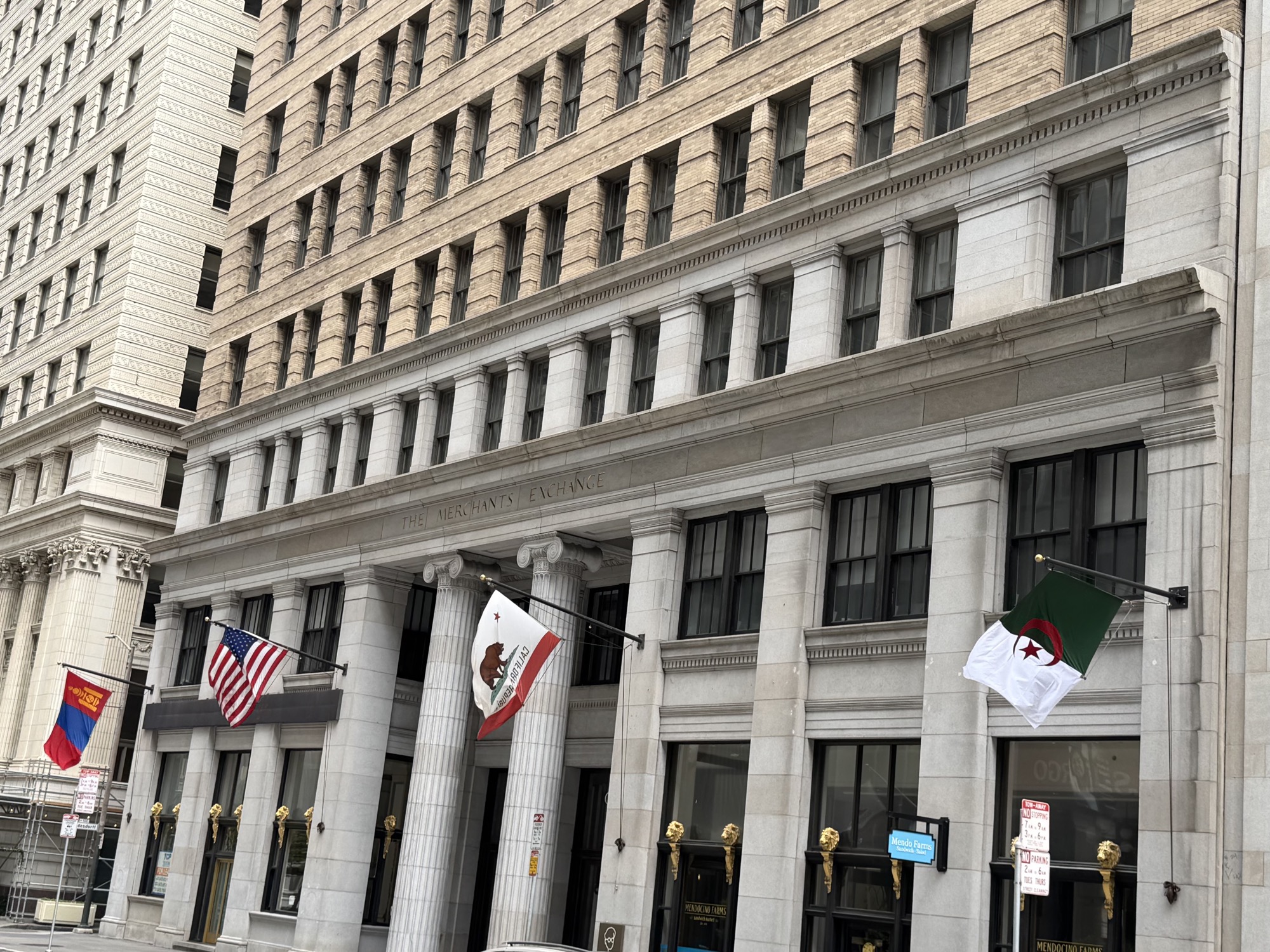
The San Francisco Grain Exchange conducted business within a succession of increasingly grand commercial structures tracing the city’s rise as the financial capital of the American West. The earliest institutional home was the original Merchants Exchange building on Battery Street, erected in 1855, featuring a rooftop lookout station from which watchmen relayed signals about arriving vessels—a practice described by Roger Lotchin in San Francisco, 1846–1856 (1974). The definitive structure was the Merchants Exchange Building at 465 California Street, designed by D.H. Burnham & Company with Willis Polk as supervising architect, completed in 1903–1904. As Michael R. Corbett documents in Splendid Survivors (1979), this fifteen-story steel-frame skyscraper sheathed in Tennessee granite rose in the Beaux-Arts style as one of San Francisco’s tallest buildings. The 1906 earthquake and conflagration gutted the interiors but left the steel skeleton standing. Polk, assisted by the young Julia Morgan, undertook reconstruction. Morgan designed the new skylit marble lobby leading to the grand Exchange Hall, featuring Ionic marble columns, a coffered ceiling, and vaulted skylights—an interior that Sara Holmes Boutelle praises in Julia Morgan, Architect (1988) as one of Morgan’s earliest masterworks. Morgan subsequently established her permanent office on the thirteenth floor. The Produce and Call Board, the San Francisco Grain Exchange, and the Chamber of Commerce all occupied space within this building, making it the nerve center of Pacific Coast commodity trading.
The decorative program of the Merchants Exchange Building’s great hall stands as one of the most significant ensembles of commercial art on the Pacific Coast, conceived to glorify the maritime trade upon which the Grain Exchange depended. When Julia Morgan redesigned the interior after 1906, she commissioned William Alexander Coulter (1849–1936), the foremost marine painter of the San Francisco Bay region, to fill the bays between the hall’s Ionic columns with monumental canvases. Between 1909 and 1920, Coulter executed five oil-on-canvas murals, each approximately sixteen by eighteen feet, depicting the sailing vessels and harbors sustaining California’s grain export economy. As Scott A. Shields notes in Artists at Continent’s End (2006), Coulter had arrived in San Francisco in 1869 and became the city’s preeminent chronicler of maritime life. The five murals depict key nodes of the Pacific grain trade: Port Costa, the great wheat-loading wharf on the Carquinez Strait; Honolulu Harbor; and three views of San Francisco Bay including the Golden Gate prior to the bridge. One canvas, “Arrived All Well,” depicting a full-rigged grain ship entering the Bay, was selected by the U.S. Post Office for a commemorative stamp in 1923. The murals served a functional as well as aesthetic purpose: they surrounded the hall where brokers negotiated grain contracts, ship charters, and insurance, immersing traders in an iconographic celebration of the very commerce they transacted. The coffered ceilings and vaulted skylights flooded natural light onto the canvases. The murals remain in situ, recognized by the California Register of Historical Resources as among the finest examples of institutional maritime art in the western United States.
The San Francisco Grain Exchange occupied a pivotal position within what William Issel and Robert W. Cherny, in San Francisco, 1865–1932 (University of California Press, 1986), describe as the financial capital of the American West. California Street served as the principal corridor of financial power, linking waterfront wharves at its eastern terminus to banks and commodity exchanges climbing toward Nob Hill. Montgomery Street earned the sobriquet “Wall Street of the West” for its extraordinary concentration of banking houses and brokerage firms. The Grain Exchange’s location at 465 California Street placed it at the intersection of these axes, within steps of the Bank of California, Wells Fargo, and Pacific Mail Steamship offices connecting commodity markets to Liverpool, Hong Kong, and Valparaíso. The Financial District itself was built upon filled land: Yerba Buena Cove’s original shoreline ran near Montgomery Street, with successive Gold Rush landfill extending buildable ground eastward. The 1906 earthquake devastated 490 city blocks and destroyed some 28,000 buildings, as Andrea Henderson Rees documents (San Francisco Chronicle, 2006). Yet the district was rebuilt with remarkable speed—largely by 1910—with masonry-clad steel-frame buildings rising along the same street grid. The Merchants Exchange Building, among the few structures whose steel skeleton survived the conflagration, became a symbol of the city’s determination to restore commercial primacy. The rapid reconstruction reinforced California Street’s role as the axis of western finance.
The origins of the San Francisco Grain Exchange lie in the explosive demand for provisions accompanying the California Gold Rush of 1848–1849. As Jim Gerber argues in “The Gold Rush Origins of California’s Wheat Economy” (América Latina en la Historia Económica, 2010), the near-simultaneous development of gold mining and grain farming defied standard models predicting agricultural collapse during mineral booms. Significant wheat production began as early as 1852, and California achieved grain self-sufficiency by 1854. The Merchants’ Exchange of San Francisco, incorporated in 1866, formalized commodity-trading infrastructure by housing the Chamber of Commerce, the Produce and Call Board, and the U.S. Hydrographic Office. Alan L. Olmstead and Paul W. Rhode, in A History of California Agriculture (Giannini Foundation, 2003), document that by the late 1870s, between one-quarter and three-quarters of all grain shipped from the U.S. to Britain originated in California. By 1888, wheat was harvested on three million acres, and California ranked second nationally. This bonanza era made San Francisco one of the world’s great grain-trading ports, with square-rigged ships loading wheat at Port Costa for Liverpool. The 1906 earthquake devastated the exchange’s home but not its function; trading resumed within two years in the rebuilt building. The twentieth century brought decline: as the Northern California Grain Exchange archival records (UC Berkeley Bancroft Library, 1904–1993) document, post-1946 construction of inland processing plants decentralized the market. In 1957, traders established the Stockton Grain Exchange closer to producing regions; within a decade the San Francisco and Stockton exchanges merged as the Northern California Grain Exchange, which disbanded in 1993.
The commodities passing through the San Francisco Grain Exchange reflected California’s transformation from Gold Rush provisioning ground to one of the world’s great granaries. Wheat dominated from the 1860s through the 1890s. As Olmstead and Rhode document (2003), California’s flat Central Valley offered few obstacles to the large headers and combined harvesters enabling vast-scale cultivation; by 1879 wheat and barley accounted for seventy-five percent of cropland. Jim Gerber confirms that by the late 1870s California supplied between one-quarter and three-quarters of American grain exports to Britain. Ships loaded at Port Costa on the Carquinez Strait carried California wheat to Liverpool, competing with Russian and Australian supplies. Barley, both for feed and for the state’s growing brewing industry, constituted the second-largest grain. Beyond staple grains, the Produce and Call Board facilitated transactions in hay, oats, and dried beans. As California agriculture diversified, the exchange expanded to encompass rice (commercial cultivation began around 1912), dried fruits and raisins from the San Joaquin Valley, wine grapes from Sonoma and Napa, and canned goods from the burgeoning fruit-packing industry. The California Fruit Growers Exchange and allied cooperatives, as Victoria Saker Woeste discusses in The Farmer’s Benevolent Trust (1998), developed alongside the grain exchange as complementary commodity-marketing institutions. The shift from grain monoculture to diversified horticulture ultimately diminished the Grain Exchange’s centrality, contributing to its mid-twentieth-century migration from San Francisco to interior agricultural regions.
Images will be added as the project develops. Photographs by Larry Ng and from research sources.