Samara Grain Exchange (Самарская хлебная биржа)
Samara, Russia · Established Exchange society chartered 1893; building completed 1898
This site requires authorization to access.
To request access, contact
william.goetzmann@yale.edu
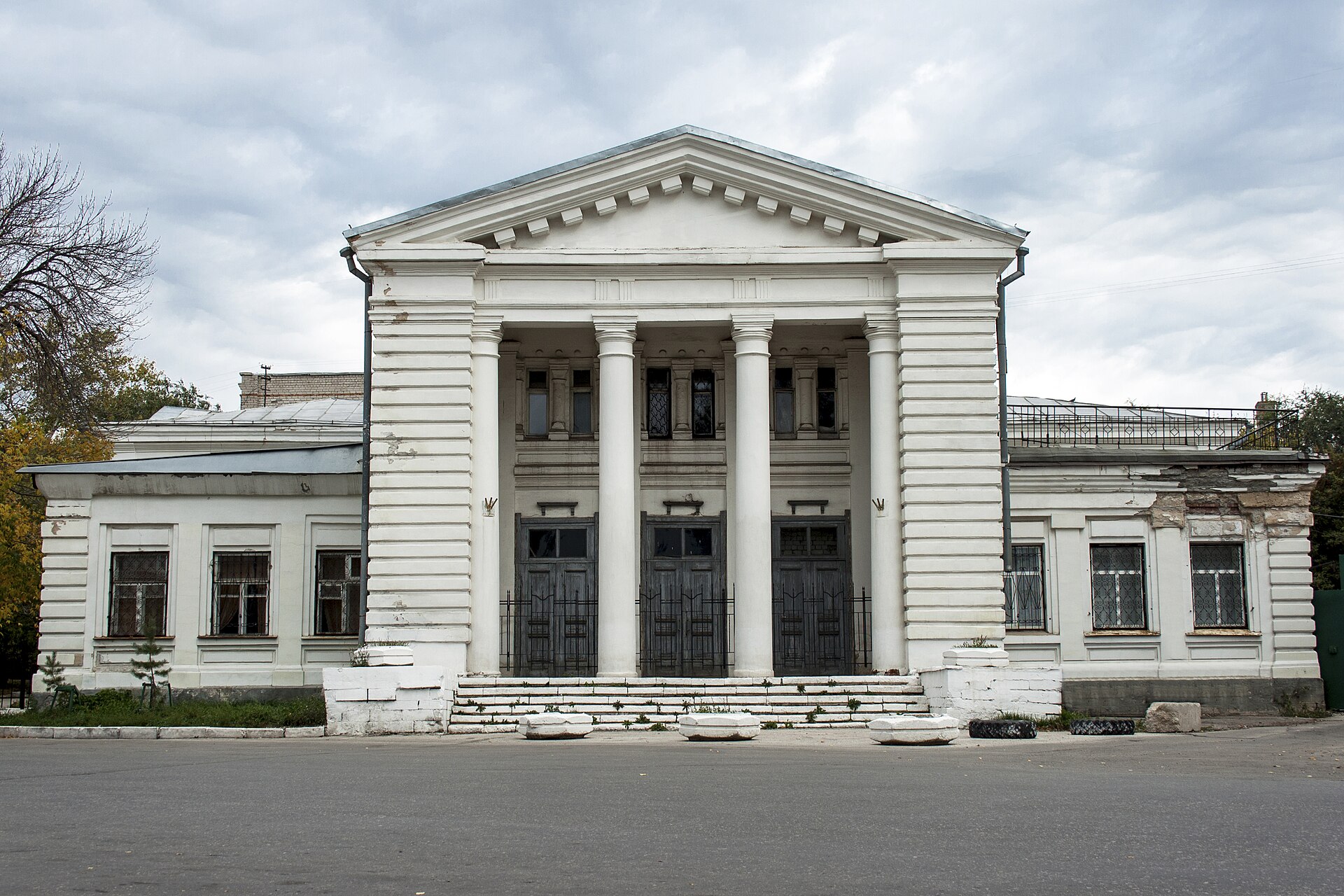
The Samara Grain Exchange occupies a two-storey brick structure on Khlebnaya (Grain) Square, erected in 1898 to designs by Alexander Alexandrovich Shcherbachev, who served as Samara's city architect from 1889 to 1899 (Samara Regional Organisation of the Union of Architects of Russia, biographical entry on A. A. Shcherbachev). Trained at the Moscow School of Painting, Sculpture and Architecture and the Imperial Academy of Arts in St Petersburg, Shcherbachev worked across a notably eclectic range — neo-Gothic for the city's Roman Catholic church, Moorish and Italian-Renaissance modes for its merchant mansions — but for the exchange he reached for the sober Russian Classicism that, in the words of the Russian-language survey of Khlebnaya Square (Russian Wikipedia, 'Хлебная площадь (Самара)'), 'expressed the official public tastes of that era.' The stuccoed facade is organised around a four-column portico over the main entrance and articulated with pilasters, a stone interior staircase, and single-storey side porches. Built at the expense of the merchants Alexander Kurlin and Pavel Shikhobalov — the same flour-milling dynasties whose fortunes the building served — it stands today at Stepana Razina Street 3a and is registered as an object of cultural heritage (reg. no. 6300092000).
The exchange is an essentially utilitarian commercial building, and its artistic interest lies less in fine art than in the restrained classical grammar of its architecture: the columnar portico, pilastered facade, and symmetrical massing that signalled probity and order to the grain merchants who met inside. This is consistent with Shcherbachev's wider Samara work, where the most overtly decorative gestures — the carved 'gingerbread' detailing of the Klodt mansion (1898) or the atlantes of the Shikhobalov house — were reserved for private residences rather than for the city's trading institutions (Samara Union of Architects, A. A. Shcherbachev). No major sculptural or painted programme is recorded for the exchange; its visual rhetoric is architectural, and its meaning is carried by the dignity of the classical order rather than by ornament.
Khlebnaya Square is the oldest square in Samara, occupying the spit of land between the Volga and its tributary the Samarka where an eighteenth-century fortress once stood (the ruins were uncovered in excavations in 2011). From the mid-nineteenth century the square became the largest grain market of the entire Volga region, and the neoclassical exchange was, as the Russian survey of the square notes, its 'architectural dominant' (Russian Wikipedia, 'Хлебная площадь (Самара)'). Around it clustered the working apparatus of the grain economy: a bread quay on the waterfront, steam flour mills, warehouses, and a vast reinforced-concrete grain elevator designed by the engineer Petrov and completed in 1916, reckoned at its opening among the largest in Europe and second in capacity in Russia. The exchange thus sat at the physical hinge between the river — by which Samara's wheat moved — and the railway hub that the Orenburg line had made of the city after 1877.
Samara's rise was built on grain. A modest fortress town of about 15,000 in 1850, it became a provincial capital that same year and, after the Orenburg Railway reached it in 1877, one of the most important transport and grain-trading centres of the Russian Empire, its population approaching 90,000 by 1900 (advantour.com, 'History of Samara'). The grain-exchange society was chartered in 1893 and the present building completed in 1898; contemporaries reckoned it among the largest grain exchanges in Russia. The institution served the merchant houses — Subbotin, Kurlin, Shikhobalov, Smirnov — who founded the local flour-milling industry and made Samara, for a time, the largest flour producer in the empire, its wheat known wherever it was exported. The exchange remained the commercial heart of the Volga wheat trade until the upheavals of the Revolution and the Soviet nationalisation of grain commerce ended private exchange dealing; its functions as a grain market for the Volga basin are said to have persisted into the 1930s before the building passed to other uses.
What changed hands on Khlebnaya Square was wheat — grain and flour from the black-earth steppe of the middle Volga and Trans-Volga, supplemented by the produce of the German colonist farms of the region. Transactions for the buying and selling of grain were concluded both on the open square and, as the Russian account records, in the nearby Revel tavern, before the chartered exchange of 1898 gave the trade a formal roof. Russia was in this period the world's dominant wheat exporter, supplying a large share of the international market on the eve of 1914 (Wikipedia, 'Russian grain exports'), and Samara was among the empire's principal sources: older estimates credit the Samara district with on the order of a tenth of imperial grain exports. From the bread quay below the exchange, grain and milled flour were loaded onto Volga shipping for movement downriver and onward to Baltic and Black Sea ports and the markets of western Europe, tying this provincial exchange directly into the global grain economy of the belle époque.
Images will be added as the project develops. Photographs by Larry Ng and from research sources.