Intermountain Stock Exchange
Salt Lake City, USA · Established 1888
This site requires authorization to access.
To request access, contact
william.goetzmann@yale.edu
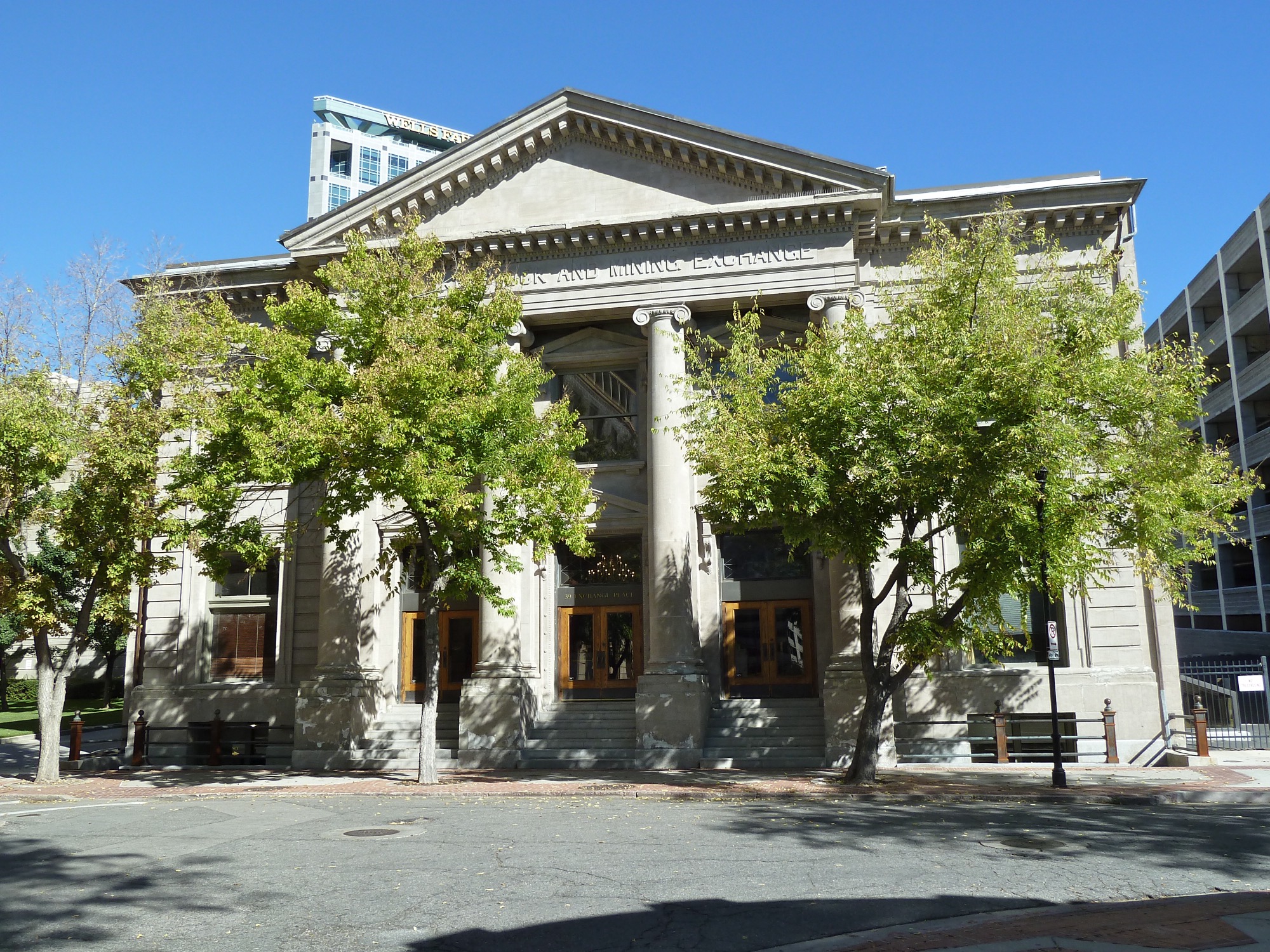
The Salt Lake Stock and Mining Exchange Building at 39 Exchange Place is a two-story, T-shaped Neoclassical Revival structure designed by Chicago-trained architect John C. Craig and completed in 1909 on land donated by mining magnate Samuel Newhouse. As documented in the National Register of Historic Places nomination (NRHP #76001830, listed 1976), the building’s front façade presents five bays, with the three center bays framed by four freestanding two-story Ionic columns supporting a massive Greek-style pediment above a denticulated cornice. The pedimental imagery—classical motifs evoking commerce and industry—is echoed in the lintels above the six central door and window fenestrations. Constructed of sandstone with brick exterior sides and rear over a raised basement, the building employs steel-frame and masonry construction typical of the era’s protected commercial architecture (Exchange Place Historic District NRHP nomination, 1978). Craig, who had practiced in Denver, Seattle, and Chicago before settling in Salt Lake City in 1902, also designed the Herald Building (1905) and the Eagle Gate Apartments, bringing metropolitan architectural sophistication to Utah’s emerging financial district. The interior centers on a grand double-height central hall originally outfitted for trading, featuring a mezzanine-level catwalk and four round interior columns along the hall’s edges. A large chalkboard along one wall displayed fluctuating stock quotations in real time. Though modest in scale compared to eastern exchanges, Craig’s temple-front design lent the building a gravitas befitting its role as the only SEC-registered stock exchange between Chicago and the Pacific coast.
The decorative program of the Salt Lake Stock and Mining Exchange Building draws on classical vocabulary to project financial authority in the American West. The façade’s four monumental Ionic columns and Greek pediment consciously evoke the temple-front tradition long associated with banking and exchange buildings from Wall Street to the City of London, what architectural historian Dell Upton in “Architecture in the United States” (Oxford University Press, 1998) describes as the “temple of commerce” motif. The pedimental sculpture and lintel ornamentation incorporate allegorical imagery of industry and mineral wealth, appropriate for an institution devoted to mining finance. Inside the trading hall, the decorative scheme was functional rather than lavish: the double-height space with its mezzanine catwalk prioritized sightlines and acoustic clarity for open-outcry trading, while the massive chalkboard quotation wall served as both utilitarian fixture and visual centerpiece. The building’s ornamental program should be understood in the context of its Exchange Place neighbors. The flanking Boston and Newhouse Buildings (Henry Ives Cobb, 1908–1911) feature lion-head stonework symbolizing industry and buffalo motifs representing the American West, as noted in the SAH Archipedia entry on the district. Copper-plated trim, cartouches, and agricultural and industrial relief panels on the Newhouse Building’s façade complemented the Exchange’s own classical ornament. The Commercial Club Building nearby, designed by Walter Ware and Alberto Treganza, extended this decorative language of civic ambition. Together, these buildings formed what the Deseret News described as a “historic, thriving little street,” where ornamental programs collectively proclaimed Salt Lake City’s aspirations as the “Wall Street of the West.”
The Salt Lake Stock and Mining Exchange Building occupies a pivotal position at 39 Exchange Place, a narrow one-block street running between South Main Street and 400 South in downtown Salt Lake City. The Exchange Place Historic District, listed on the National Register in 1978, comprises ten closely grouped buildings erected between 1903 and 1917 that constitute a remarkably intact early-twentieth-century financial precinct. As historian John McCormick documented in “Salt Lake City Penny Stocks” (Utah Historical Quarterly, vol. 89, no. 4, 2021), the district emerged from a deliberate effort by non-Mormon business interests—led by mining magnate Samuel Newhouse—to create a competing commercial center four blocks south of the Mormon-dominated retail district near Temple Square. Newhouse financed Utah’s first skyscrapers, the eleven-story Boston and Newhouse Buildings (Henry Ives Cobb, 1908–1911), whose L-shaped configuration and rounded corners create a monumental limestone gateway into Exchange Place. He donated the land for both the Exchange Building and the adjacent Commercial Club, envisioning, as the Salt Lake Tribune reported, a “Western Wall Street” rivaling eastern financial centers. The district’s Chicago and New York architectural influences—imported through architects Cobb and Craig—marked a self-conscious assertion of cosmopolitan identity in a city still dominated by its religious founding culture. A 1979 pedestrian plaza conversion by Niels E. Valentiner and Associates closed the street between the twin towers, adding brick pavers, landscaping, and period street lamps while preserving the mosaic tile entries that survive from the original construction.
Organized in 1888 to channel venture capital into Utah’s booming silver, gold, and lead mines, the Salt Lake Stock and Mining Exchange was incorporated in 1899 by prominent figures including J. E. Jackson and Herman Bamberger (Exchange Place Historic District NRHP nomination, 1978). It was, as the National Register documentation notes, “the only registered exchange between Chicago and the west coast states,” serving a vast hinterland of extractive industry. The Exchange tracked national economic cycles closely: it flourished during the 1920s metals boom, went quiet during the Depression, and revived when World War II drove up prices for copper, lead, and zinc from Utah mines. Its most dramatic chapter came during the uranium frenzy of 1953–1955, when, as McCormick recounts in Utah Historical Quarterly, Salt Lake City “became the gambling capital of the world”—on March 24, 1954, more shares traded over the counter in Salt Lake than on the New York Stock Exchange. The SEC opened a branch office in Salt Lake City to address rampant fraud, but as the agency’s own reports conceded, federal regulators “concentrated on high finance and barely noticed Utah.” The uranium bubble collapsed in 1956 when the Atomic Energy Commission curtailed purchases, and subsequent congressional hearings revealed widespread fraudulent promotion. The Exchange limped through the 1960s, renamed itself the Intermountain Stock Exchange in May 1972 to project broader regional relevance, but by then it was the second-smallest exchange in the nation after Spokane. Trading volumes dwindled until the final trade in 1979; the corporate shell was acquired by Commodity Exchange, Inc. (COMEX) in 1986, and all ISE-listed securities were delisted.
The Salt Lake Stock and Mining Exchange served principally as a marketplace for shares in extractive-industry ventures across the Intermountain West. From its 1888 founding, the Exchange listed equity shares in gold, silver, copper, lead, and zinc mines concentrated in Utah’s Bingham Canyon, Park City, Tintic, and Beaver County districts. Early listings also included shares in three proposed Utah railroads, a copper smelter, and even the Salt Lake Daily Tribune, as documented in the BYU Special Collections finding aid for the Salt Lake Stock Exchange records (MSS 364). The companies tended overwhelmingly toward speculative “penny stocks”—low-priced shares in small, often unproven mining ventures that made the Exchange a magnet for risk-seeking capital. During the 1920s boom, trading volumes peaked as investors speculated on base-metal and precious-metal claims. The Exchange’s most intense period of activity came during the uranium rush of 1953–1955: as Raye Ringholz documented in “Uranium Frenzy” (Utah State University Press, 2002), eighty-one uranium firms registered with the Utah Securities Commission by end of 1954, and by 1955 some 467 salesmen across eighty brokerages were pushing uranium shares. Many new issues were “shells” or “blind pools” designed not to develop mines but to provide cheap SEC registration for promoters who used wash trades to inflate prices before dumping shares on unsuspecting investors. Utah’s 1919 blue-sky law proved inadequate to curb these practices. After the uranium collapse, oil and gas exploration shares supplemented the traditional mining listings, and the 1972 Intermountain rebranding attempted to attract diversified industrial listings, but the Exchange never achieved the breadth of instruments necessary to compete with national markets.
Images will be added as the project develops. Photographs by Larry Ng and from research sources.