Saint Petersburg Bourse (Birzha)
Saint Petersburg, Russia · Established 1703

This site requires authorization to access.
To request access, contact
william.goetzmann@yale.edu
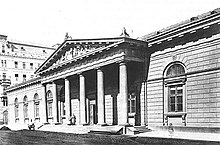
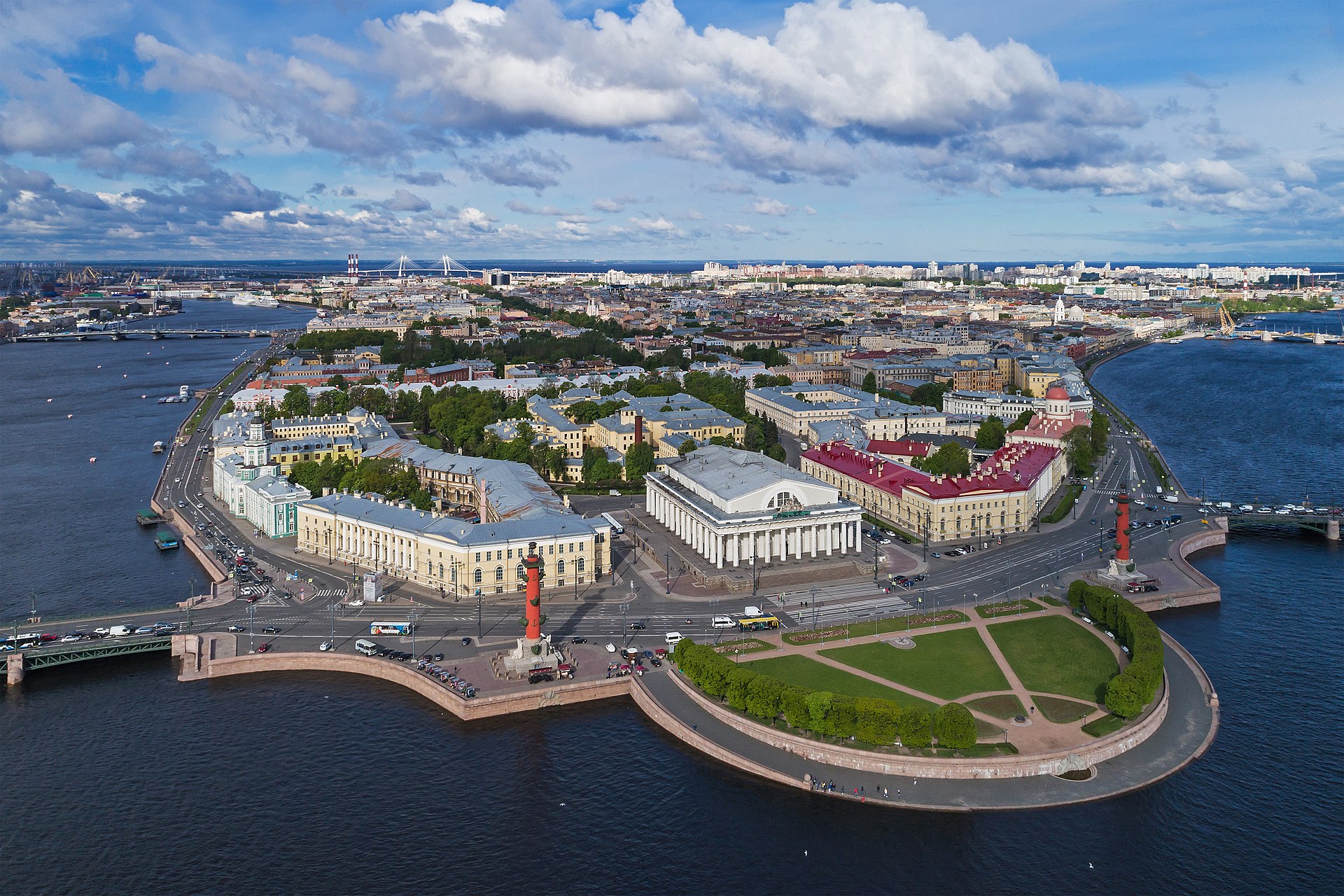
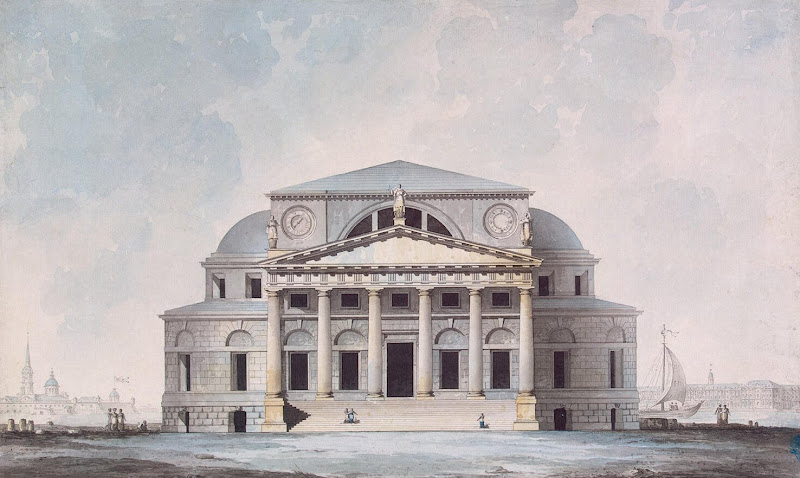
The Saint Petersburg Bourse stands at the tip of the Strelka, the eastern spit of Vasilyevsky Island, where the Neva River divides into its two main branches. It was purpose-built as a commodity and merchants’ exchange for the Baltic port—not as a securities exchange. As Robert E. Jones documented in *Bread upon the Waters: The St. Petersburg Grain Trade and the Russian Economy, 1703–1811* (University of Pittsburgh Press, 2013), the institution served the empire’s hemp, flax, tallow, timber, and grain trade alongside ship insurance and foreign bills of exchange. Securities trading began only in the early 1830s as a subsidiary activity, and even after the 1860s reforms brought a wave of railway and banking shares to the floor, commodities and securities traded together in the same hall without physical partition. The formal *fondovyi otdel* (securities department) was created only in 1900 under Finance Minister Sergei Witte’s reforms—an administrative and regulatory separation, not an architectural one. The building had a troubled architectural prehistory. In 1781–1787, Giacomo Quarenghi, Catherine the Great’s preferred architect, designed and partially constructed an exchange on the same site: 10,000 piles were driven into the marshy ground and walls partly erected, but the Petersburg merchants ‘categorically disliked’ the building because its façade recalled the Winter Palace and did not suit the commercial character of the site. Quarenghi refused to modify his design. Count Alexander Stroganov, president of the Imperial Academy of Arts, proposed auctioning the unfinished structure, but no buyers appeared. It was demolished circa 1804, and two million bricks from it were reused in the construction of the present building. The commission for the replacement went to Jean-François Thomas de Thomon (1760–1813), a figure whose biography has been significantly revised by recent scholarship. As the 2020 Tchoban Foundation exhibition established (Nadejda Bartels and Elke Blauert, eds., *Jean-François Thomas de Thomon: Drawings for Saint Petersburg*, Berlin, 2020), he was born in Paris in 1760—not in Bern, Switzerland, in 1754, as the *Grove Dictionary of Art* and older references state. The Swiss attribution derives from Thomas de Thomon’s own fabrication: he entered Russia through Hamburg and Riga posing as a Swiss citizen, concealing his identity as a French royalist fleeing the Revolution. He trained under Julien-David Le Roy at the Académie royale d’architecture in Paris from 1777, alongside Charles Percier and Pierre François Léonard Fontaine—who would become Napoleon’s architects. He subsequently studied at the French Academy in Rome (Palais Mancini), where the Doric temples at Paestum made a decisive impression visible in the Bourse’s unfluted columns. After passing through Vienna, Hungary, and Poland, he settled in St Petersburg in 1799, gaining appointment as Professor of Architecture at the Imperial Academy of Arts in 1810. Thomas de Thomon’s approved design (1804, modified 1805) took the Temple of Hera at Paestum as its model. Construction began in 1805 and the building was substantially complete by 1810, but the opening was delayed until the summer of 1816 by the upheaval of the Napoleonic Wars. A peristyle of forty-four unfluted Doric columns, resting on a massive granite stylobate, encircles the building and supports an entablature of triglyphs and slotted metopes. A monumental granite staircase descends from the main entrance toward the Neva. Inside, the single great barrel-vaulted trading hall—illuminated by an oblong skylight—served all traders without distinction of commodity or security. Thomas de Thomon’s own *Recueil des plans et façades des principaux monumens construits à Saint Pétersbourg* (Pluchart, 1806) documents the design before completion; his original drawings survive in the State Hermitage (V. G. Shevchenko, *Thomas de Thomon: Works on Paper: Catalogue of the Hermitage Collection*, State Hermitage, 2010, 320 pp., 337 illustrations) and in the Kunstbibliothek, Staatliche Museen zu Berlin. Thomas de Thomon died on 23 August 1813 after falling from the scaffolding of the Bolshoi Kamennyi Theatre, another of his commissions. The building was transferred to the State Hermitage Museum in December 2013, which has since conducted extensive restoration of the foundations, granite facing, façades, pediment sculptures, and skylight.
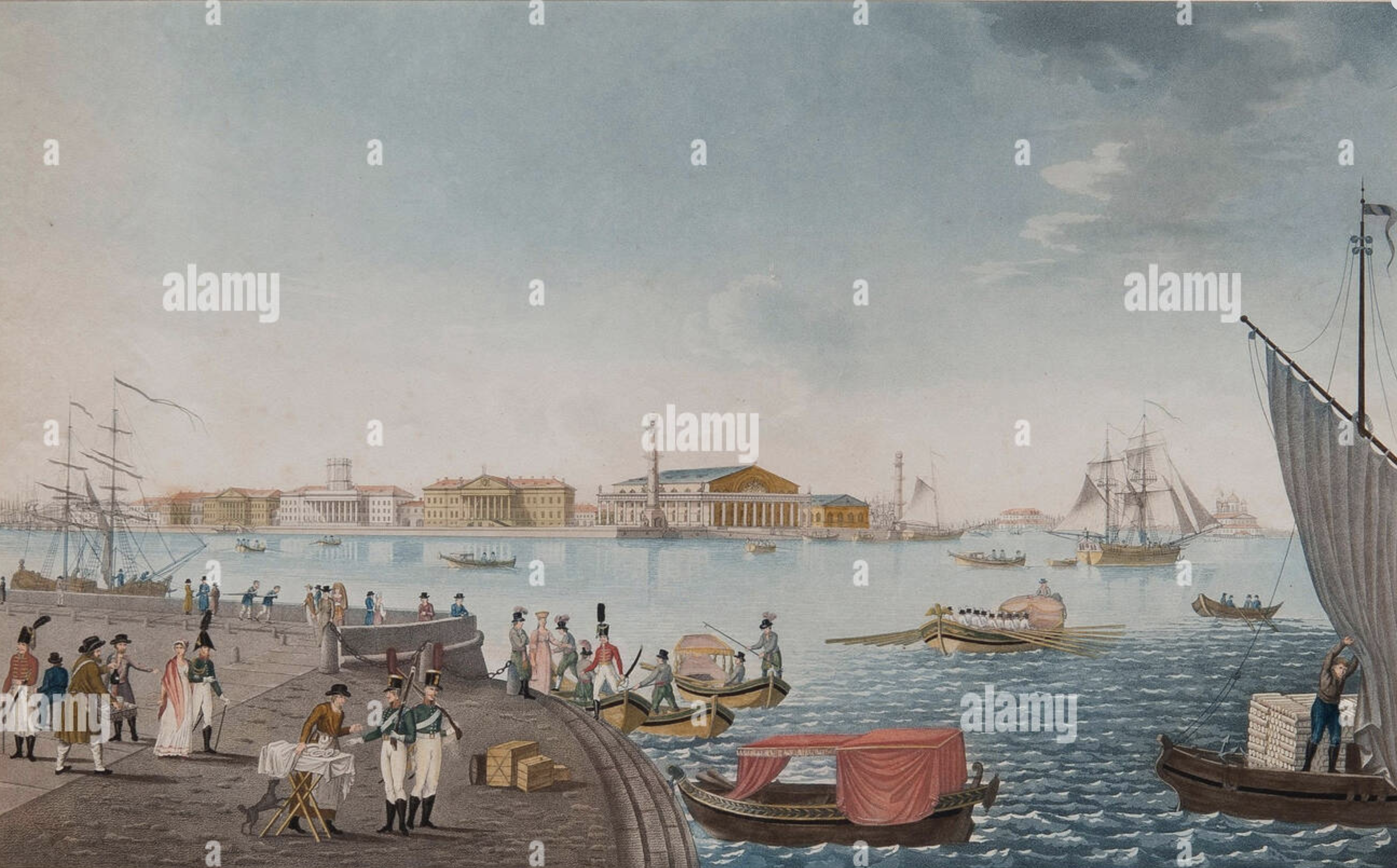
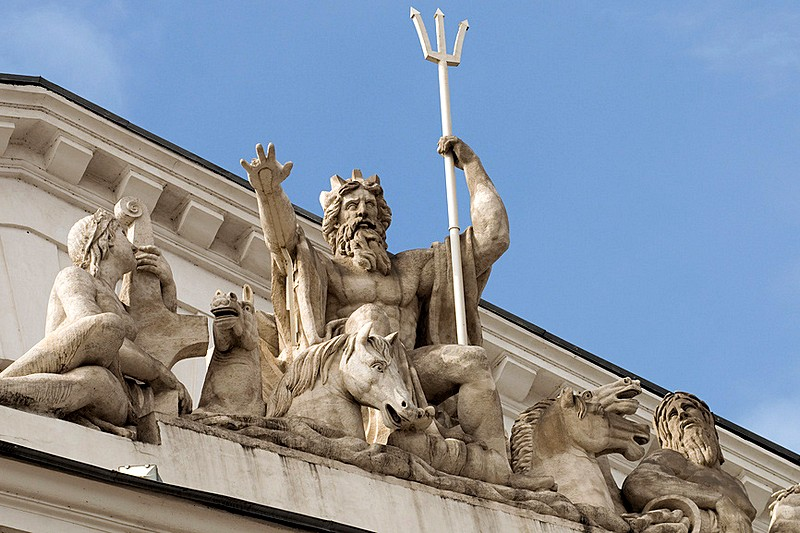
The decorative program of the Bourse was entrusted to Vasily Ivanovich Demut-Malinovsky (1779–1846), one of the foremost Russian sculptors of the Empire period, who had trained under Mikhail Kozlovsky at the Imperial Academy of Arts and later studied with Antonio Canova in Rome. Above the Neva-facing portico Demut-Malinovsky placed a monumental sculptural group, ‘Neptune with Two Rivers,’ depicting the sea god flanked by allegorical figures of the Neva and the Volkhov; the opposite attic carries ‘Navigation with Mercury and Two Rivers,’ personifying commerce. The iconographic program—Neptune, Mercury, personified rivers, ship prows, anchors—celebrates maritime and riverine commerce, not financial securities, confirming the building’s original purpose as a commodity-trade hall. The paired Rostral Columns that flank the exchange bear their own sculptural program. Four colossal seated figures at their bases, carved from Pudost limestone (a soft tufa quarried near Gatchina that hardens after extraction), represent Russia’s great waterways: the Neva and the Volkhov at the southern column, the Volga and the Dnieper at the northern one. The Dnieper was sculpted by the Antwerp-born Jozef Camberlein; the remaining three figures were the work of the French sculptor Jacques Thibault, assisted by the celebrated Russian stone-carver Samson Sukhanov—a peasant from Arkhangelsk who went on to carve the granite columns of St Isaac’s Cathedral. Eight copper ship prows (rostra), along with anchors and relief carvings of sea horses, fish, and crocodiles, ornament the column shafts in the ancient Roman triumphal tradition. The columns originally served as navigation beacons for the commercial port, with bowls of burning resin at the summit. Inside the exchange, the barrel-vaulted trading hall features double-sunk coffers and a recurring semicircular motif that echoes the exterior’s Doric severity. Thomas de Thomon’s architectural drawings for the Bourse survive in the Kunstbibliothek, Staatliche Museen zu Berlin, and the State Hermitage; thirty-four large-format sheets were exhibited by the Tchoban Foundation in 2020 (Bartels and Blauert, eds., *Jean-François Thomas de Thomon: Drawings for Saint Petersburg*, 2020, 200 pp., ISBN 978-3-944899-14-5). The Swedish-born artist Benjamin Patersen depicted the Strelka ensemble in tinted engravings and watercolours circa 1807, recording the exchange as it neared completion; the painter Fyodor Alekseyev captured the view of the Bourse and Admiralty from the Peter and Paul Fortress in a canvas now in the State Tretyakov Gallery.
Thomas de Thomon conceived the Bourse not as an isolated building but as the centerpiece of an entire architectural ensemble at the working heart of St Petersburg’s port. He designed the semicircular embankment and granite wharves that frame the point of the island, along with the paired Rostral Columns—which served both as navigation beacons and as triumphal monuments—creating one of the most celebrated urban vistas in European neoclassicism. The siting was richly layered in meaning. Peter the Great had originally intended Vasilyevsky Island to be the political and administrative center of the new capital, an ambition expressed by Domenico Trezzini’s Twelve Colleges building (begun 1722), which housed the government ministries until it became the University of St Petersburg in 1835. The Kunstkamera (1718–1734), Peter’s public museum of curiosities, stood on the University Embankment nearby. Thomas de Thomon’s ensemble overlaid a new mercantile identity onto a site originally designated for governance and Enlightenment learning: the ‘window on Europe’ was transformed from a bureaucratic vision into a maritime-commercial one. The surrounding infrastructure confirmed the port’s commercial character. The Naval Customs House (*Tamozhnya*), designed by Giovanni Francesco Lucchini and built in 1829–1832, stands immediately to the north on the Makarova Embankment. Two massive Northern and Southern Warehouses (*pakgauzy*), also designed by Lucchini in 1826–1832, flank the Bourse symmetrically, completing the semicircular layout that Thomas de Thomon envisioned but did not live to see built. Across the Neva, on the English Embankment (*Angliyskaya naberezhnaya*), sat the mansions and counting-houses of the British, German, and Dutch merchant communities who dominated the grain, hemp, tallow, and naval-stores trade—by 1775 virtually all the houses on the Embankment belonged to wealthy English merchants, royal bankers, and shipowners. The banking house of Stieglitz & Company was among the most powerful private concerns; Baron Alexander von Stieglitz (1814–1884) became the first Governor of the State Bank of Russia under Alexander II. The *Kommercheskaya gazeta* (Commercial Gazette), published from 1803 under the Department of External Commerce, served as the principal commercial newspaper; from 1808 it included a *birzhevoi preyskurant* (exchange price list) as a supplement.
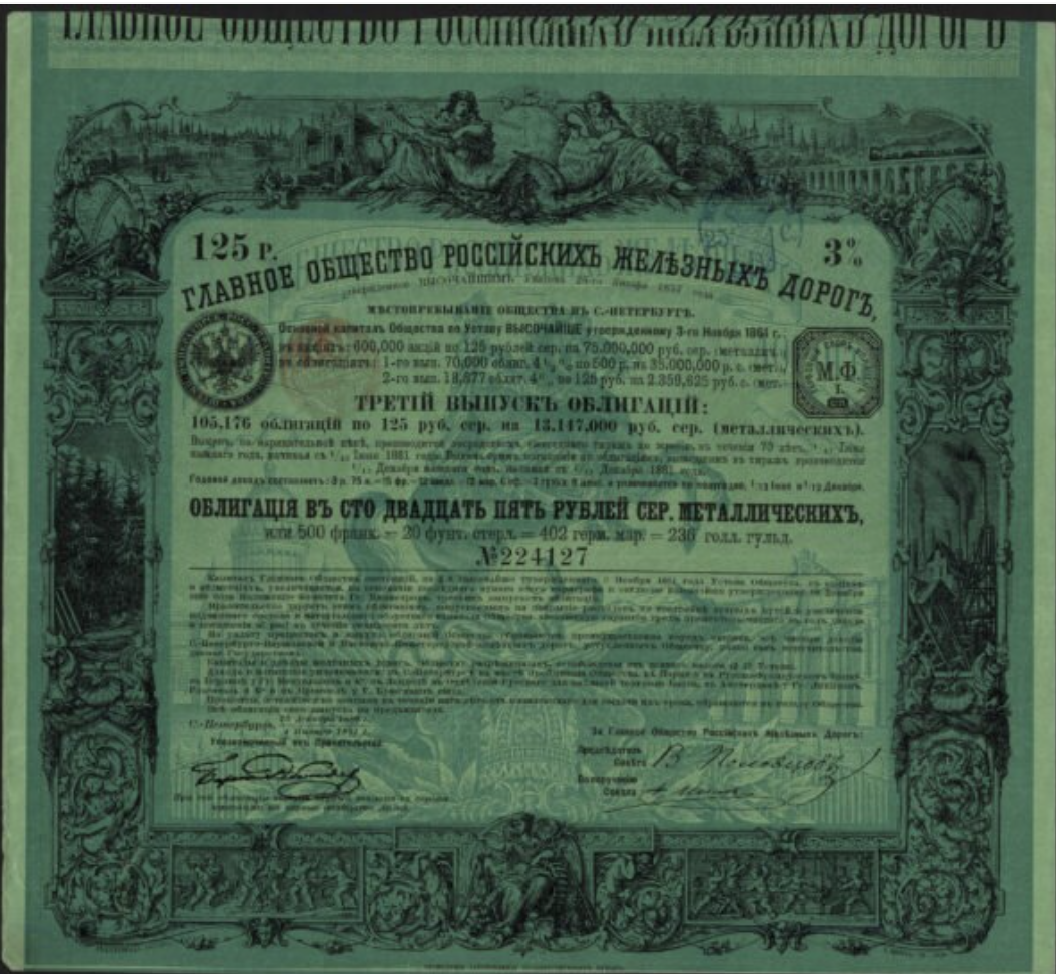
The St Petersburg exchange was founded by decree of Peter the Great around 1703, making it one of the oldest in the Russian Empire. For its first century the institution dealt overwhelmingly in commodities—the Baltic port’s hemp, flax, tallow, timber, and grain—alongside ship insurance, foreign currencies, and bills of exchange (*veksels*). The de Thomon building on the Strelka, opened in 1816, replaced a failed predecessor by Giacomo Quarenghi and gave the exchange its monumental architectural form. Securities trading began in the early 1830s, when shares of a small number of Russian joint-stock corporations first appeared alongside commodity transactions. Russia adopted its first corporate law in 1836, implementing a concession system requiring imperial approval for each company. The great transformation came with the reforms of the 1860s, following the emancipation of the serfs and the Crimean War: a wave of incorporations—particularly railway companies and independent commercial banks—drew public attention and capital to the exchange. As Boris Ananich documented in *Bankirskie doma v Rossii 1860–1914 gg.* [Banking Houses in Russia 1860–1914] (Leningrad: Nauka, 1991), private banking houses played a growing and largely unregulated role alongside the official exchange. Throughout this expansion, securities and commodities traded together in the same hall of the de Thomon building, without physical partition or separate premises. The traders who generated the pricing data collected by William Goetzmann and Simon Huang (‘Momentum in Imperial Russia,’ *Journal of Financial Economics* 130, 2018)—covering 598 companies from 1865 to 1914—conducted their business at Birzhevaya Ploshchad 4, Vasilyevsky Island, in the barrel-vaulted trading hall originally designed for the hemp and grain trade. The absence of a purpose-built securities exchange building in Russia is itself a significant finding: unlike London (where securities broke away from the Royal Exchange and built their own Capel Court in 1802) or Paris (where Napoleon commissioned a separate temple for the Bourse in 1808), the Russian state saw no need for an architectural distinction between commodity and financial markets until Sergei Witte’s reforms of 1900 created the *fondovyi otdel* (securities department)—an administrative and regulatory separation, not a spatial one. P. V. Lizunov’s comprehensive monograph *Sankt-Peterburgskaya birzha i rossiiskii rynok tsennykh bumag (1703–1917)* [The Saint Petersburg Exchange and the Russian Securities Market] (St Petersburg: Blitz, 2004, 575 pp.) provides the most detailed Russian-language treatment of the institution’s evolution. By the 1890s the principal sectors were banking and railroads, with oil companies—notably the Nobel Brothers Petroleum Company, quoted in both St Petersburg and Paris—mining, insurance, iron and steel, and utilities (L. Borodkin and G. Perelman, ‘St Petersburg Exchange: On the Road to Maturity,’ in *Financial Centres and International Capital Flows*, Oxford University Press, 2011). By 1900 the capitalisation of equities on all Russian exchanges reached approximately 1,557 million dollars, placing St Petersburg fifth globally behind London, New York, Paris, and Berlin. In 1900 the official Bulletin listed some 700 named securities. At its height the exchange quoted 312 types of shares worth approximately two billion rubles. The Bourse closed in August 1914 with the outbreak of World War I, briefly reopened in January–February 1917, and was permanently shuttered after the Revolution.
Founded by decree of Peter the Great around 1703, the Saint Petersburg exchange initially served as a commodity market where merchants traded Russia’s principal exports—hemp, flax, tallow, timber, and grain—alongside ship insurance and foreign bills of exchange (*veksels*). As Robert E. Jones documented in *Bread upon the Waters* (University of Pittsburgh Press, 2013), the Bourse was central to the empire’s Baltic grain export trade. Securities trading began in the early 1830s, when shares of a small number of Russian corporations first appeared alongside commodity transactions. Russia adopted its first corporate law in 1836, requiring imperial approval for each joint-stock company. The reforms of the 1860s brought a wave of incorporations, concentrating capital for railway construction and the establishment of independent commercial banks. By the 1890s the principal sectors were banking and railroads, with oil companies—notably the Nobel Brothers Petroleum Company, whose shares were quoted in both St Petersburg and Paris—as well as mining, insurance, iron and steel, and utilities (Borodkin and Perelman, ‘St Petersburg Exchange: On the Road to Maturity,’ OUP, 2011). In 1900, Finance Minister Witte’s reforms formally separated the securities and commodities departments, creating the *fondovyi otdel* under a special chancellery (*kantselyariya*) of the Ministry of Finance. At its height the exchange quoted 312 types of shares worth some two billion rubles, plus government bonds and state-guaranteed loans. William Goetzmann and Simon Huang (‘Momentum in Imperial Russia,’ *Journal of Financial Economics* 130, 2018) collected monthly price data for 598 companies listed between 1865 and 1914—one of the largest historical datasets for any pre-World War I market. The Bourse closed in August 1914 with the outbreak of World War I and was permanently shuttered after the Revolution of 1917.