Rybinsk Grain Exchange (Рыбинская хлебная биржа)
Rybinsk, Russia · Established 1811
This site requires authorization to access.
To request access, contact
william.goetzmann@yale.edu
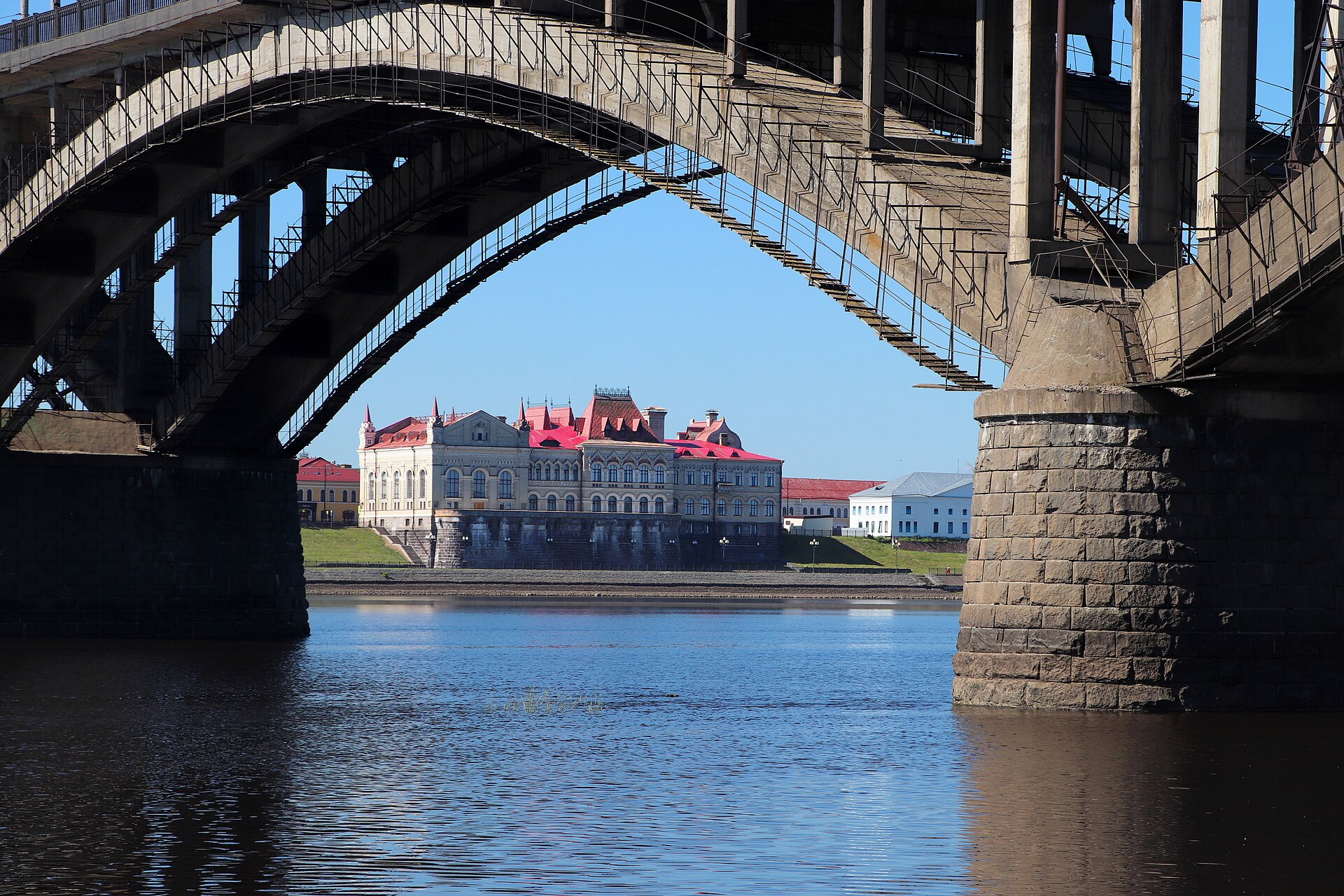
The Rybinsk grain trade is embodied in two contrasting bourses standing side by side on the Volga embankment. The Old Exchange, raised between 1806 and 1811 to the design of the architect Gerasim Varfolomeyevich Petrov and opened on 18 July 1811 in the presence of the Yaroslavl governor-general Prince Mikhail Golitsyn, is a restrained, white-rendered block whose strict proportions and sparing ornament rank it, as the Rybinsk Museum-Preserve notes, among the better monuments of provincial Russian classicism (rybmuseum.ru). A century later the exchange committee, by then presiding over one of the largest grain markets in the empire, commissioned a far grander home: the New Exchange, solemnly opened on 2 October 1912 to the project of Alexander Vasilievich Ivanov, an architect of the Moscow palace administration. Built of brick in the neo-Russian (Russian Revival) idiom inflected with Art Nouveau, it presents two faces -- the embankment elevation resembling a medieval fortress and the town side a fairytale palace -- crowned by figured roofs with openwork iron crests. Its walls were clad in costly German glazed tiles and set with roughly two hundred coloured majolica panels bearing double-headed eagles and floral ornament, a programme described in detail by the museum's own studies of the building's 'tiled attire' (2rybinsk.ru; culture76.ru). Both structures are protected as architectural monuments of federal significance.
The artistic interest of the complex lies overwhelmingly in the ceramic skin of the 1912 building rather than in any collection of paintings or sculpture original to the exchange. The polychrome majolica facing -- some two hundred tiles in all, worked into the German glazed-brick cladding -- carries heraldic double-headed eagles, beaded borders and stylised herbs and flowers, making the facade itself the principal work of decorative art (2rybinsk.ru). Inside, period photographs and museum descriptions record wrought-iron stair railings and moulded ceiling plasterwork preserved from the original fit-out (rybmuseum.ru). The Old Exchange, by contrast, is austere by design: its appeal is the disciplined geometry of provincial classicism rather than applied ornament. Since 1993 the New Exchange has held the holdings of the Rybinsk State Historical-Architectural and Art Museum-Preserve -- more than 120,000 items, many drawn from local noble estates -- so that the building now functions as a gallery, though these collections postdate and are unrelated to its commercial origins.
The two exchanges anchor Rybinsk's riverfront ensemble on the Volzhskaya Embankment (ul. Volzhskaya naberezhnaya 2), at the historic Red Square close to the soaring Transfiguration Cathedral, with which they form the city's iconic panorama as seen from the river and the Volga road bridge. Their prominence on the waterfront was no accident: Rybinsk owed its existence to the river, and the bourses were placed where grain was physically handled. The town, granted city status by Catherine the Great in 1777, grew into the great trans-shipment point of the upper Volga, since the river above Rybinsk ran too shallow for the heavy barges of the Middle and Lower Volga; cargoes were broken here and reloaded onto smaller craft for the Vyshny Volochyok, Mariinsky and Tikhvin canal systems linking the Volga basin to the Baltic and St Petersburg (en.wikipedia.org, 'Rybinsk'; en.wikipedia.org, 'Volga-Baltic Waterway'). The exchanges thus sat at the hinge of an imperial grain artery.
The Rybinsk bourse was the first exchange opened in the Russian provinces and, by date of foundation, the third in the empire after those of St Petersburg and Moscow; funds for the 1811 building were donated by the out-of-town merchants who traded in the town (laperuz.com; 2rybinsk.ru). Under capable management the exchange grew until, by turnover, it ranked as the largest grain exchange in Russia, its committee's opinions regularly solicited by imperial government bodies -- prestige that prompted the construction of the larger 1912 hall next door (2rybinsk.ru). That new building enjoyed only a brief commercial life: with Russia's entry into the First World War, the government introduced a state monopoly on the grain trade in 1915, ending the exchange's open-market function. The Old Exchange, by then nicknamed the 'pilots' exchange,' was requisitioned to billet troops of the Grokhovsky Regiment during the war and later served as a river station and water-police office in the Soviet period. Since 1993 the New Exchange has housed the Rybinsk State Historical-Architectural and Art Museum-Preserve, and both buildings now belong to that institution.
What changed hands at Rybinsk was, above all, grain -- the rye, wheat and other cereals shipped up the Volga from the fertile southern and middle provinces toward the capital. The town earned its fame as the 'capital of the barge-haulers' (burlaks), the labourers who hauled and worked the vessels that converged on its quays each season, and the exchange existed precisely to regulate the upper-Volga grain trade at the point where southern barges discharged their loads for onward shipment by smaller craft through the canal systems to St Petersburg (en.wikipedia.org, 'Rybinsk'). Trading was a merchant affair: dealers from across Rybinsk and beyond gathered in the bourse to conclude grain contracts, and the exchange committee set the commercial tone of a market whose price signals reached the imperial government. Alongside grain the riverfront economy handled salt and other bulk goods stored in the town's warehouses and depots, but it was cereals -- the food supply of the Baltic capital -- that defined the institution and gave the building its name, the 'Grain Exchange' (хлебная биржа).
Images will be added as the project develops. Photographs by Larry Ng and from research sources.