Bourse des Marchands (Palais des Consuls)
Rouen, France · Established 1556
This site requires authorization to access.
To request access, contact
william.goetzmann@yale.edu
In March 1556, King Henri II issued a royal edict creating both an open-air bourse on the port of Rouen — reserved for merchants outside the city walls — and a covered exchange inside a consular building for inclement weather, along with a merchant tribunal of elected judges-consuls. This made Rouen one of the earliest cities in France with a royally authorized merchant institution, following Toulouse (1549).
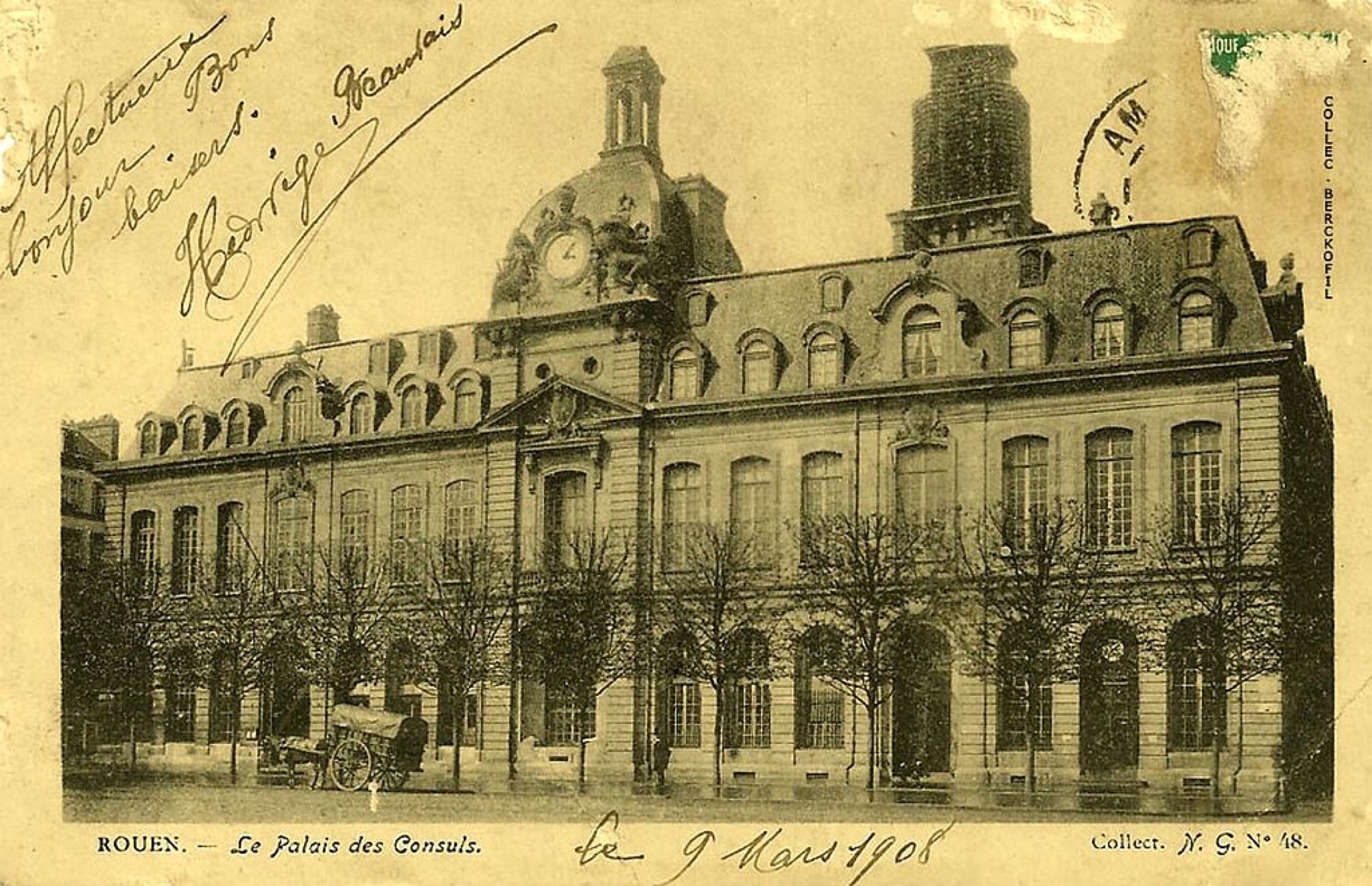
The 1743 Palais des Consuls by Jean-François Blondel (1683–1756), architect of Rouen and uncle of the celebrated theorist Jacques-François Blondel, was a refined classical edifice whose main facade faced the Quai de la Bourse with a monumental noble floor and articulated attic storey, characteristic of mid-eighteenth-century French civic architecture. Jacques-François Blondel, born in Rouen and trained by his uncle, published the four-volume Architecture françoise (1752–1756, Paris: Jombert), which documented French buildings through detailed engraved plates; though focused on Parisian structures, the work codified the very classical principles his uncle had applied at Rouen. Historic photographs from circa 1908, preserved in the Wikimedia Commons collection, show the Blondel facade before its total destruction by fire during the Allied bombing of the Semaine rouge on May 31, 1944. The 1952–1956 reconstruction by Pierre Chirol, Robert Flavigny, François Herr, and Roger Pruvost incorporated Art Deco-inflected decorative programs including ironwork by the master ferronnier Raymond Subes, furniture and luminaires by André Arbus and Jean Adnet, and wall bas-reliefs by Maurice de Bus — elements documented before their dispersal at auction in 2018, as reported in La Tribune de l'Art.
The Palais des Consuls occupied a commanding position on the Quai de la Bourse, directly fronting the Seine at the heart of Rouen's riverfront commercial district. Rouen's prosperity depended on its monopoly over Seine navigation reaching upstream as far as Paris — a privilege so valuable that when urban riots erupted in the fourteenth century, Philip IV temporarily revoked it as punishment, as recounted in the city's municipal histories. Situated barely ten minutes' walk from both the Gothic Cathédrale Notre-Dame and the late-medieval Palais de Justice — one of the rare civil Gothic buildings in France — the bourse anchored a dense institutional triangle linking spiritual authority, royal justice, and mercantile power. As Normandy's commercial capital, Rouen was the furthest point inland accessible to oceangoing vessels on the Seine, a geographic advantage that made it France's principal seaport through the sixteenth century, as noted in the Encyclopædia Britannica. The city's river geography channeled goods between the Atlantic ports of Le Havre and Honfleur downstream and the Parisian basin upstream, concentrating warehousing, textile finishing, and financial services along the quays. Pierre Dardel documented the flows of this internal and external commerce in his study Les courants du commerce extérieur et intérieur de Rouen au XVIIIe siècle (Annales de Normandie, 1954), demonstrating how the city's position made it the indispensable entrepôt for northern France.
The first formal Palais des Consuls was built in 1743 by architect Jean-François Blondel on the Quai de la Bourse. It served as both the commercial exchange and the seat of the merchant court. The building was destroyed by Allied bombing on May 31, 1944, and rebuilt in 1952–1956 in a modern style.
The Rouen bourse served as the principal marketplace for Normandy's textile trade — the draperie rouennaise that had made the city one of medieval Europe's great cloth-producing centers, exporting woolens, linens, and from the eighteenth century the cotton-linen hybrid fabrics known as rouenneries and indiennes (printed calicoes) destined for both domestic and colonial markets. Grain and wine moved through the bourse as well; Judith A. Miller, in Mastering the Market: The State and the Grain Trade in Northern France, 1700–1860 (Cambridge University Press, 1999), documents how Rouen competed with Paris as a grain-distribution hub, with state administrators covertly managing prices along the Seine supply corridor. Rouen merchants were also deeply enmeshed in Atlantic and colonial commerce: the banking dynasty Le Couteulx et Cie financed slave-trading expeditions departing Le Havre, outfitting approximately eleven vessels that transported some 2,500 enslaved persons to Caribbean sugar plantations, as detailed by Éric Saunier in Le négoce rouennais, la traite des Noirs et l'esclavage (Presses universitaires de Rouen et du Havre). The bourse facilitated the negotiation of bills of exchange (lettres de change) and maritime insurance contracts — Rouen having received a royal patent for insurance as early as 1556, predating the Ordonnance de la Marine of 1681 that first codified French insurance law. Colonial return cargoes of sugar, coffee, cotton, indigo, and gum arabic were warehoused at Rouen before redistribution, as Guillaume Foutrier analyzed in his study of brokers and agents at the Rouen bourse published in the Revue d'histoire moderne et contemporaine (2016).
Images will be added as the project develops. Photographs by Larry Ng and from research sources.