Rotterdam Stock Exchange (Beurs Rotterdam)
Rotterdam, Netherlands · Established 1720
This site requires authorization to access.
To request access, contact
william.goetzmann@yale.edu
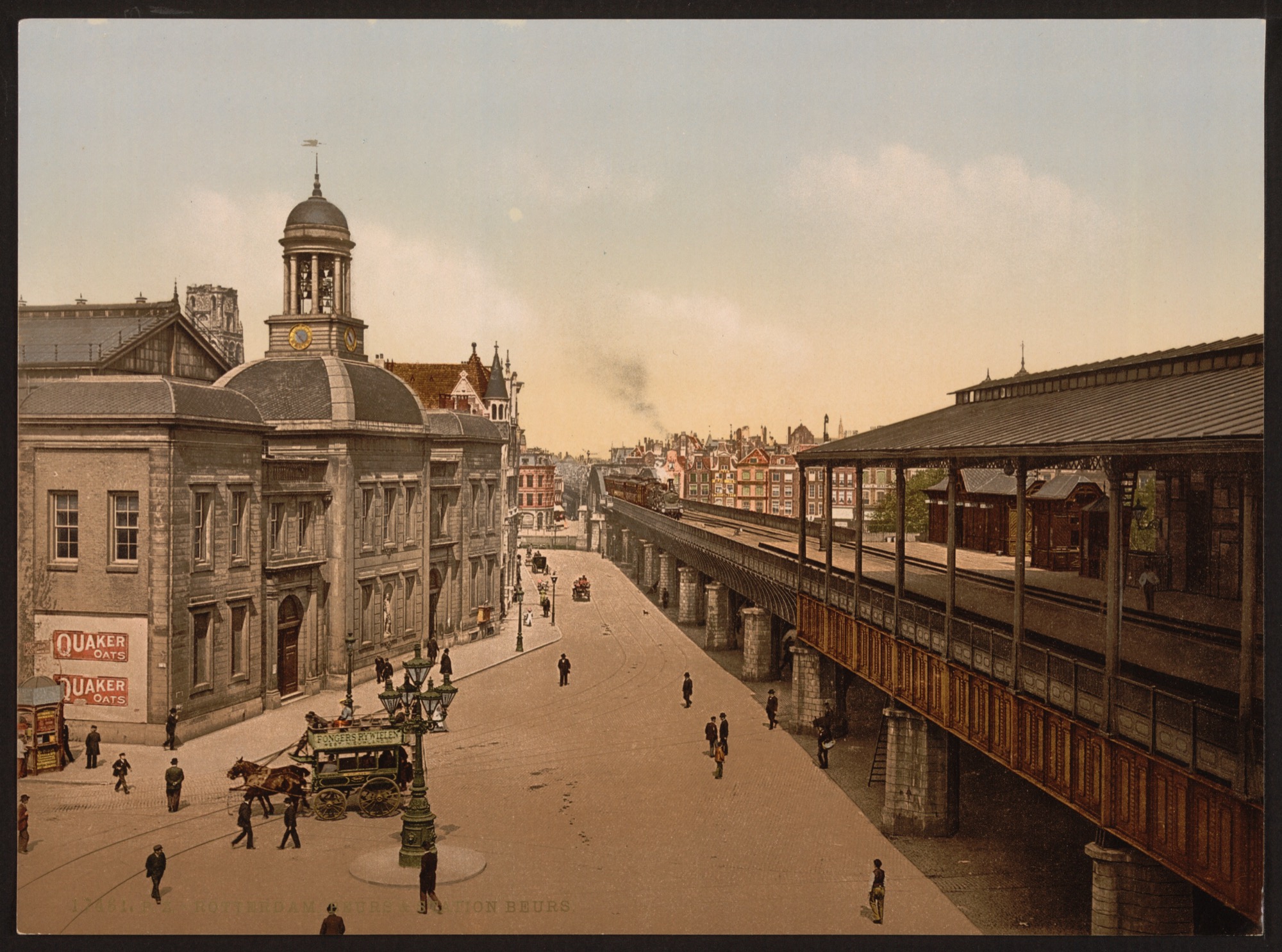
Rotterdam’s exchange architecture spans four centuries and at least four buildings. The city’s first beurs opened in 1598 on the Haringvliet, over a decade before Hendrick de Keyser’s celebrated Amsterdam exchange, as documented by the Euronext Heritage Foundation (beursgeschiedenis.nl). When this proved too small, trade relocated to the Noordblaak in 1635. In 1736, architect Adriaen van der Werff designed an exchange building on the Westnieuwland that would serve Rotterdam’s merchants for two centuries. The current Beurs, now designated Rijksmonument 513765, was designed by Jan Frederik Staal (1879–1940), a pivotal figure in Dutch modernism whose career evolved from the Amsterdam School toward Nieuwe Bouwen functionalism, as the Rijksdienst voor het Cultureel Erfgoed has recognized. Staal won a restricted 1928 competition among six prominent architects; his executed design of 1933 abandoned earlier Amsterdam School characteristics for a rationalist program suited to commercial purposes. Built between 1936 and 1940, the reinforced concrete structure comprises three seven-story office wings arranged around a vast central exchange hall measuring ninety by sixty meters, spanned by curved Gusto steel trusses. The facades are clad in light-grey glazed brick specially manufactured by the Porcelijne Flesch factory, with granite accents at the monumental Coolsingel entrance, where a broad staircase ascends beneath a cantilevered canopy supported by six concrete columns. A slender clock tower with green-glazed tiles, lion reliefs, and an open metal belfry crowns the composition. Margaret Staal-Kropholler (1891–1966), Staal’s wife and collaborator, designed the interiors, including the Chamber of Commerce room with teak paneling, perforated ceiling panels with concealed lighting, and marble floors in diamond patterns. During the Rotterdam Blitz of May 14, 1940, the newly completed building sustained seven direct bomb hits, but its concrete skeleton survived where surrounding wooden structures were leveled. Restored by 1941, it continued functioning throughout the German occupation. A 2003–2014 renovation by Mecanoo architects stripped away postwar additions to reveal the original trading-hall trusses and steel-and-glass detailing.
The decorative program of Rotterdam’s Beurs blends modernist restraint with carefully placed sculptural and ornamental accents. The most distinguished work is a four-meter bronze statue of Gijsbert Karel van Hogendorp (1762–1834), the Rotterdam-born statesman who championed free trade and drafted the 1814 Constitution. Created by Belgian sculptor Jozef Geefs (1808–1885) and unveiled by King William III in 1867 during heated national debates between protectionists and free-trade advocates, the statue migrated through several locations before being placed on the Beurs steps in 1961, as documented by BKOR (Beeldende Kunst en Openbare Ruimte Rotterdam). In the central hall stands a bronze Mercurius by J. Th. Stracké, transferred from the old Beurs on the Blaak, embodying the classical association between Mercury and commercial exchange. The south facade at Beursplein features a blind wall treated with a decorative diamond-pattern checkerboard in three shades of grey brick, a subtle geometrical ornament characteristic of Nieuwe Bouwen restraint. The Chamber of Commerce meeting room, designed by Margaret Staal-Kropholler, preserves its original teak-paneled walls, rooster-patterned perforated ceiling panels with hidden central lighting, and furniture designed by Wijmer arranged in a large oval configuration. Earlier depictions of Rotterdam’s exchange life survive in seventeenth- and eighteenth-century engravings and city views; an original 1736 engraving of the Van der Werff exchange is held by Cornell University’s John Reps Collection of urban views.
Rotterdam occupies the strategic confluence of the Rhine and Meuse rivers near their North Sea outlet, a position that made it, by the twentieth century, the largest port in the world. The exchange’s successive locations trace the city’s mercantile geography: the 1598 beurs on the Haringvliet lay at the old harbor front; the 1635 move to Noordblaak followed expanding trade; the 1736 Van der Werff exchange on Westnieuwland served the eighteenth-century commercial core. Staal’s 1936–1940 building on the Coolsingel was sited at what the Rijksdienst voor het Cultureel Erfgoed describes as an urbanistically defining position at the intersection of Coolsingel and Beursplein. On May 14, 1940, the Luftwaffe dropped approximately one hundred tons of bombs on the city center in fifteen minutes, destroying some 25,000 buildings and killing over 1,150 people, as Antonius Robben documented in his study “Metonyms of Destruction” (History and Anthropology, 2021). The Beurs, newly completed, survived due to its concrete construction while the surrounding medieval city was obliterated. Rotterdam’s reconstruction, guided first by Willem Gerrit Witteveen’s 1940 plan and then by Cornelis van Traa’s modernist Basisplan, widened the Coolsingel from 44 to 80 meters and imposed functional zoning that separated residential, commercial, and industrial uses, as the Wederopbouw Rotterdam heritage project has chronicled. The Beurs stood as one of the few prewar structures in a rebuilt landscape that included Van den Broek and Bakema’s Lijnbaan shopping precinct (1953), Europe’s first pedestrian shopping street.
Rotterdam’s exchange history predates Amsterdam’s celebrated beurs by over a decade: the first Rotterdam exchange opened on the Haringvliet in 1598, primarily for commodity trade, as the Euronext Heritage Foundation records. Both the VOC (est. 1602) and the WIC (est. 1621, listed 1623) maintained chambers in Rotterdam—the WIC’s “Kamer van de Maze”—making the city a secondary node in the Dutch Republic’s revolutionary securities market, as Lodewijk Petram describes in The World’s First Stock Exchange (Columbia University Press, 2014). Yet Rotterdam’s exchange always operated, in the words of beursgeschiedenis.nl, “in the shadow of the Amsterdam stock exchange,” with its principal strength in commodity rather than securities trading. Formal securities organization came only in 1898 with the founding of the Vereeniging van Effectenhandelaren (Association of Securities Traders), which set lower listing requirements—one-fifth the capital threshold demanded by Amsterdam—attracting local firms. By 1958, approximately 800 funds were listed. The nineteenth-century port boom, catalyzed by the completion of the Nieuwe Waterweg in 1872 and driven by entrepreneurs like Lodewijk Pincoffs (whose 1879 fraud scandal with the Rotterdamsche Handelsvereeniging shook the city), transformed Rotterdam into Europe’s premier commodity port. The new Beurs opened on the Coolsingel just days before the May 1940 bombardment; its survival and rapid 1941 restoration symbolized commercial continuity through occupation. In 1974, the Rotterdam and The Hague securities exchanges were abolished after the Amsterdam Vereniging voor de Effectenhandel restructured as a national body, concentrating all Dutch securities trading in Amsterdam. Amsterdam Exchanges subsequently merged with Brussels and Paris to form Euronext on September 22, 2000.
Rotterdam’s exchange specialized overwhelmingly in commodities rather than securities, reflecting the city’s identity as a physical transshipment hub. From the sixteenth century, herring drove Rotterdam’s rise as a wholesale trading center, as the city leveraged its Rhine and Scheldt connections for domestic and foreign trade, as Carola Hein’s PORTUS study of Rotterdam’s port history documents. The VOC era brought spices, tea, and textiles; by the eighteenth century, slave-produced colonial goods dominated Rotterdam’s Rhine export trade—coffee, sugar, indigo, and tobacco—with coffee alone accounting for nearly half the value of Rhine-bound exports by 1790, according to research published in the Tijdschrift voor Sociale en Economische Geschiedenis (TSEG). The completion of the Nieuwe Waterweg in 1872 opened Rotterdam to ocean-going steamships, and by 1913 Rhine barge tonnage had increased eightfold over 1890 levels, carrying steel, iron ore, cereals, and petroleum, as Paul Th. van de Laar demonstrated in “Port Traffic in Rotterdam: The Competitive Edge of a Rhine-Port, 1880–1914” (Physica-Verlag, 2003). Royal Dutch Petroleum, founded in The Hague in 1890 and listed on the Amsterdam exchange, established its operational base in Rotterdam, merging with Shell in 1907 to create a petroleum giant headquartered along the Nieuwe Maas. The Europoort complex, opened in 1966, made Rotterdam the center of Europe’s petrochemical and oil-refining industry. Wouter Jacobs of Erasmus University Rotterdam has argued in the Tijdschrift voor Economische en Sociale Geografie (2014) that commodity trading firms headquartered in Rotterdam link global commodity chains with world-city financial networks, encompassing physical trade, paper trading, treasury operations, and holding-company functions.
Images will be added as the project develops. Photographs by Larry Ng and from research sources.