Rosario Board of Trade (Bolsa de Comercio de Rosario)
Rosario, Argentina · Established 1884
This site requires authorization to access.
To request access, contact
william.goetzmann@yale.edu
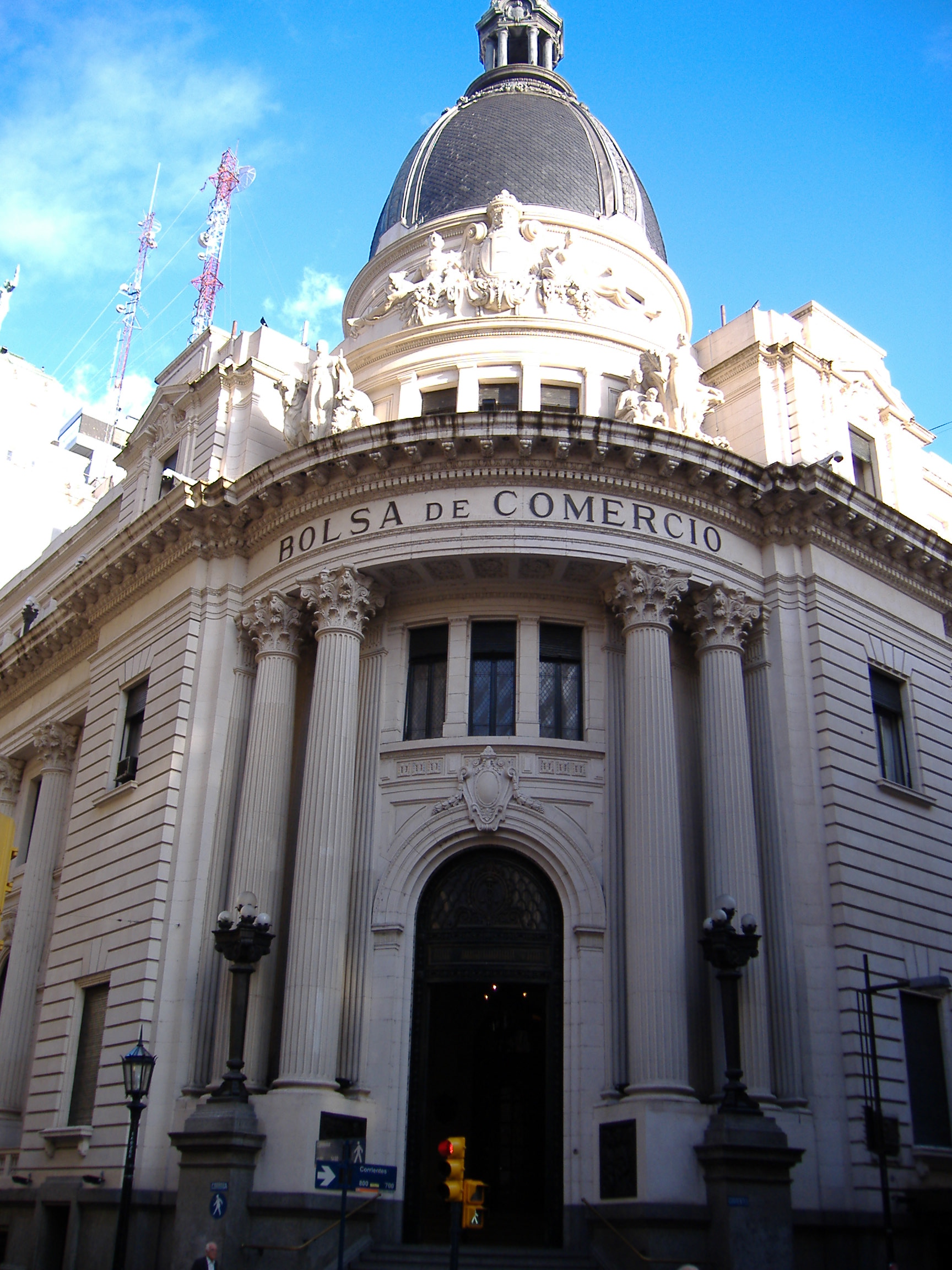
The landmark headquarters of the Bolsa de Comercio de Rosario rises at the busy corner of Córdoba and Corrientes streets, the product of a public competition for preliminary designs launched in 1926 and won by the architect Raúl R. Rivera under the motto 'LUZ 21' (es.wikiarquitectura.com, 'Bolsa de Comercio de Rosario'). Constructed between 1927 and 1929 by the firm of Rafael Candia hijo and Carlos Isella and inaugurated on 11 November 1929, the building is a confident exercise in French academic classicism of the kind that Argentine elites favored for civic monuments, its monumentality and Baroque detailing consciously echoing the contemporaneous Congreso de la Nación in Buenos Aires (Bolsa de Comercio de Rosario, 'El edificio de la Bolsa de Comercio cumple 90 años', 2019). The composition pivots on a beveled cylindrical corner volume, approached by a grand staircase and framed by double-height columns, that is crowned by a formidable dome — long among the tallest and most conspicuous silhouettes on Rosario's skyline. Conceived to project solidity, prestige, and prosperity, the structure was later declared a National Historic Monument and is maintained in its original condition.
The building's principal artistic program is sculptural and allegorical rather than pictorial, in keeping with the restrained decorative vocabulary of academic exchange architecture. The façade carries figural groups by the sculptor Enrique Cerantonio personifying the four pillars of the regional economy — agriculture, livestock (ganadería), the stock exchange or commerce, and industry — that announce the institution's purpose to the street below (Bolsa de Comercio de Rosario, 'El edificio de la Bolsa de Comercio cumple 90 años', 2019). These allegories of the productive land, paired with the crowning dome over the corner, give the exterior the air of a temple of commerce. Beyond this sculptural ornament the interiors are comparatively sober, relying on classical detailing, fine materials, and the dignified proportions of the trading and assembly halls rather than on extensive murals or painted decoration.
The exchange occupies one of the most heavily trafficked intersections in Rosario, where the pedestrianized Córdoba shopping street meets Corrientes in the commercial core of Argentina's third-largest city. Rosario grew explosively in the late nineteenth century as the principal port and railhead for the grain frontier of the surrounding pampa — by the 1880s some sixty agricultural colonies were shipping their harvests through the city — and the Bolsa's monumental seat was raised at the heart of this mercantile district to embody that wealth in stone (Bolsa de Comercio de Rosario, 'Historia'). Its dome belongs to a celebrated cluster of cupolas at Córdoba and Corrientes, and the building anchors a streetscape of early-twentieth-century banks and commercial palaces. Its strategic position along the Paraná River, upstream of which now lies the dense belt of soybean-crushing plants and export terminals, keeps the institution physically and symbolically at the center of Argentine agribusiness.
The institution traces its origin to 18 August 1884, when the entrepreneur Felipe Moré gathered local merchants to found the Centro Comercial del Rosario, which adopted blackboards to record steamship movements and commercial information from the outset (Bolsa de Comercio de Rosario, 'Historia'). In January 1899 the body was reorganized and renamed the Bolsa de Comercio de Rosario, and in the same year it constituted the country's first Cámara Arbitral de Cereales, descended from an arbitral commission for grain created in 1893 (Cámara Arbitral de Cereales de Rosario, 'Historia'). The Bolsa pioneered organized markets in Argentina: a grain futures market that became the Rosario Futures Exchange (ROFEX) opened in 1909, and a securities market followed in 1927. Across the twentieth and twenty-first centuries it broadened into livestock auctions (ROSGAN), a securities and check market (MAV), and, after the 2024 consolidation of MATBA-ROFEX into the A3 platform, an integrated complex of physical, financial, and derivatives markets — making it Argentina's second-oldest and one of its most important exchanges after Buenos Aires.
From its earliest days the Bolsa was above all a grain and oilseed market, and it remains the largest physical grain exchange in Argentina, handling the bulk of the country's cereal and oilseed commerce and today functioning as arguably the world's foremost center for physical soybean trading. Prices are not merely transacted but officially determined: each week appointed members ('semaneros') of the Cámara Arbitral de Cereales fix the 'precios pizarra' (blackboard prices) that serve as the benchmark reference for grain values nationally and internationally, alongside the chamber's roles in grading quality and arbitrating disputes (Cámara Arbitral de Cereales de Rosario, 'Historia'). Around this core the exchange has long traded soy, wheat, corn, and flax, agricultural futures and options, livestock through televised remote auction, and securities and financial instruments — a portfolio that mirrors the productive base of the Argentine pampa that the building's allegorical sculptures celebrate (Rosario Board of Trade, Wikipedia).
Images will be added as the project develops. Photographs by Larry Ng and from research sources.