Rome Stock Exchange (Borsa di Roma)
Rome, Italy · Established 1802
This site requires authorization to access.
To request access, contact
william.goetzmann@yale.edu
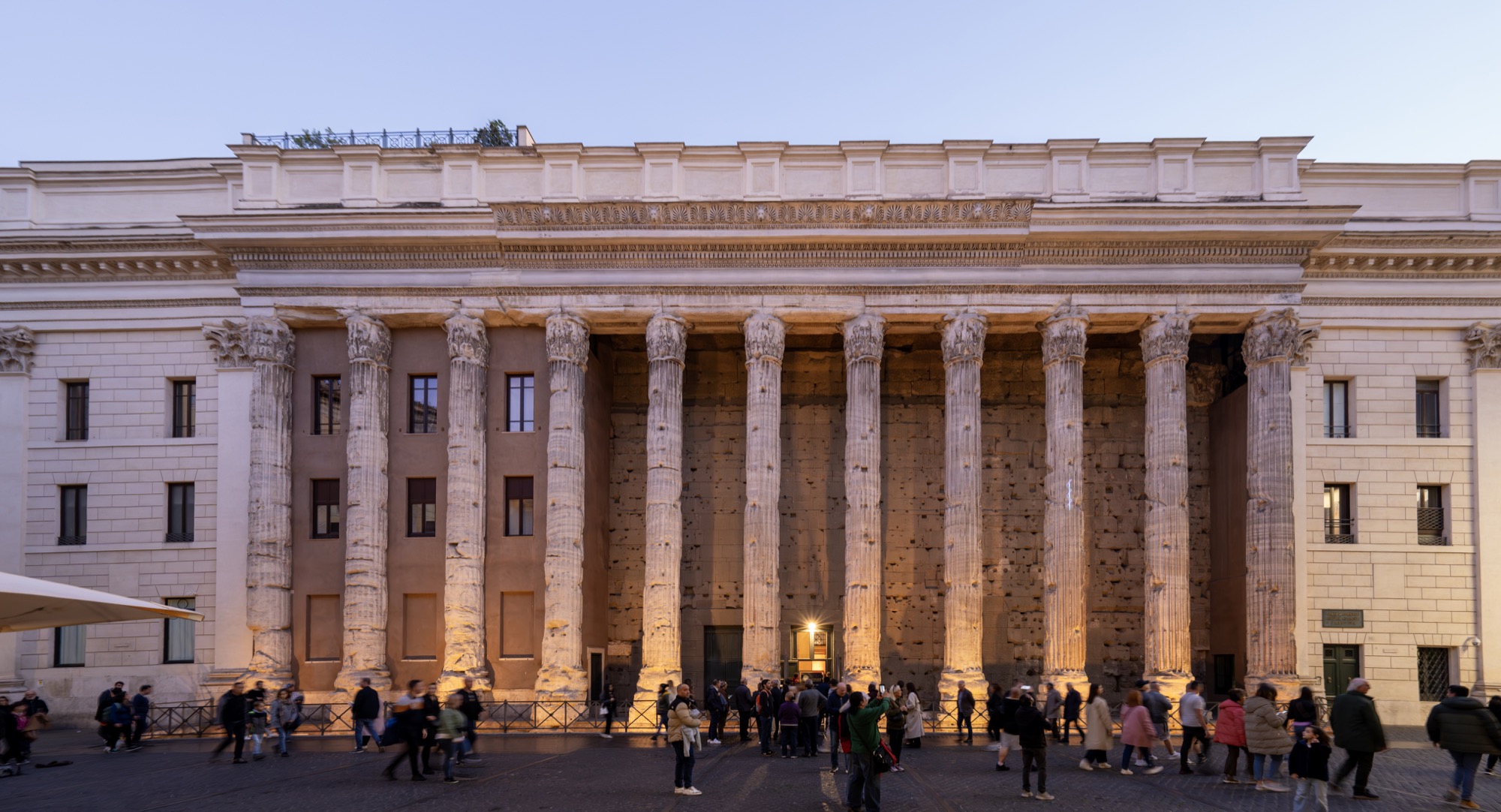
The Rome Stock Exchange occupies one of the most remarkable architectural palimpsests in the history of commercial buildings: the Temple of Hadrian (Hadrianeum), an octastyle peripteral temple on the Campus Martius dedicated in 145 AD by Antoninus Pius to his deified adoptive father. As detailed in the monograph by Claudio Parisi Presicce and Massimo Baldi, Hadrianeum: il progetto architettonico e le fasi costruttive (L’Erma di Bretschneider, 2024), the original temple stood on a peperino podium approximately four meters high, with thirty-eight Corinthian columns of Proconnesian marble, each 14.8 meters tall and 1.44 meters in diameter, enclosing a cella covered by an eighteen-meter coffered barrel vault. The rectangular sacred precinct measured roughly 85 by 138.8 meters and included a surrounding portico, monumental archway facing the Via Lata, and curvilinear exedrae. In 1695, under Pope Innocent XII, Carlo Fontana incorporated the surviving north colonnade of eleven columns and the cella wall into the Palazzo della Dogana di Terra, the central customs house for overland goods entering Rome. The temple’s ancient fabric was thus encased within a Baroque commercial edifice. When the Rome Chamber of Commerce acquired the building in 1873, it commissioned the architect Virginio Vespignani to direct a comprehensive restoration that stripped away much of Fontana’s Baroque ornamentation and imposed a more austere neoclassical character suited to the building’s new function as the seat of both the Chamber and the Borsa Valori. Vespignani’s work, completed around 1879, exposed and celebrated the ancient columns while modernizing the interior. Excavations in 1928 revealed that the temple floor stood four meters above the ancient street level, underscoring the monumental scale of the original structure.
The decorative program of the Hadrianeum constituted one of the most ambitious sculptural ensembles of the Antonine period. Amanda Claridge’s 1999 reconstruction drawings, later confirmed by Parisi Presicce and Baldi (2024), placed a series of rectangular marble relief panels in the attic storey of the surrounding portico. These panels depicted female personifications of Roman provinces, each standing on a lower cornice with her head supporting an upper projecting frame, alternating with reliefs of captured military and naval trophies. Nineteen panels survive, carved in Proconnesian marble; scholars have tentatively identified representations of Egypt, Thrace, Dacia, Gallia, Germania, Hispania, Parthia, and others, though the absence of inscriptions makes definitive attribution difficult. Seven province figures and three trophy reliefs are displayed in the courtyard of the Palazzo dei Conservatori at the Capitoline Museums in Rome; three provinces and two trophies reside in the Naples National Archaeological Museum; and two restored panels are housed in the Palazzo Massimo alle Terme. The eleven surviving Corinthian columns bear richly ornamented capitals with palmette and acanthus-leaf carving characteristic of the late Hadrianic style, which Pier Luigi Tucci in his Bryn Mawr Classical Review (2024) assessment describes as showing Asiatic and Pergamene influence. Giovanni Battista Piranesi immortalized the building in his Vedute di Roma series (c. 1750–1778) with an etching titled Veduta della Dogana di Terra a Piazza di Pietra, now held by the Metropolitan Museum of Art, the Art Institute of Chicago, and Harvard Art Museums, depicting the ancient columns rising behind the bustling customs house.
Piazza di Pietra lies in the heart of the ancient Campus Martius, the vast flood plain within the bend of the Tiber that served in republican Rome as a field for military exercises, religious ceremonies, and monumental public construction. The Temple of Hadrian stood within a dense cluster of imperial monuments: the Pantheon, rebuilt by Hadrian himself, lies barely two hundred meters to the southwest, while Piazza Colonna and the Column of Marcus Aurelius stand immediately to the northwest. The column, erected in the 190s AD to commemorate the Marcomannic Wars, may have originally stood in a square positioned between the Hadrianeum and the Temple of Marcus Aurelius. In the medieval period, as the population contracted into the low-lying areas near the river, the Campus Martius became a crowded quarter where a forest of towers rose among the ancient ruins. The area was continuously inhabited through the Renaissance and Baroque periods, forming what is today recognized as the centro storico. Rome’s role as a financial center was shaped by the papacy: the Monte di Pietà, founded in 1539 and relocated to its permanent palazzo near Campo de’ Fiori, provided charitable lending as an alternative to usury, while the papal Apostolic Chamber managed an elaborate system of public debt, as Francesco Guidi Bruscoli documented in Papal Banking in Renaissance Rome (Ashgate, 2007). Piazza di Pietra itself takes its name from the ancient stones reused in constructing the surrounding buildings, a testament to centuries of adaptive reuse in this commercial quarter.
The Borsa di Roma was established on December 24, 1802, during the Napoleonic occupation of the Papal States, when French authorities created the Rome Chamber of Commerce and charged it with supervising exchange operations and brokers. It was the third stock exchange founded in Italy, after Venice (1630) and Trieste (1775). As Donatella Strangio documents in The Roman Stock Exchange between the 19th and 20th Centuries (Palgrave Macmillan, 2022), the earliest meetings of Roman bankers and brokers took place at the Archiginnasio of the Sapienza University, with only nineteen members registered in 1812. After the re-establishment of the Chamber of Commerce in 1831, the exchange moved to Piazza di Pietra, inside the former Temple of Hadrian. Papal finance dominated this era: Daniela Felisini’s Alessandro Torlonia: The Pope’s Banker (Palgrave, 2016) describes how Alessandro Torlonia, in partnership with James de Rothschild, introduced innovative public debt management to the papal treasury in the 1830s. The capture of Rome on September 20, 1870, and its designation as capital of unified Italy in 1871 transformed the exchange. The city’s population doubled within twenty years, and the Borsa became increasingly important as a market for national government securities. By the twentieth century it was second in importance only to Milan. A 1976 Senate survey found the Rome exchange handled twelve percent of equity shares and 17.2 percent of government securities traded nationally. In 1997, all ten Italian regional exchanges were consolidated into Borsa Italiana, based in Milan, ending the Borsa di Roma’s independent existence after nearly two centuries.
The Rome Stock Exchange functioned primarily as a market for government debt securities, a character that distinguished it from the more equity-oriented exchanges of Milan and Genoa. During the papal period, the chief instruments traded included bonds issued by the Apostolic Chamber and obligations of the Monte di Pietà and other charitable lending institutions managed under papal authority. The Torlonia bank, acting as fiscal agent to the Holy See, placed papal loan certificates that circulated among a small circle of Roman bankers and international partners, notably the Rothschilds. After Italian unification in 1870, the exchange became dominated by the rendita italiana, the five-percent perpetual government bond (Consolidato) modeled on the French Rente, which constituted the backbone of Italian public debt. In the first post-unification decades, more than two-thirds of exchange trading concerned public debt securities, as Strangio (2022) demonstrates. Italian government bonds were also traded extensively on foreign exchanges, particularly Paris, where holders could convert coupons into gold at the official exchange rate. Alongside government bonds, the Borsa di Roma listed shares of the major Roman banks, insurance companies, and, characteristically for the new capital, real estate companies that fueled the city’s rapid expansion. Trading was conducted through a small number of authorized stockbrokers (agenti di cambio), whose numbers grew from nineteen in 1812 to thirty-nine by 1925 and fluctuated between forty and seventy during the twentieth century. The exchange floor within the ancient temple walls thus served as an intimate marketplace where a relatively compact group of operators traded the fiscal instruments of both the papal and the national state.
Images will be added as the project develops. Photographs by Larry Ng and from research sources.