Monte di Pietà (Palazzo del Monte di Pietà, Rome)
Rome, Italy · Established 1462 (Perugia, first Monte); 1539 (Rome, Sacro Monte di Pietà); palazzo acquired 1603
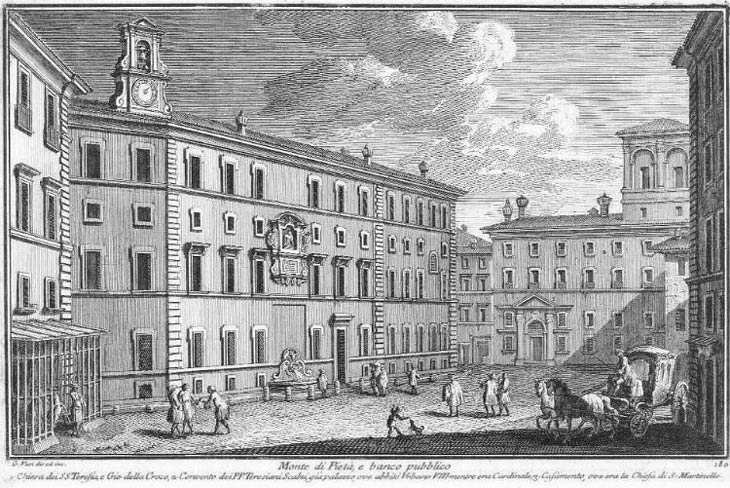
The Sacro Monte di Pietà di Roma reached its permanent home only after two earlier seats. According to the Italian institutional census of the Monti (the Mons Pietatis database of Italian Monti) and Donato Tamilia's documentary history Il Sacro Monte di Pietà di Roma (1900), the Monte first operated in the Banchi Vecchi near Santa Lucia del Gonfalone; in 1585 Sixtus V bought it a building on Via dei Coronari for 7,000 scudi. In 1603 the Monte acquired the palazzo in Rione Regola that now bears its name, a block near Santissima Trinità dei Pellegrini, south of Campo de' Fiori. The core of that building had been designed in 1588 by Ottaviano Mascarino (Mascherino) for Cardinal Prospero Santacroce and passed in 1591 to the Petrignani family of Amelia before its sale to the Monte. Under Clement VIII Aldobrandini, and on the commission of Cardinal Pietro Aldobrandini, Carlo Maderno enlarged the palazzo, with the young Francesco Borromini reportedly assisting; Maderno also designed the commemorative plaque on the main front, an aedicule with the dead Christ rising from the tomb (the emblem of the Monte) flanked by the arms of Paul III Farnese, the founder, and Clement VIII. Giuseppe Vasi, describing the square in Delle magnificenze di Roma antica e moderna (book 9, 1759), records that Maderno also designed two fountains fed by the Acqua Paola in 1613. Building campaigns continued for more than a century. The architects associated with the works include Breccioli, Francesco Peparelli, Giovanni Antonio De Rossi and, for the rear front towards the Trinità dei Pellegrini, Nicola Salvi, the architect of the Trevi Fountain, whose façade is dated 1735 to 1740. In 1759 the Monte bought the adjacent Casa Grande of the Barberini (the former residence of Urban VIII as cardinal, latterly a Carmelite house), and an arch over the street, the Arco del Monte, was built to link the two buildings (dated 1762 or 1768 in different accounts). The standard architectural monograph is Marina Carta's Palazzo del Monte di Pietà di Roma (1994). The palazzo, whose façades were repainted in 2014 in their eighteenth-century colour, still houses a pawn-lending business, now a private credito su pegno company.
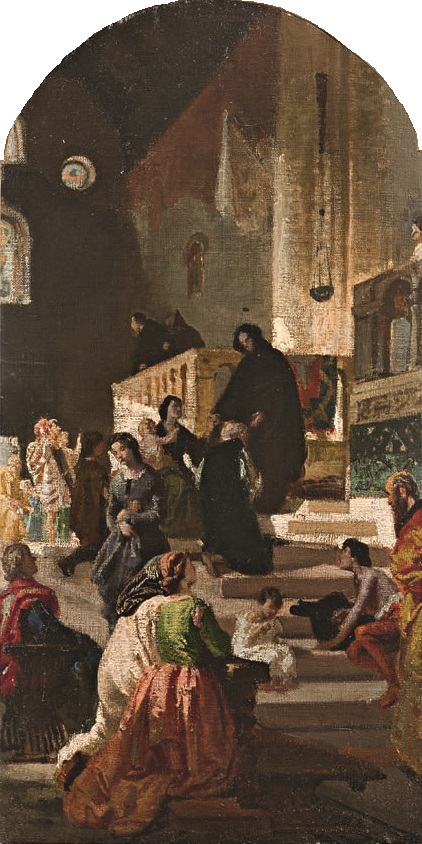
The artistic centre of the palazzo is the Cappella della Santissima Trinità (or Cappella del Monte di Pietà), entered from the portico and rarely open. A first chapel by Maderno opened on 5 June 1618. In 1639 the Arciconfraternita del Sacro Monte di Pietà commissioned Francesco Peparelli to rebuild it; after his death in 1641 Giovanni Antonio De Rossi took over, giving the room its oval plan articulated by paired Corinthian pilasters in Sicilian jasper, and the decoration was carried through to completion around 1725 to 1730 by Carlo Francesco Bizzaccheri (chronology after Roma Segreta and Roma Felix, which differ on Bizzaccheri's starting date, 1696 or 1725). The chapel is among the most complete late Baroque sculptural interiors in Rome, and it is notable that the program substitutes marble reliefs for altarpieces. The high altar carries Domenico Guidi's white Carrara marble Pietà (1676), the image that gave the Monti their name and emblem. On the side walls are two large narrative reliefs chosen for a lending institution: Pierre Legros the Younger's Tobias relief (catalogued as Tobias and Gabael, the biblical episode of money deposited in trust and later reclaimed, though some guides call it Tobias and the Angel) and Jean-Baptiste Théodon's Joseph and his Brothers in Egypt, the story of the provident steward who stored grain against famine. They are flanked by statues of the virtues: Faith by Francesco Moderati, Hope by Agostino Cornacchini, Charity by Giuseppe Mazzuoli and Almsgiving by Bernardino Cametti. Domenico Guidi also carved the bust of Carlo Borromeo in the vestibule. The vault, begun under De Rossi, is an institutional history in stucco: four medallions by Lorenzo Ottoni, Simone Giorgini and Michele Maglia show Paul III confirming the Monte's privileges in the presence of Cardinals Santacroce and Farnese and of the founder Giovanni da Calvi, Pius IV's donations, Sixtus V pointing the poor to the new seat, and Clement VIII handing Cardinal Aldobrandini the chirograph in favour of the Monte; the gilded stucco frames are by Niccolò and Andrea Berrettoni, Giovanni Maria Galli da Bibbiena and Filippo and Cinzio Ferrari. Outside the chapel, the movement left a large visual culture: the Pietà or Christ in the tomb used as a sign over Monti across Italy, and the cult of the Observant founders in paintings such as Federico Faruffini's nineteenth-century Blessed Bernardino da Feltre distributing bread to the poor. Maria Giuseppina Muzzarelli's Il denaro e la salvezza: L'invenzione del Monte di Pietà (Il Mulino, 2001) gives particular attention to this persuasive power of the Pietà image. Vasi's etching of the piazza (plate 180, 1759) is the classic eighteenth-century view of the building.
The palazzo stands on the small Piazza del Monte di Pietà in Rione Regola, between Campo de' Fiori and the Tiber, a few steps from Santissima Trinità dei Pellegrini, Palazzo Spada and Via dei Giubbonari. The Monte's moves trace the geography of Roman finance. Its first seat lay in the Banchi Vecchi, the banking street of Florentine and Genoese houses on the road to the Vatican; its 1585 house on Via dei Coronari was in the same bend of the Tiber; and the permanent site in Regola placed it in a dense quarter of artisans, cloth dealers and second-hand trades, close to the Jewish Ghetto that Paul IV enclosed in 1555 a short distance downstream. That proximity matters: as Brian Pullan noted in his British Academy lecture Charity and Usury: Jewish and Christian Lending in Renaissance and Early Modern Italy (2004), Roman Monte officials were accused in the seventeenth century of valuing pledges low in order to push borrowers towards the Jewish banks, a sign that the two sets of lenders served overlapping clients in the same streets. Vasi's text accompanying plate 180 (1759) adds a policing detail: because people carried valuables to and from the Monte, the square was notorious for theft, and the papal authorities set up a bargello (police post) nearby. By the eighteenth century the building had become the place where the papal state's money was handled: the Monte housed the Depositeria della Camera Apostolica and the Tesoreria segreta from 1743, and the mint from 1749 (Mons Pietatis database). The modern street pattern still shows the institution's footprint, from the Arco del Monte to the shops around the square that buy gold and redeem pledges. In Venice the analogue is Ca' Corner della Regina on the Grand Canal, which became the seat of the city's Monte di Pietà in 1834 and kept that role until 1969. In 2024 Fondazione Prada, which has used the palazzo as its Venice venue since 2011, showed there Christoph Büchel's installation Monte di Pietà (20 April to 24 November 2024), a failing pawnshop reconstructed on the building's former use and framed as a meditation on debt.
The Monti di Pietà were invented by the Observant Franciscans. As Pullan (2004) summarises, during the century after the first foundation at Perugia in 1462 more than two hundred Monti were founded in Italy, about ninety owing their existence at least in part to Observant preachers who arrived with model statutes and legal opinions. At Perugia, the Dizionario Biografico degli Italiani credits Michele Carcano, invited by the governor Ermolao Barbaro, with the preaching of early 1462 that led the council to found the Monte in April of that year (operating from February 1463); much of the literature credits Barnaba Manassei da Terni, though Treccani notes this is not documented. Bernardino da Feltre (1439-1494) became the movement's most energetic promoter, founding or reforming Monti at Mantua, Padua, Piacenza and elsewhere; Vittorino Meneghin's Bernardino da Feltre e i Monti di Pietà (1974) and I Monti di Pietà in Italia dal 1462 al 1562 (1986) remain the basic studies. Florence followed in 1495-96, after the expulsion of the Medici; Carol Bresnahan Menning's Charity and State in Late Renaissance Italy: The Monte di Pietà of Florence (Cornell, 1993) shows how a charitable pawnshop intended to supplant Jewish lenders became, after it was allowed interest-bearing deposits in 1530, a savings institution and instrument of Medici patronage and state finance. The movement was frankly anti-Jewish as well as anti-usury. Pullan stresses that the friars attacked all usurers but particularly Jews, seeking not only to end their lending but to forestall intimacy between Jews and Christians; at Padua in 1491 Bernardino hung a banner on a former Jewish bank 'to the perpetual confusion of Satan and the perversion of usury'. His preaching at Trent in 1475 preceded the ritual-murder accusation over the boy Simon, studied by R. Po-chia Hsia in Trent 1475 (Yale, 1992). Yet the outcome was coexistence more than replacement: Monti borrowed from Jewish banks to start, Jewish lenders served a broader consumer market, and expulsion often came decades later. Rome founded its Monte only in 1539, on the petition of the Observant Giovanni Maltei da Calvi, approved by Paul III's bull of 9 September; Jewish loan banks in Rome were closed only by Innocent XI's order of 1682, when the Monte handled some 85 per cent of personal loans (Pullan, 2004). Venice, Pullan observes, was probably the only great Italian city never to adopt an orthodox Monte before 1806; two attempts in the 1520s failed, and from 1573 the Ghetto's Jewish community was obliged to run non-profit banks for the poor at 5 per cent. Doctrinal controversy, led by Dominicans who mocked the 'Mons Impietatis', was settled by Leo X's bull Inter multiplices at the Fifth Lateran Council (4 May 1515), which declared that a moderate charge to cover expenses, without profit, was not usury. In Rome Cardinal Carlo Borromeo, protector from 1564, gave the Monte statutes in 1565; Gregory XIII (1584) required judicial deposits to be lodged with it. The Monte was merged into the Cassa di Risparmio di Roma by royal decree of 18 February 1937; its archive, owned by UniCredit, is held by Fondazione Roma.
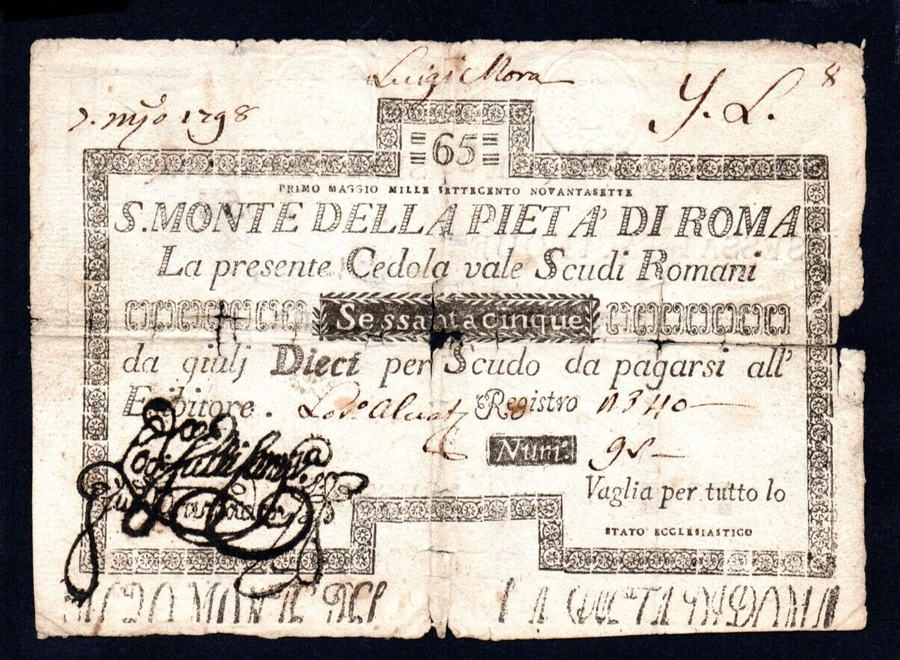
The core business was the pawn (pegno). Borrowers brought clothing, linen, tools, jewels and plate; appraisers valued them, and the Monte lent a fraction of the value for a fixed term, typically a year. Pullan (2004) lists the founding principles: loans on pledges only, not promissory notes; no compound interest; no higher charges on smaller loans; and no more than ten per cent, with five per cent becoming the widely accepted rate, against twenty-five to thirty per cent commonly sanctioned for Jewish banks and up to sixty per cent in small towns. The charge was justified as payment for staff, premises and storage, the loan itself being gratuitous. In Rome, Vasi's 1759 description records loans up to fifteen scudi without interest and larger sums at five per cent, with unredeemed pledges auctioned after seven months and any surplus returned to the owner; the Mons Pietatis database dates complete gratuity of lending to 1636. Pledges thus created a secondary market in second-hand goods, the auction sales of the Monte. The Monti also became deposit banks. Pullan describes the decisive step as permission to pay interest on deposits, borrowing at perhaps four per cent and lending about two points higher, approved by Paul III for Modena in 1542. Florence took interest-bearing deposits from 1530 (Menning, 1993). In Rome the Monte's depositary receipts (cedole) were declared payable to bearer from 1724 and circulated as money; from 1785 it issued printed cedole of 3 to 1,500 scudi alongside the Banco di Santo Spirito, until wartime overissue and the Roman Republic of 1798 destroyed their value. In Naples the Monte della Pietà, founded in 1539, began taking deposits and became a banco in 1584, a lineage that ended in the Banco di Napoli. Siena's Monte Pio (1472) is the ancestor of the Monte dei Paschi, refounded in 1624 with the Maremma pasture revenues (paschi) as security for its depositors (Banca MPS historical notes). Mauro Carboni and Massimo Fornasari ('The untimely demise of a successful institution', Financial History Review, 2019) follow the Monti into the nineteenth century. A distinction is essential. The word monte (heap, fund) also named the Roman public debt, which was a different institution. From Clement VII's Monte della Fede of 1526 the Camera Apostolica issued successive monti camerali, each divided into luoghi di monte of 100 scudi, transferable shares paying fixed interest; vacabili luoghi lapsed at the holder's death and paid roughly double the rate of perpetual non vacabili. The debt rose from about 10 million scudi in 1590 to some 37 million by 1672; see Fausto Piola Caselli's chapter on papal public debt in Government Debts and Financial Markets in Europe (2008). The two were linked administratively rather than conceptually: in 1743 Benedict XIV merged the Depositeria that paid interest on the luoghi into the Monte di Pietà, which thereby became the paying agent of the papal debt as well as the city's pawnbank.