Rio de Janeiro Stock Exchange (Bolsa de Valores do Rio de Janeiro)
Rio de Janeiro, Brazil · Established 1845
This site requires authorization to access.
To request access, contact
william.goetzmann@yale.edu
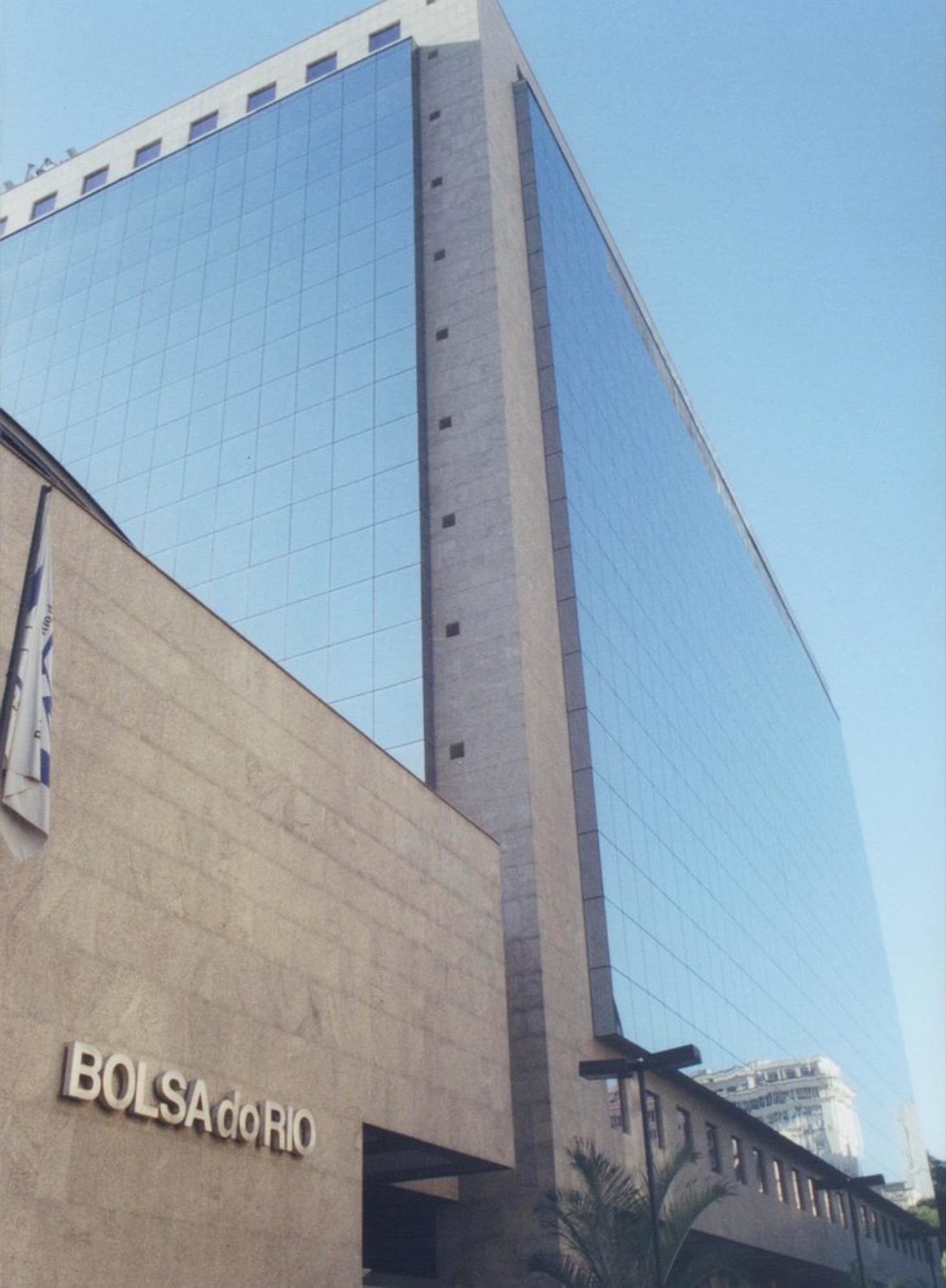
The Bolsa de Valores do Rio de Janeiro occupied several premises over its long institutional life, each reflecting a distinct phase of Brazilian commercial architecture. The exchange’s earliest ancestor was the Praça do Comércio, a neoclassical pavilion designed by Auguste Henri Victor Grandjean de Montigny—the French architect who arrived with the Missao Artística Francesa in 1816—and inaugurated on 13 May 1820 at the waterfront near the Candelaria church. As Margareth da Silva Pereira documented in her study of Grandjean’s Brazilian oeuvre, the building featured a vaulted nave with zenith illumination through a central dome, flanked by twenty-four Doric columns in the manner of a Roman basilica, with subsidiary rooms occupying the four corners (Pereira, “Grandjean de Montigny e a Arquitetura no Brasil,” in Grandjean de Montigny: Da Arquitetura Civil, PUC-Rio, 2008). This structure—today the Casa França-Brasil—served as the city’s first formal commercial exchange for only four years before Pedro I converted it to a customs house. Brokers subsequently conducted business in open-air gatherings along the Rua Direita (later renamed Rua Primeiro de Março), the colonial city’s commercial spine. In 1834, the city council commissioned Grandjean to design a public market on the site at Praça XV de Novembro, and this market building—demolished during the Pereira Passos urban reforms of 1903–1906—eventually gave way to the purpose-built Edifício Bolsa do Rio. The exchange began operations in its new headquarters at Praça XV de Novembro, 20, on 4 December 1935, though the formal inauguration did not occur until 24 December 1938. The building, influenced by the eclectic and early modernist idiom then prevailing in Rio’s Centro district, provided a double-height pregão (trading hall) where brokers conducted viva-voz (open outcry) transactions beneath high ceilings designed to accommodate the din of speculative commerce. As Carlos Cova recounts in Pulsão do Mercado: Uma História da Bolsa de Valores do Rio de Janeiro (Jakobsson Estúdio, 2020), the building’s siting at Praça XV deliberately anchored the exchange to the historic locus of royal and imperial power—the Paço Imperial stood directly across the square—thereby conferring upon securities trading the symbolic gravitas of the state.
The decorative program of the Bolsa de Valores do Rio de Janeiro reflected the tensions between European academic tradition and emerging Brazilian modernism that characterized Rio’s public architecture during the Vargas era. The pregão hall at Praça XV featured restrained classical ornament—coffered ceiling panels, fluted pilasters, and cornices rendered in the eclectic vocabulary common to Rio’s financial district—while incorporating Art Deco geometric motifs in metalwork balustrades and light fixtures that echoed the modernizing ambitions of the 1930s Estado Novo. The exchange’s interior made prominent use of Brazilian hardwoods and polished granite, materials that signaled both national identity and institutional permanence. The ticker boards and quotation displays, updated manually in the early decades and later electrified, constituted a form of functional decoration in themselves—the typographic grid of share prices serving as both financial instrument and visual spectacle. As Maria Bárbara Levy noted in História da Bolsa de Valores do Rio de Janeiro (IBMEC, 1977), the physical environment of the pregão was inseparable from the culture of speculation: brokers in colored vests gestured and shouted beneath the hall’s ornamental ceiling, their bodies composing a kinetic tableau not unlike the market scenes depicted by Jean-Baptiste Debret in his Voyage Pittoresque et Historique au Brésil (1834–1839), which captured the bustling commercial life of the Rua Direita in the Joanine period. The earlier Praça do Comércio designed by Grandjean de Montigny had deployed a more austere neoclassical decorative scheme—the monumental Doric colonnade, the restrained mouldings, the dome admitting zenithal light—reflecting the Enlightenment rationalism of the French Artistic Mission. Financial instruments themselves constituted objects of graphic design: the ornately engraved share certificates (cautções) of nineteenth-century Brazilian companies, with their allegorical vignettes of commerce, industry, and agriculture, circulated as artifacts of both economic and visual culture, as analyzed in the exhibition catalog A Arte dos Negócios: Força e Beleza dos Títulos Brasileiros (Museu de Valores do Banco Central, 2009).
The Bolsa de Valores do Rio de Janeiro stood at the epicenter of Brazil’s historic financial geography, on the western edge of Praça XV de Novembro facing Guanabara Bay. This square—originally the Largo do Paço—had served since the mid-eighteenth century as the ceremonial and administrative heart of colonial, and later imperial, Brazil. The Paço Imperial, residence of the Portuguese viceroys from 1743 and of the Brazilian emperors after independence in 1822, occupied the square’s southern flank, while the stone quay at the waterfront received both passenger ferries and commercial vessels. As Nireu Cavalcanti detailed in O Rio de Janeiro Setecentista: A Vida e a Construção da Cidade (Jorge Zahar, 2004), the Rua Direita (renamed Rua Primeiro de Março in 1870) ran northward from the square as the colonial city’s primary commercial artery—Jean-Baptiste Debret likened it to the Rue Saint-Honoré of Paris for the wealth of its merchant houses. By the late nineteenth century, the surrounding blocks had consolidated into a dense financial district: the Banco do Brasil, established in 1808 by decree of Dom João VI and housed after 1880 in a monumental eclectic building designed by Francisco Joaquim Bethencourt da Silva with a glass dome and Portuguese stone carvings, stood nearby on Rua Primeiro de Março. The Candelaria church, rebuilt in neoclassical style with Italian marble between 1775 and 1898, anchored the northern terminus of this financial corridor. The Pereira Passos urban reforms of 1903–1906—modeled on Haussmann’s transformation of Paris—demolished the cramped colonial streetscape to create the broad Avenida Central (later Avenida Rio Branco), lined with Beaux-Arts commercial palaces. As Jaime Larry Benchimol argued in Pereira Passos: Um Haussmann Tropical (Biblioteca Carioca, 1992), these reforms physically restructured the relationship between the exchange district and the modernizing city, replacing the intimate colonial fabric with monumental boulevards that projected Brazil’s aspirations to cosmopolitan modernity. The exchange’s location at Praça XV thus placed it within walking distance of the customs house, the central post office, the ferry terminal to Niterói, and the principal banking houses—a compact financial ecosystem that persisted until the transfer of the national capital to Brasília in 1960 eroded Rio’s administrative primacy.
The Bolsa de Valores do Rio de Janeiro traces its origins to the arrival of the Portuguese court in Rio de Janeiro in 1808, when Dom João VI opened Brazilian ports to international trade and established the Banco do Brasil, creating the institutional foundations for a securities market. As Maria Bárbara Levy documented in her pioneering História da Bolsa de Valores do Rio de Janeiro (IBMEC, 1977)—a work reviewed in the Business History Review as groundbreaking for Latin American financial history—formal brokerage activity commenced with the inauguration of the Praça do Comércio on 13 May 1820, three years after Salvador’s exchange, making Rio’s among the earliest in the Americas. Imperial Decree No. 417 of 1845 formalized the profession of the corretor de fundos (securities broker), establishing the regulatory framework that Maria Bárbara Levy identified as the effective founding of an organized exchange. The Viscount of Mauá—Irineu Evangelista de Sousa, whom Anyda Marchant profiled in Viscount Mauá and the Empire of Brazil (University of California Press, 1965)—catalyzed the market’s growth through his railroad, banking, and industrial enterprises, channeling capital that had previously flowed from the slave trade into productive investment. The Encilhamento of 1889–1891 marked the exchange’s first great speculative crisis: as Gail Triner analyzed in Banking and Economic Development: Brazil, 1889–1930 (Oxford University Press, 2000), Finance Ministers the Viscount of Ouro Preto and Ruy Barbosa unleashed a torrent of credit and new company formations—listed firms surging from roughly 90 in 1888 to some 450 by mid-1891—before the bubble collapsed amid fraudulent IPOs and monetary inflation, an episode that Carlos Marichal’s A Century of Debt Crises in Latin America (Princeton University Press, 1989) situated within the broader contagion of the Baring Crisis. The BVRJ remained Brazil’s preeminent exchange through the mid-twentieth century, but the transfer of the capital to Brasília in 1960 and the military government’s securities-market reforms of 1964–1965 shifted competitive advantage toward São Paulo’s Bovespa. The 1971 stock market boom and bust accelerated this decline, and the devastating 1989 crash—triggered when speculator Naji Nahas defaulted on obligations exceeding US$500 million, collapsing the BVRJ’s clearing house—proved fatal. The exchange limped on as a government-bond trading platform before its sale to the BM&F (Bolsa de Mercadorias e Futuros) on 11 April 2002, ending nearly two centuries of securities trading in Rio de Janeiro.
The Rio de Janeiro exchange handled a diverse and evolving portfolio of financial instruments that mirrored Brazil’s economic transformation from a slave-based plantation economy to an industrializing republic. In its earliest decades, government bonds—the apólices da dívida pública, bearing fixed interest and backed by imperial revenues—dominated trading, as the Brazilian state borrowed to finance infrastructure, military campaigns (notably the Paraguayan War of 1864–1870), and compensation to Portugal for recognizing Brazilian independence. As Aldo Musacchio documented in Experiments in Financial Democracy: Corporate Governance and Financial Development in Brazil, 1882–1950 (Cambridge University Press, 2009), the exchange’s role expanded dramatically with the proliferation of joint-stock companies: railway shares—particularly those of the Mauá and São Paulo Railway companies—became major trading vehicles, alongside banking stocks, insurance company shares, and debentures. The coffee economy profoundly shaped the securities landscape: as Steven Topik argued in The Political Economy of the Brazilian State, 1889–1930 (University of Texas Press, 1987), coffee export revenues sustained the fiscal apparatus that underwrote government bonds, while coffee warehousing and transport companies issued shares and mortgage bonds (letras hipotecárias) that circulated actively on the pregão. During the Encilhamento of 1889–1891, the exchange witnessed frenzied trading in the shares of newly formed industrial enterprises, textile mills, and speculative ventures, many of them fraudulent—three asset classes dominated: stocks, debentures, and mortgage bonds, as documented in Levy’s História da Bolsa de Valores do Rio de Janeiro (IBMEC, 1977). In the twentieth century, the BVRJ became a major market for federal and state government bonds, public utility shares, and—after the military government’s capital-market reforms of the 1960s—the tax-advantaged Decree-Law 157 mutual funds that channeled savings into equities. By the 1980s, amid hyperinflation and indexation, overnight repurchase agreements and inflation-indexed government securities had become the exchange’s primary instruments, a financialization of debt that André Lara Resende analyzed in “Stabilization and Reform in Brazil” (in Economic Reform in New Democracies, Cambridge University Press, 1993).
Images will be added as the project develops. Photographs by Larry Ng and from research sources.