Riga Stock Exchange (Rīgas Birža)
Riga, Latvia · Established 1816
This site requires authorization to access.
To request access, contact
william.goetzmann@yale.edu
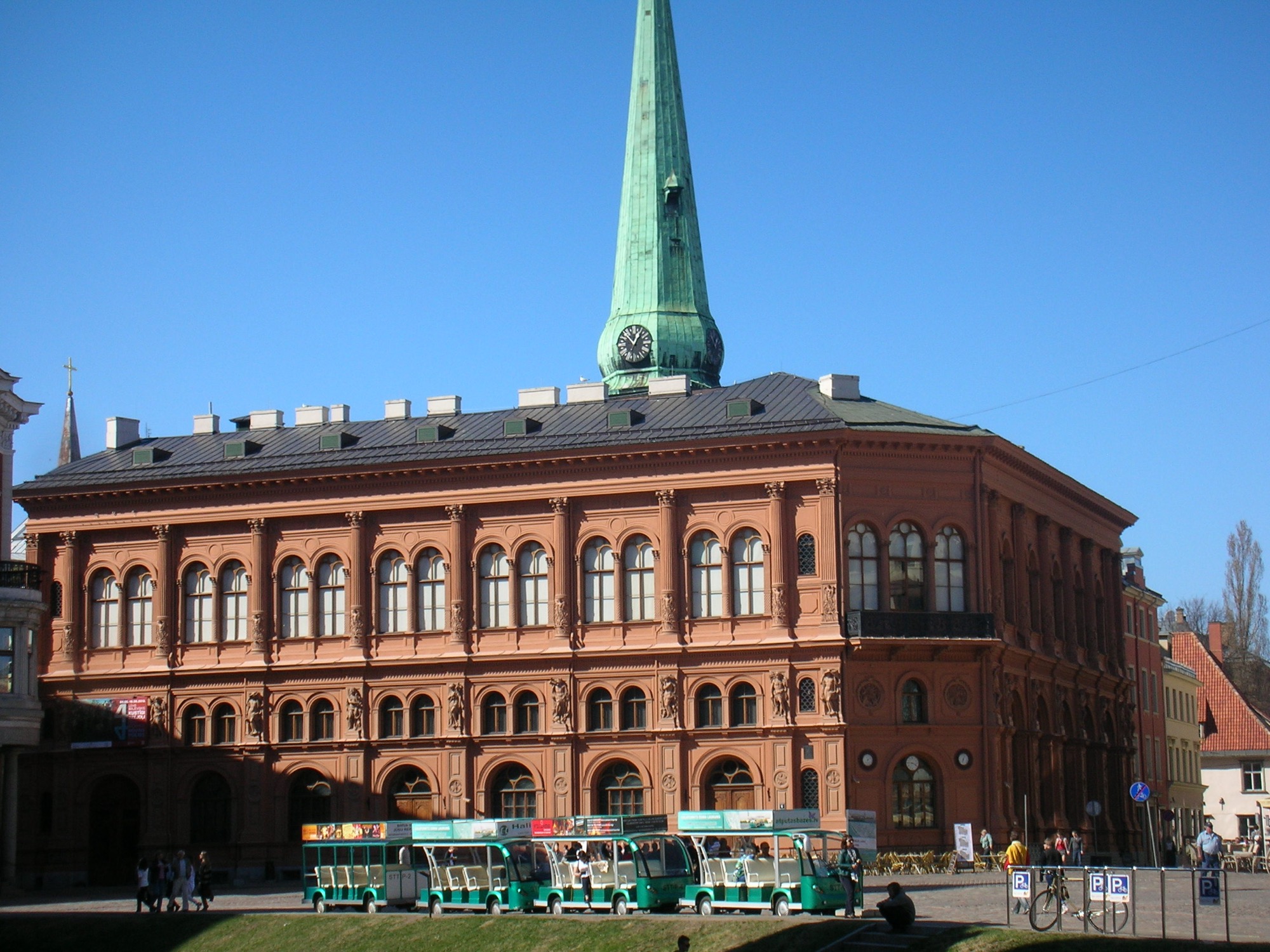
The Riga Stock Exchange (Rīgas Birža) at Doma laukums 6 was designed by Harald Julius von Bosse (1812–1894), a Baltic German architect trained at Darmstadt who became a professor at the Imperial Academy of Arts in St. Petersburg in 1854 and court architect in 1858. Bosse began his design in 1850, but the Exchange Committee rejected his initial site; construction ultimately commenced on 25 March 1852 at the corner of Pils iela, Skūņu iela, and Jēkaba iela, on Dome Square. The building was completed in 1855 and ceremonially opened on 26 May 1856 in the presence of Tsar Alexander II, who timed his visit to Riga for the occasion. Bosse modeled the structure on the Venetian Renaissance palazzo, employing tall semicircular windows, columns, pilasters, and terracotta ornament to project an image of mercantile wealth and abundance. As Ojars Sparitis documents in “Terracotta Sculpture on the Riga Stock Exchange Facade” (Acta Academiae Artium Vilnensis, no. 104, 2022), the facade was enriched with terracotta sculptures and medallions of allegorical content, executed in the St. Petersburg workshop of the Danish sculptor David Jensen. The ground floor housed the main trading hall in a comparatively austere style suited to commercial business, while the upper stories contained ceremonial halls and galleries with lavish gilding, artificial marble, parquet flooring, gilded chandeliers, and mirrors. Neo-Gothic doors within former safes survive as vestiges of the building’s financial function. Designated a State Cultural Monument of national importance, the building underwent major reconstruction from 2008 to 2011 by general contractor RBS Skals with design by Arhitektoniskas izpetes grupa Ltd. Since 20 August 2011, the building has served as the Art Museum Riga Bourse (Mākslas muzejs Rīgas Birža), housing Latvia’s most extensive collection of foreign art.
The decorative program of the Riga Stock Exchange facade constitutes one of the most elaborate allegorical sculptural ensembles on any nineteenth-century Baltic exchange building. As Sparitis details in his 2022 study in Acta Academiae Artium Vilnensis, architect Harald Bosse intended the facade sculptures to illustrate the specific transactions conducted at the Riga exchange. The Danish sculptor David Jensen, working from his St. Petersburg atelier, produced terracotta figures of ancient gods and personifications: Mercury with a sail and bundles of goods at his feet as guardian of trade; Saturn representing agriculture; Tritons symbolizing seafaring; Faunus for animal husbandry; a personification of the textile industry depicted with bundles of flax and linen and a distaff, acknowledging Riga’s key linen export trade; and Pomona as nymph of fruit-bearing crops. Each figure appears three times across the facade, totaling eighteen sculptural groups accompanied by decorative medallions with emblematic content. Jensen’s achievement, as Sparitis argues, was to create images where aestheticized antique form conveyed the content of a modern industrial era, allegorically reflecting the economic life of Riga and its administrators’ self-perception. The interior decorative program is equally ambitious: the ceremonial halls on the upper floors feature extensive gilding on walls and ceilings, artificial marble paneling, wallpaper printed on historical machines in Germany, polished wood showcases, and gilded chandeliers. The building’s current function as art museum allows its original decorative interiors to interact with the collections, creating what the Latvian National Museum of Art describes as “a united ensemble.” The museum now displays European paintings including Dutch Golden Age and German Romantic works, ancient Egyptian and Greco-Roman artifacts, and the largest collection of Asian art in the Baltic states, all framed within Bosse’s original historicist interior scheme.
The Riga Stock Exchange stands on Dome Square (Doma laukums), the largest public space in Riga’s Old Town (Vecrīga), where seven streets converge in the heart of the UNESCO World Heritage-listed Historic Centre of Riga (inscribed 1997). The building faces the Riga Dome Cathedral, the medieval church whose presence has anchored civic life since the thirteenth century. Riga’s commercial identity is inseparable from its position on the Daugava River, some fifteen kilometers from the Baltic Sea, a location that Bishop Albert exploited when founding the city in 1201. Riga joined the Hanseatic League in 1282 and rapidly became a key eastern node in the League’s Baltic network, with North German merchants and craftsmen settling in the city from its earliest decades. The Great Guild (Die Grosse Gilde zu Riga), founded as the Guild of the Holy Cross around 1252 and formalized in 1354, organized the city’s German-speaking merchant elite for nearly six centuries until its dissolution in 1936. The nearby House of the Blackheads, originally erected in 1334 as a warehouse and meeting hall for unmarried merchants and shipowners, was destroyed in 1941 and faithfully reconstructed from archival studies between 1996 and 2000. The Spīķeri warehouse district along the Daugava, where fifty-eight red-brick granaries were built between 1864 and 1886 to store hay, oats, linseed, and timber, physically embodied the infrastructure of Riga’s export trade. This concentration of merchant guild halls, exchange buildings, warehouses, and ecclesiastical architecture within the compact medieval street plan of Vecrīga makes the area a remarkably legible material record of Baltic commercial urbanism.
In the first half of the nineteenth century, as Riga’s trade expanded, its merchants established the Stock Exchange Committee (Börsencomité) as a permanent institution to govern commercial affairs. Until 1847, all deals were conducted in the City Hall (Rathaus), but that year the Great Guild voted to vacate the premises and build a dedicated structure. Construction of the new exchange began in 1852 and the building opened in 1856. The Riga Bourse Committee proved instrumental in modernizing the city’s commercial infrastructure, financing the first telegraph line in 1852 and promoting railroad expansion, as Katja Wezel documents in “The Most Successful Trading Hub in Late Imperial Russia” (Zeitschrift für Ostmitteleuropa-Forschung, 2021, DOI: 10.25627/202170311017). The Riga-Daugavpils railway opened in 1848 and the transformative Riga-Tsaritsyn line in 1871, connecting the port to the Russian interior’s grain-producing black-earth regions. By 1901–1905, Riga had surpassed St. Petersburg and Odessa to become the Russian Empire’s highest-value export port, handling 18.2 percent of Russia’s total exports by 1913 and maintaining over 800 trading partners worldwide. The Bourse Committee also managed port infrastructure, owning dredgers, cranes, and icebreakers. Wezel’s study in the Jahrbuch für Wirtschaftsgeschichte (2024, DOI: 10.1515/jbwg-2024-0018) shows how the Exchange Committee represented businessmen of all ethnic backgrounds by the early twentieth century. World War I and the Russian Revolution ended the old exchange system. Under Soviet rule the building became the House of Science and Technology Propaganda. After Latvian independence was restored, the Riga Stock Exchange was reestablished in 1993 and held its first trading session in 1995 in the historical building on Dome Square, with the opening bell a bronze gift from the Paris Stock Exchange. The exchange later joined the OMX group and is now Nasdaq Riga, while the historic building was restored and reopened in 2011 as the Art Museum Riga Bourse.
Riga’s exchange economy rested on the Baltic commodity trades that had sustained the city since its Hanseatic origins: flax, hemp, timber, grain, tallow, and linseed. As the leading Baltic export port for flax throughout the eighteenth century, Riga shipped approximately 65,900 shippounds of flax annually during 1801–1806 and 120,300 shippounds of hemp in the same period, according to data compiled by Artur Attman in “The Russian Market in World Trade, 1500–1860” (Scandinavian Economic History Review, 1981, DOI: 10.1080/03585522.1981.10407958). These fibrous commodities were essential to European shipbuilding: hemp for rigging and rope, flax for sailcloth. Russia held a virtual natural monopoly on these articles as long as sailing vessels dominated oceanic transport. The opening of the Riga-Tsaritsyn railroad in 1871 briefly made grain the port’s most dynamic export, connecting Riga to the southern black-earth wheat districts and triggering a grain trade heyday in the 1870s, though Western European protective tariffs and the German-Russian trade war peaking in 1893 subsequently curtailed grain volumes. Meanwhile, timber exports expanded dramatically. Wezel’s 2024 study documents that raw wood shipments increased roughly fivefold between 1866 and 1910, from 14.3 million cubic feet annually to 74.7 million by 1906–1910, with the United Kingdom absorbing the majority as railroad sleepers and construction materials. By 1906, Riga also handled 59.5 percent of Russia’s butter exports and 40.1 percent of its egg exports, facilitated by a cold storage facility financed by London’s Union Society in 1902. Trading on the exchange floor followed the open-outcry conventions standard across European bourses of the period, with the Exchange Committee publishing price lists, regulating transactions, and adjudicating commercial disputes among its multi-ethnic membership of Baltic German, Jewish, Latvian, Russian, and Polish merchants.
Images will be added as the project develops. Photographs by Larry Ng and from research sources.