Richmond Stock Exchange
Richmond, USA · Established 1870s
This site requires authorization to access.
To request access, contact
william.goetzmann@yale.edu
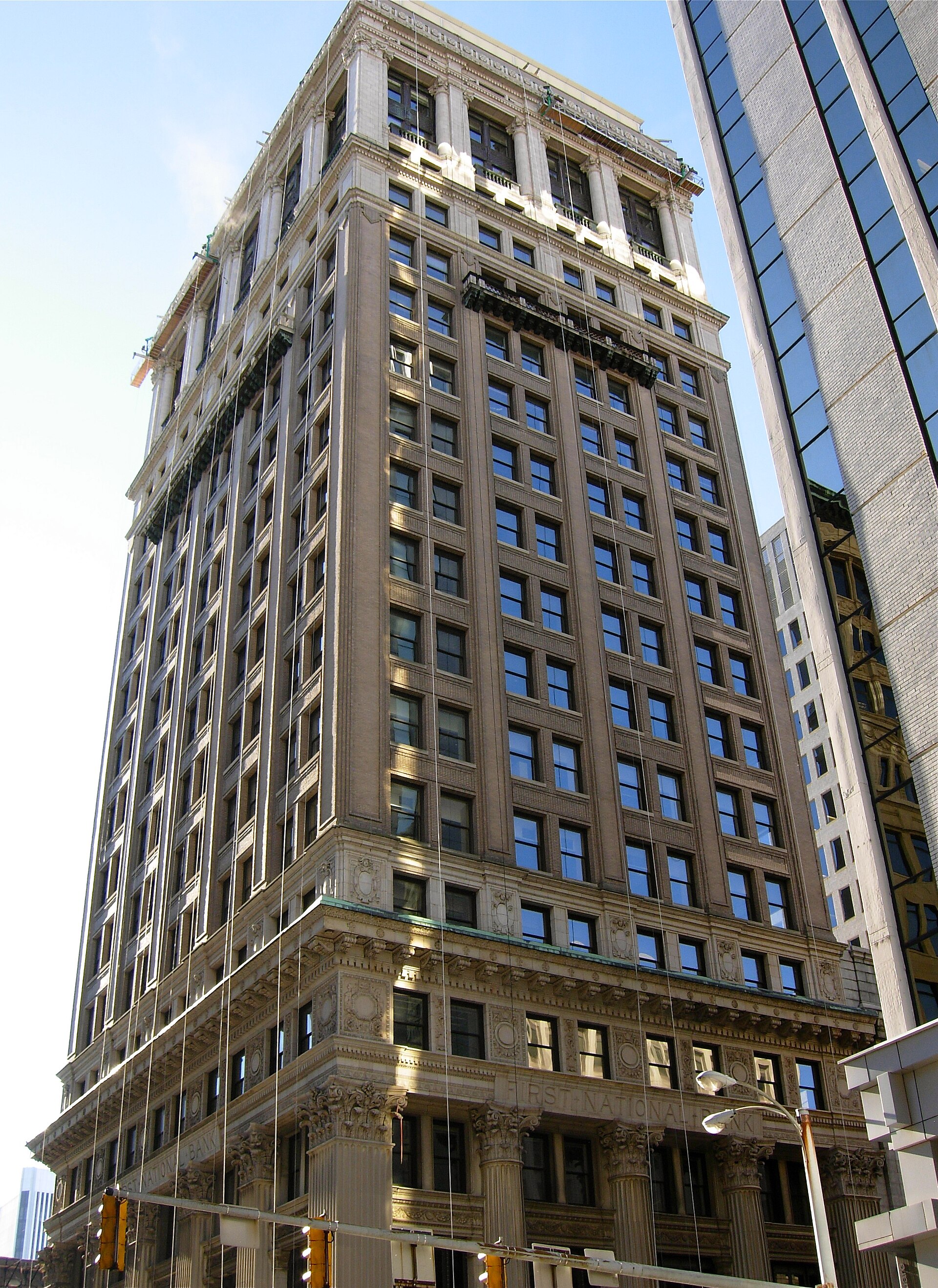
The Richmond Stock Exchange never occupied a purpose-built trading hall; instead, its members convened daily at noon inside the First & Merchants National Bank Building at the corner of Ninth and Main Streets, a nineteen-story Classical Revival skyscraper designed by the English-born architect Alfred Charles Bossom and completed in 1913. As Robert Winthrop documented in Architecture in Downtown Richmond (2004), Bossom’s steel-frame tower—clad in brick, limestone, and granite—was Richmond’s first high-rise office building and its tallest structure for seventeen years. The base features fifty-foot fluted Corinthian pilasters and engaged columns supporting a seventeen-and-a-half-foot entablature rich with classical ornament, while the shaft rises through nine stories of deeply recessed paired windows to an extraordinarily ornate, four-story terra-cotta crown. The interior banking hall, where exchange members gathered around a small call-board to disseminate quotations, contained marble-clad columns supporting low-springing arches that framed groin vaults once stenciled with mosaic patterns. Two hand-forged circular vault doors made by the Diebold Company of Canton, Ohio—reportedly hauled up Main Street by mules during construction—remain the only surviving examples of their type. This monumental Beaux-Arts envelope, as the Society of Architectural Historians’ SAH Archipedia notes, deliberately evoked “the order and authority of great civilizations” to project financial stability along Richmond’s Main Street Banking Historic District, listed on the National Register of Historic Places in 2005.
The decorative program of Richmond’s financial district reflected the ambitions of a Southern capital rebuilding itself after the catastrophic Evacuation Fire of April 1865, which destroyed over eight hundred buildings across thirty-five blocks of the commercial core. As the Virginia Department of Historic Resources documented in the Main Street Banking Historic District nomination (2005), the post-war reconstruction introduced prefabricated cast-iron facades—designed by architects such as George H. Johnson working with the Baltimore foundry Hayward, Bartlett & Company—that gave downtown a dignified, classically inflected appearance at minimal expense. Inside the First National Bank Building where the stock exchange met, Bossom deployed a restrained but impressive decorative vocabulary: marble detailing throughout the ground-floor banking room, groin-vaulted ceilings adorned with stenciled mosaic patterns, and the proud Corinthian order carried from the street façade into the interior colonnade. The broader financial district along Main Street presented an ensemble of Italianate, Italian Renaissance, Neoclassical Revival, and Beaux-Arts ornament, with buildings designed by prominent firms including Clinton and Russell of New York (who executed four structures) and Richmond architects W. Duncan Lee, Charles M. Robinson, and Marcellus Wright, Sr. These commercial interiors typically featured carved stone entablatures, ornamental metalwork, and marble lobbies that signaled creditworthiness—what architectural historian Dell Upton, in Another City: Urban Life and Urban Spaces in the New American Republic (2008), described as the architecture of commercial trust essential to antebellum and postbellum Southern finance.
Richmond’s Main Street functioned as what the Virginia Department of Historic Resources has called “the historic financial center for the capital and, for a time, Virginia”—a compact corridor of banks, insurance companies, and securities firms stretching eastward from the State Capitol toward Shockoe Bottom and the James River waterfront. The financial district lay adjacent to the older Shockoe Slip and Tobacco Row neighborhoods, where massive brick warehouses built between 1886 and 1929 stored hogsheads of Virginia leaf tobacco for auction and export. As historian Gregg Kimball documented in American City, Southern Place: A Cultural History of Antebellum Richmond (2000), the city’s topography funneled commerce from the falls of the James River through Shockoe Valley, creating a natural concentration of warehouses, counting houses, and exchange floors. By the 1870s, Main Street had become Richmond’s Wall Street, with securities brokers such as Davenport & Company (founded 1863) and later Scott & Stringfellow (founded 1893) clustered within walking distance of the tobacco auction floors and the railroad terminals that connected Richmond to national markets. In the 1970s, Richmond headquartered more New York Stock Exchange member firms than any American city outside New York, a density that reflected the capital needs of Virginia’s dominant tobacco, banking, and railroad industries. The city’s role as both state capital and former Confederate capital gave its financial corridor a dual significance—mediating between political power at Capitol Square and the commercial energies of the James River basin.
The Richmond Stock Exchange was formally organized in June 1873, when the investment firm of Isaac Davenport Jr. and Charles E. Wortham became a founding member, as recorded in Davenport & Company’s corporate history. The exchange emerged from a city already deeply enmeshed in securities trading: as the Finaeon database of regional U.S. stock markets documents, Richmond had hosted informal dealing in government bonds and bank shares since at least the 1830s, making it one of the early secondary markets catalogued alongside Baltimore, Charleston, and Philadelphia. During the Civil War, Richmond’s status as Confederate capital transformed it into the financial nerve center of the rebellion; Confederate Treasury Secretary Christopher G. Memminger oversaw the issuance of war bonds yielding four to eight percent interest, which as historian Marc Weidenmier demonstrated in “Turning Points in the U.S. Civil War: Views from the Grayback Market” (Journal of Economic History, 2002), traded actively in both domestic and European markets until their collapse in 1865. The Evacuation Fire that April devastated the financial district, but banks and insurance agencies reopened during the 1870s–1880s, surviving both the Panic of 1873 and the Panic of 1893. After the Securities Exchange Act of 1934, the Richmond Stock Exchange registered as one of twenty-four exchanges with the Securities and Exchange Commission, its members meeting daily in the First & Merchants Bank Building to call quotations on local securities. By the early 1970s, however, declining membership rendered the exchange unviable; when a principal member firm announced it would no longer pay dues, the exchange quietly ceased operations in 1972, one of many regional bourses absorbed by the consolidation of American securities markets.
The Richmond Stock Exchange specialized in disseminating quotations and facilitating transactions in locally domiciled securities—a function typical of regional American exchanges, as Stuart Banner explained in Anglo-American Securities Regulation: Cultural and Political Roots, 1690–1860 (1998). In its earliest decades, the exchange dealt primarily in Virginia state bonds, municipal debt, and the shares of railroad companies central to the state’s economy, including the Richmond, Fredericksburg and Potomac Railroad (chartered 1834), the Richmond and Danville Railroad (established 1847), and the Virginia Central Railroad. Bank stocks from institutions along Main Street also circulated on the call board. During the Civil War interlude, Richmond became a hub for Confederate government bonds—which, as the Virginia Department of Historic Resources has documented, accounted for thirty-two percent of Confederate revenues—alongside Virginia Treasury notes and cotton-backed securities marketed in London and Amsterdam. In the postbellum period, the exchange’s listings reflected Richmond’s emergence as the nation’s leading tobacco manufacturing center: securities of tobacco firms, insurance companies, and utilities such as Virginia Electric and Power Company joined the board. Instruments available through member firms like Davenport & Company initially comprised “railroad, bank and state bonds,” expanding by the late 1880s to include municipal and industrial securities. Scott & Stringfellow, founded in 1893, became the first Southern firm to purchase a seat on the New York Stock Exchange within two years of its establishment, illustrating how Richmond’s regional market served as a stepping stone to national capital flows. The exchange’s narrow focus on local quotations ultimately proved its undoing in an era of electronic consolidation.
Images will be added as the project develops. Photographs by Larry Ng and from research sources.