Iceland Stock Exchange (Kauphöll Íslands / Nasdaq Iceland)
Reykjavík, Iceland · Established Modern
This site requires authorization to access.
To request access, contact
william.goetzmann@yale.edu
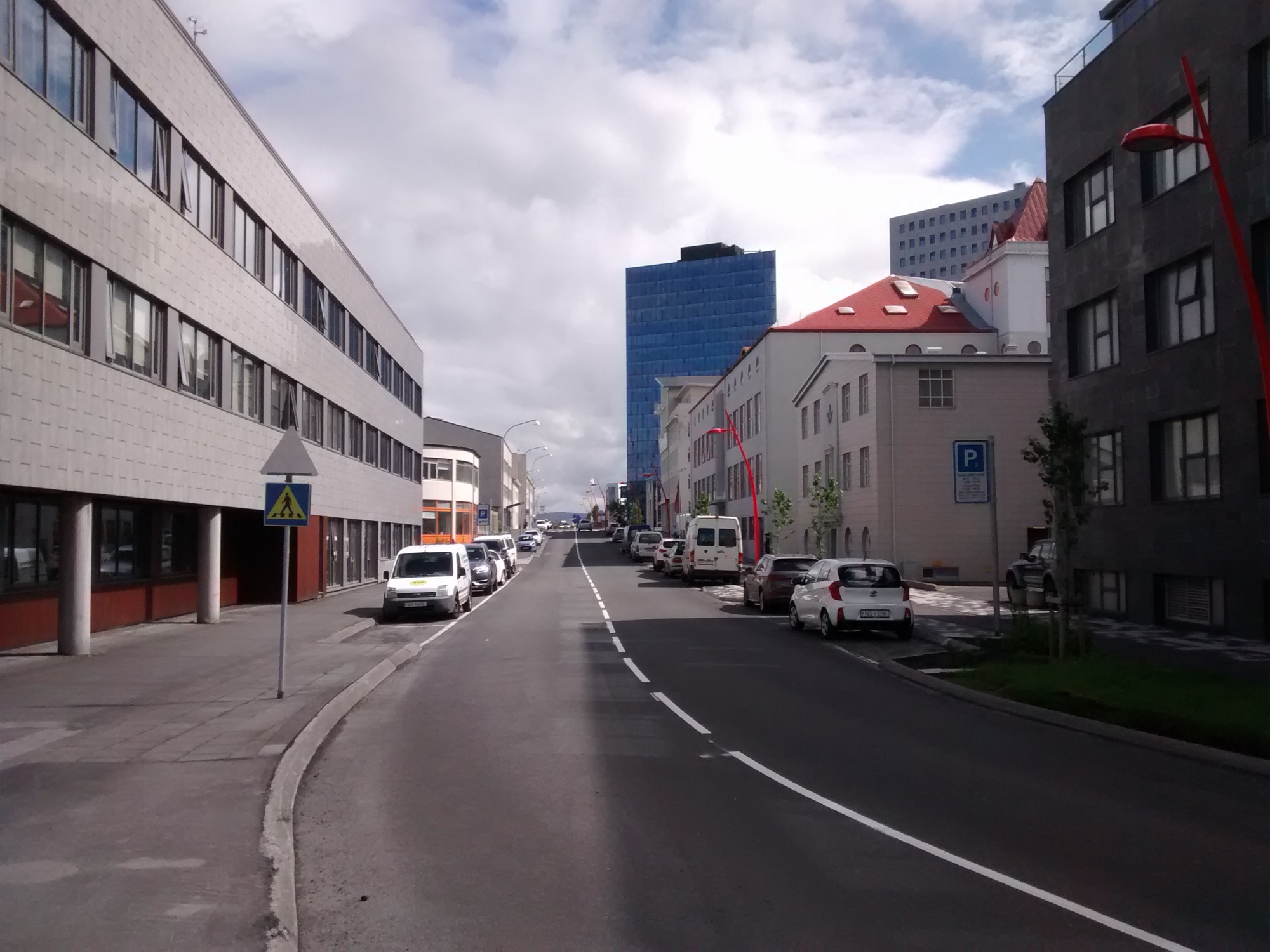
Unlike the columned temples of older European bourses, the Iceland Stock Exchange has never occupied a purpose-built trading palace; as a fully electronic market created in the late twentieth century, it has always been a tenant rather than a monument. Today Nasdaq Iceland (Kauphöll Íslands) is housed in the Höfðatorg complex at Laugavegur 182, at the western end of Borgartún, the cluster of modern office blocks that the Reykjavík city government and the architects of PK Arkitektar planned and the contractor Eykt built during the boom years of the 2000s. The complex's defining element, completed in 2008, is a roughly nineteen-storey glass-curtain-wall tower of about seventy metres, long described as the second-tallest building in Reykjavík and one of six structures forming an 85,000-square-metre development of offices, a hotel, and apartments. The exchange's quarters are unremarkable corporate floors: there is no public trading hall, no gallery, no ornamental facade, only the screens and servers of the INET matching engine that Nasdaq installed across its markets in 2010. As the developer Eykt records in its project documentation for Höfðatorg, the ambition of the architecture was civic and commercial rather than ceremonial, an attempt, in the firm's words, to answer Iceland's raw climate with bright, optimistic glass volumes.
Honesty requires acknowledging that the Iceland Stock Exchange possesses almost no artistic or iconographic tradition of its own. Where the Oslo Børs guards a bronze Mercury and Gerhard Munthe's painted interiors, and older bourses display allegories of Commerce and Fortune, Kauphöll Íslands was born in 1985 as an electronic institution with no trading floor to decorate and no founding-era patrons commissioning sculpture. Its visual identity is corporate branding rather than fine art: the Nasdaq wordmark replaced the older ICEX and OMX logotypes after the 2006-2007 mergers. Any artistic interest at its address is environmental rather than institutional, belonging to the Borgartún district as a whole. A short walk away stands Höfði, the white timber house of 1909 that hosted the 1986 Reagan-Gorbachev summit, while the nearby harbour shoreline carries Jón Gunnar Árnason's celebrated steel sculpture Sólfar (Sun Voyager, 1990) and, across the bay on Viðey, Yoko Ono's Imagine Peace Tower. The exchange itself contributes no comparable artwork, a candid reflection of its character as a small, modern, screen-based marketplace.
The exchange sits in Borgartún, the street that, as the English Wikipedia entry on Borgartún notes, became the centre of Reykjavík's financial district in the years leading up to the country's 2008 economic crisis, as new office buildings rose to house a rapidly expanding banking sector. Running east-west from Snorrabraut toward Laugarnes, Borgartún concentrated the headquarters of Iceland's banks, pension funds, and corporate offices, earning a local reputation as a miniature Wall Street for a nation of roughly 320,000 people. The Höfðatorg tower that anchors the western end was controversial precisely because of this skyline ambition, rising opposite older residential neighbourhoods. The district's symbolic centrepiece is Höfði house, the former French consul's residence where the 1986 summit between Ronald Reagan and Mikhail Gorbachev helped end the Cold War, and the city government's own service offices, national registry, and Statistics Iceland occupy the street's western blocks. The exchange's placement here ties it directly to the geography of Iceland's financial boom and bust, the same handful of streets where the banks that nearly destroyed the market once had their towers.
The Iceland Stock Exchange (Verðbréfaþing Íslands, later Kauphöll Íslands) was founded in 1985 as a joint venture of several banks and brokerage firms on the initiative of the Central Bank of Iceland, as the English-language history maintained by Nasdaq and summarised in the Wikipedia entry on Nasdaq Iceland records. Trading began in 1986 in Icelandic government bonds, with the central bank acting as market maker; the first electronic trading system followed in 1989, and trading in equities began in 1991. By 1999 the exchange listed about seventy-five companies, and a law effective 1 January 1999 converted it into a limited company. In 2000 it joined the NOREX alliance and adopted the SAXESS trading platform, which, as Nasdaq's own account observes, reduced the isolation of the Icelandic market and increased its liquidity. In 2006 Kauphöll Íslands merged into the Nordic exchange operator OMX, and when Nasdaq acquired OMX in 2007 it became Nasdaq OMX Iceland, later simply Nasdaq Iceland, migrating to Nasdaq's INET platform in 2010. The Yale Program on Financial Stability's case study Iceland: Landsbanki Restructuring, 2008 (Journal of Financial Crises, vol. 6) documents the institutional backdrop against which this small market matured and then convulsed.
From the outset the market was dominated by debt: it opened in 1986 trading Icelandic government bonds, and fixed income, including treasury and housing bonds in Icelandic króna, has remained a mainstay alongside a small equity list that today numbers only a few dozen companies in fishing, retail, transport, real estate, and finance. That very smallness made the exchange acutely vulnerable in 2008. As the Bank for International Settlements Financial Stability Institute case study The Banking Crisis in Iceland records, the three big banks, Glitnir, Landsbanki, and Kaupthing, had grown until their combined assets approached ten times national GDP, and by June 2008 six banks made up roughly 87 percent of the weight of the OMXI15 index. When Glitnir's planned nationalisation on 29 September 2008 was followed within a week by emergency legislation of 6 October and the collapse of all three banks, as the Wikipedia account of the 2008-2011 Icelandic financial crisis details, trading was suspended for three days; when the market reopened on 14 October the OMXI15 index closed down about 77 percent against its 8 October level. The OMX Iceland All-Share index, which had peaked above 3,495 in July 2007, ultimately lost more than ninety percent of its value, an almost total erasure of the listed banking sector that remains one of the starkest illustrations of how a concentrated equity market can be hollowed out by a single industry's failure.
Images will be added as the project develops. Photographs by Larry Ng and from research sources.