Prague Stock Exchange (Burza cenných papírů Praha)
Prague, Czech Republic · Established 1871
This site requires authorization to access.
To request access, contact
william.goetzmann@yale.edu
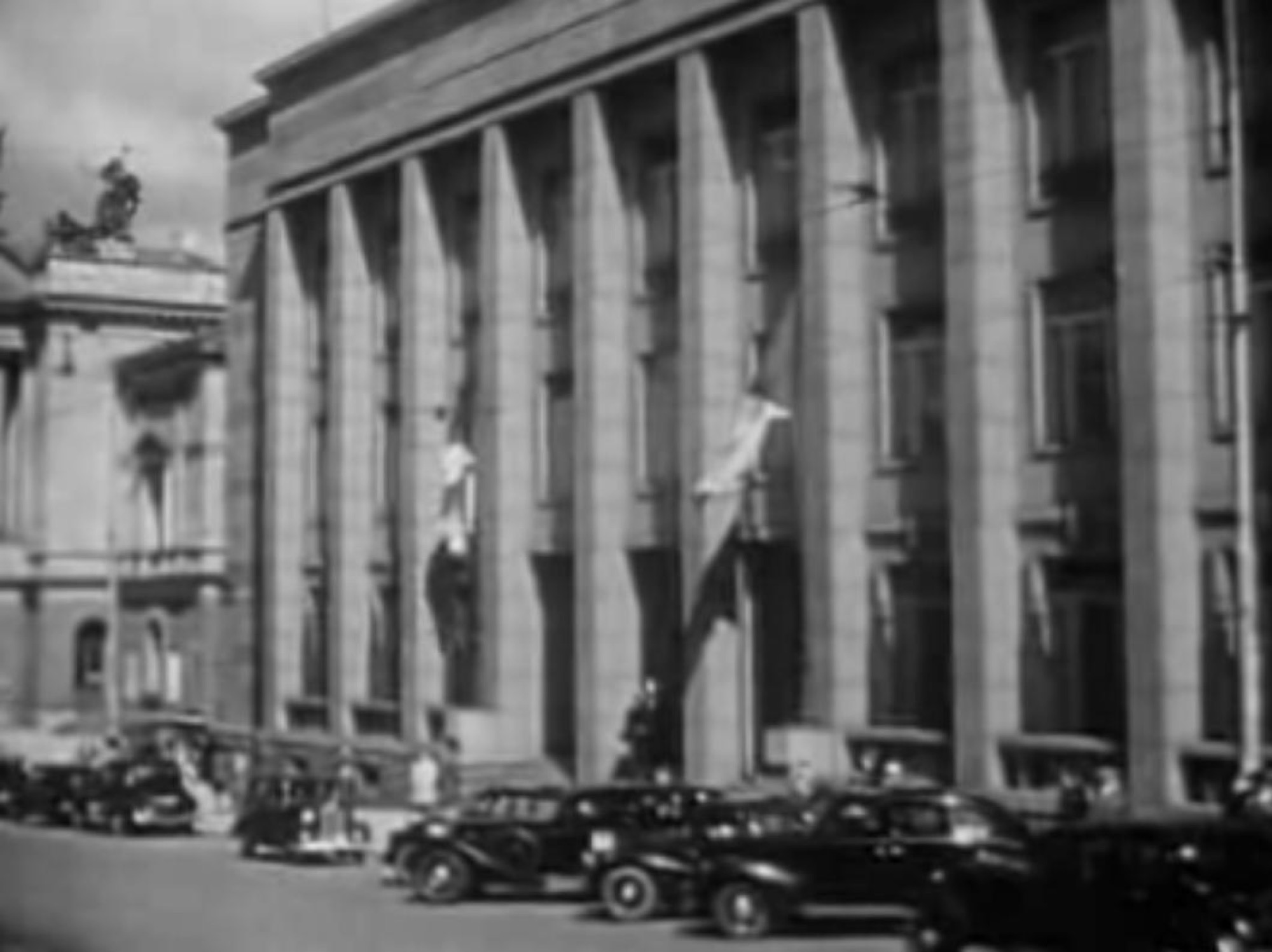
The Prague Stock Exchange occupied three distinct buildings across its history, each reflecting a different era of Czech commercial ambition. When the exchange opened on April 17, 1871, trading took place in a rented commercial building on Na Příkopě, Prague’s premier financial boulevard—a street that had risen on the site of the medieval moat separating the Old Town from the New Town founded by Charles IV in 1348. Na Příkopě was already lined with imposing bank headquarters designed by architects such as Osvald Polívka, whose Art Nouveau Zemšká banka (1894–1896) and Živnostenská banka (1897–1900) gave physical form to Czech financial aspirations under Habsburg rule. The exchange remained in these rented quarters for nearly seven decades. In April 1938, the bourse finally moved into a purpose-built home: the Prague Goods and Stock Exchange on Vinohradská Street, near the top of Wenceslas Square and adjacent to Josef Schulz’s monumental National Museum (1885–1891). The architect was Jaroslav Rössler (1886–1964), a student of Jan Kotěra at the Prague Academy and of Friedrich Ohmann in Vienna, where he won both the Hansen Prize (1910) and the Olbrich Prize (1911). Rössler’s design for the exchange, completed between 1936 and 1938, was a stone-fronted neo-classical building that reflected his evolution from Kotěra-influenced Modernism through a classicizing phase toward a stripped, Purist expression. The building occupied a constrained triangular site formed by Wilsonova (then Vinohradská), Legerova, and Vinohradská streets. Its monumental facade was designed to hold its own beside the National Museum while signaling the commercial dignity of the Czechoslovak capital at the height of the interwar republic. The exchange operated in this building for barely a year before the German occupation halted trading in 1939. In August 1943, the Wehrmacht confiscated the building for use as an annex to the adjacent State Opera, and in January 1945 it became a German military hospital. After the war, the building was repurposed as the seat of the Czechoslovak National Assembly. Between 1966 and 1974, architect Karel Prager—assisted by Jiří Kadeřábek and Jiří Albrecht—radically transformed the structure for the Federal Assembly, wrapping Rössler’s original in a Brutalist shell. Prager’s design added a two-story Vierendeel bridge structure supported by four slender columns, floating above the preserved historic core—what Prager called ‘a house above a house,’ influenced by Yona Friedman’s theories of suspended cities. The project featured what was then the largest hung glass curtain wall in Czechoslovakia. After the dissolution of the federation in 1992, the building housed Radio Free Europe (1995–2009) and was transferred to the National Museum in 2009. When the modern Prague Stock Exchange (Burza cenných papírů Praha) reopened on April 6, 1993, it was established in the Burzovní palác (Stock Exchange Palace) at Rybná 14 in the Old Town, a modern eight-story commercial building of charcoal glass and steel near Republic Square, with approximately 8,000 square meters of office space—a far cry from the monumental exchange halls of the Habsburg era.
The decorative programs associated with Prague’s exchange buildings must be understood within the broader context of the city’s extraordinary tradition of architectural sculpture on financial buildings. While specific documentation of the interior decoration of Rössler’s 1938 trading hall has been largely obscured by the building’s subsequent radical transformations, the commercial streetscape of Na Příkopě—where the exchange first operated—displayed some of the finest financial-architectural sculpture in Central Europe. Osvald Polívka’s bank buildings along the boulevard featured elaborate sculptural programs by Stanislav Sucharda (1866–1916), including allegorical figures of Agriculture and Commerce on the Zemská banka facade (1894–1896), as documented in the records of the National Gallery Prague. Polívka, who specialized in designing exclusive banks and savings banks with outstanding interiors, collaborated extensively with sculptors and painters to integrate decorative art into the fabric of financial architecture. Rössler’s 1936–1938 exchange building itself adopted a stripped neo-classical vocabulary appropriate to the late interwar period, with a monumental stone facade that communicated institutional authority through massing and proportion rather than applied ornament—consistent with the Purist direction his work had taken by the 1930s. The most dramatic artistic intervention came with Karel Prager’s 1966–1974 Federal Assembly transformation. Prager’s Brutalist envelope—with its floating Vierendeel trusses, massive pillars, and the largest hung glass wall in Czechoslovakia at the time—represented a conscious assertion of socialist-modernist aesthetics over the bourgeois commercial space beneath. The original exchange building was preserved within Prager’s shell but fundamentally recontextualized: what had been a temple of capitalism became the seat of a socialist parliament. The tension between Rössler’s neo-classical dignity and Prager’s levitating Brutalism created one of Prague’s most architecturally complex compositions, now visible as part of the National Museum complex. The current Burzovní palác at Rybná 14, a late twentieth-century commercial building, follows the functional minimalism typical of post-communist office architecture, with little in the way of decorative programs—a reflection of the exchange’s transformation from a physical trading floor to an electronic marketplace.
Prague’s position as a trading center was established centuries before the stock exchange’s founding, shaped by the Vltava River’s role as a vital trade route connecting southern and northern Europe. The tenth-century Hispano-Jewish merchant Abraham ben Jacob described Prague as an important seat of commerce where merchants from across Europe gathered. The Old Town’s Týn Courtyard (Ungelt), founded in the twelfth century, served as a fortified merchants’ yard where customs duties were collected on goods from across the continent. The exchange’s first home on Na Příkopě placed it at the literal boundary between the medieval Old Town and the New Town, on a street that arose where Joseph II’s 1787 decree had ordered the ancient moat filled in and the walls demolished. By the late nineteenth century, Na Příkopě had become Prague’s principal financial boulevard: gas lighting arrived in 1847, horse-drawn trams in 1875, and electric trams in 1899, while the construction of the Emperor Franz Josef Railway Station in the 1860s brought waves of merchants and industrialists to the New Town. The major Czech banks—Živnostenská banka, Zemská banka, Böhmische Escompte-Bank—erected their imposing headquarters along this street, creating a financial quarter that rivaled Vienna’s Ringstrasse in ambition if not in scale. The 1938 move to Vinohradská Street repositioned the exchange near the top of Wenceslas Square, Prague’s grand commercial boulevard that had evolved from a medieval horse market (Koňský trh) into the city’s commercial and civic center. Here the exchange stood adjacent to the National Museum, at the convergence of the New Town’s major axes, near the hotels, banks, and department stores that defined interwar Prague’s urban modernity. After the formation of Greater Prague in 1922, Wenceslas Square became the site of intensive construction of luxury commercial buildings, banks, and hotels. The post-1993 exchange at Rybná 14 returned to the Old Town, near Republic Square (náměstí Republiky), in the commercial district between the Powder Tower and the Kotva department store—a location connected by metro to the city’s business centers but stripped of the monumental symbolism that had characterized the exchange’s earlier homes.
Efforts to establish a stock exchange in Prague date to the reign of Empress Maria Theresa in the eighteenth century, but Vienna successfully blocked the initiative to prevent commercial rivalry with the imperial capital, as noted by the Prague Stock Exchange’s own institutional history. Success came only in 1871, in the wake of the Austro-Hungarian Compromise of 1867 and the liberalization of commercial law in the Habsburg lands. On April 17, 1871, approximately 400 Czech merchants—led by the prominent sugar trader Alois Oliva and including representatives from the insurance and railway industries—contributed 29,870 gold coins to found the Prague Commodities and Stock Exchange. Trading commenced that day from 11:30 a.m. to 1 p.m. in a building on Na Příkopě. The exchange rapidly became the most important sugar-trading market in all of Austria-Hungary, reflecting the explosive growth of the Bohemian beet-sugar industry: between 1831 and 1945, some 323 sugar factories were established in the Czech lands, making sugar the dominant commodity of Czech commerce. An Exchange Committee was established in the first year to formalize trading rules and suppress unofficial café trading. By 1873, fifty-nine companies were listed for securities trading, though the exchange remained dominated by commodity transactions. Membership was restricted: women, debtors, convicted criminals, and bankrupts were excluded from the trading floor—a prohibition that persisted until Czechoslovak independence in 1918. The creation of Czechoslovakia fundamentally transformed the exchange’s role. Under the Austro-Hungarian Empire, Czech securities had traded primarily on the Vienna bourse, but the nostrification laws of the early 1920s required companies operating in Czechoslovakia to transfer their headquarters from Vienna or Budapest, channeling capital market activity to Prague. As Alice Teichova documented in The Czechoslovak Economy 1918–1980 (Routledge, 1988), the interwar republic developed a sophisticated banking and industrial sector, with institutions like Živnostenská banka—headed by the powerful banker Jaroslav Preiss—controlling vast industrial empires through shareholdings and loans. The interwar period became the era of the Prague bourse’s greatest prosperity: the exchange surpassed Vienna in importance, with over sixty stocks listed by 1929. Global Financial Data’s reconstruction of Czechoslovak equity indices reveals a dramatic 603 percent surge in share prices between July 1914 and February 1920, followed by a devastating 78 percent decline during the deflationary crisis of 1920–1922 that accompanied the stabilization of the new Czechoslovak crown. Market capitalization grew from $72 million at the exchange’s founding in 1872 to $256 million in 1912 and $428 million by 1939. The Ferdinand Northern Railway (Ferdinands Nordbahn) dominated early trading, representing 50 to 80 percent of total stock market capitalization before 1900. Trading was interrupted by World War I in 1914 and resumed after the armistice. The move to the new Vinohradská Street building in April 1938 coincided with the Munich crisis; the German occupation halted exchange operations in 1939, with only limited foreign-exchange transactions permitted through 1943. After liberation in 1945, the Communist seizure of power in February 1948 led to the nationalization of industry and the permanent closure of the exchange. The modern Prague Stock Exchange (Burza cenných papírů Praha) reopened on April 6, 1993—three months after the peaceful dissolution of Czechoslovakia—with assistance from the French government and the Lyon Stock Exchange. On its first day, seven securities traded with a total volume of CZK 2 million. The reopening occurred in the context of the Czech Republic’s voucher privatization program, analyzed extensively by economists at CERGE-EI, which distributed shares in state enterprises to citizens and created an instant mass equity market. As Martin Myant argued in The Rise and Fall of Czech Capitalism (Edward Elgar, 2003), the rapid privatization created severe problems of corporate governance, with poorly regulated investment privatization funds accumulating vast portfolios. By 1993, the exchange listed over one thousand securities from voucher-privatized firms, though massive delisting followed as the market consolidated—a process analyzed by Zuzana Fungacova in her CERGE-EI working papers on administrative delisting decisions.
The Prague exchange was founded primarily as a commodities market, and sugar dominated its early decades. The Bohemian beet-sugar industry had exploded in the mid-nineteenth century: the first industrial sugar factory in the Habsburg lands was established at Kostelní Vydří in 1829, and by the 1850s hundreds of sugar factories dotted the Czech countryside. As Radio Prague International documented in its history of the Czech sugar industry, a technological breakthrough occurred in 1863 at the Prague sugar factory in Vysočany, where Hugo Jelínek performed simultaneous clarification and carbonation for the first time. Prague’s exchange became the central clearing market for this booming commodity, making it the most important sugar bourse in all of Austria-Hungary. Alongside sugar, the exchange handled other agricultural commodities including grain, and it facilitated trade in industrial raw materials serving Bohemia’s rapidly growing manufacturing sector. Securities trading grew alongside commodities from the exchange’s earliest years: by 1873, fifty-nine companies were listed for stock trading, though the number of listed Czech companies on the combined Prague and Vienna markets was just three in 1871, rising to twenty-nine by 1912 as Czech industrial capitalism matured. Railroad securities were paramount in the early decades. The Ferdinand Northern Railway (Ferdinands Nordbahn), which connected Vienna to the Polish salt mines, was the dominant security, representing between 50 and 80 percent of the entire capitalization of the Prague exchange before 1900, as reconstructed in the Global Financial Data equity indices for Czechoslovakia. Government bonds of the Austro-Hungarian Empire and later the Czechoslovak Republic also traded actively. After World War I, commodity trading declined and the exchange shifted primarily to securities. The interwar boom brought listings from the major Czech industrial and banking firms: shares in banks like Živnostenská banka, Böhmische Escompte-Bank (established 1863), Böhmische Union Bank (established 1872), and Zemská banka (established 1890) all traded actively, alongside industrial shares in mining, metallurgy, engineering, electrical, and chemical companies—the sectors that Alice Teichova’s research documented as constituting the modernized core of the Czechoslovak economy. Czech brewery shares, representing what would become one of the country’s most celebrated industries, also featured among listed securities. When the exchange reopened in 1993, the trading landscape had transformed entirely. The voucher privatization program created an instant mass equity market: over one thousand securities from newly privatized state enterprises were listed, though many were thinly traded. Jan Hanousek and Randall Filer’s research at CERGE-EI demonstrated that Czech stock prices in the 1993–1999 period were frequently disconnected from economic fundamentals, reflecting the distortions of rapid mass privatization. The modern exchange trades equities, government and corporate bonds, and investment fund certificates, with major listings including CEZ (the state energy company), Komerční banka, and other blue-chip firms.
Images will be added as the project develops. Photographs by Larry Ng and from research sources.