Porto Stock Exchange (Palácio da Bolsa)
Porto, Portugal · Established 1842
This site requires authorization to access.
To request access, contact
william.goetzmann@yale.edu
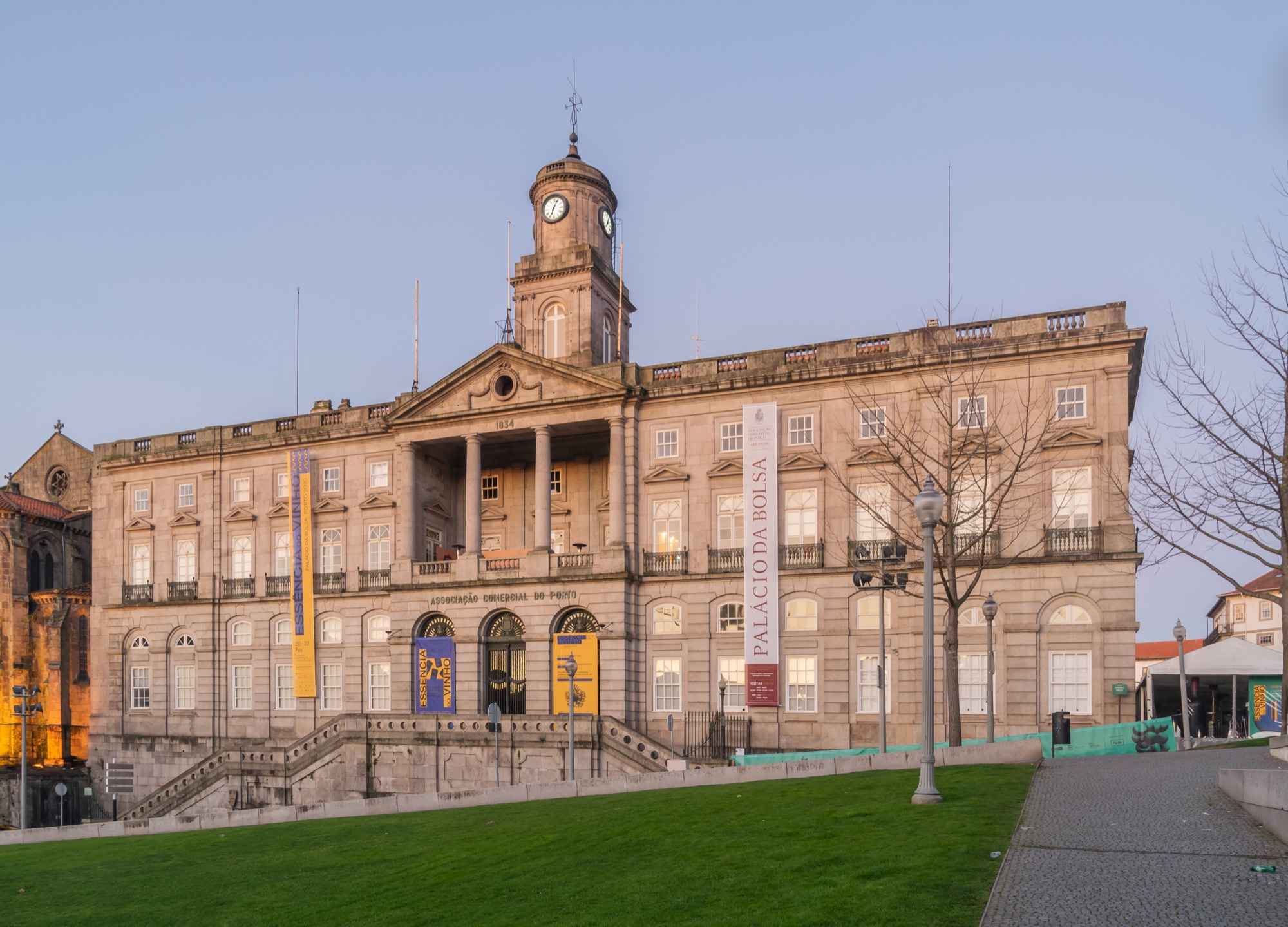
The Palácio da Bolsa rises on the ruins of the thirteenth-century Convent of São Francisco, whose cloisters were destroyed by fire on 24 July 1832 during the Liberal Wars. Queen Maria II donated the convent site to the merchants of Porto in 1841, and the foundation stone was laid on 6 October 1842 under the presidency of José Henriques Soares, Barão de Ancede. The architect Joaquim da Costa Lima Junior designed a Neoclassical palace drawing on the Neopalladian tradition established in Porto through John Carr’s Hospital of Santo António (1770s) and John Whitehead’s English Factory House, as well as the work of the Portuguese architect Carlos Amarante. The granite-clad facade and first floor were substantially complete by November 1850, but interior decoration, involving successive generations of artists and architects, continued until 1910. The central Pátio das Nações, originally the trading floor, is crowned by an octagonal iron-and-glass dome designed by Tomás Soller and erected from 1880, an early example of the industrial materials then transforming European exchange architecture. A monumental granite staircase, designed by Gustavo Adolfo Gonçalves e Sousa in 1868 and adorned with Corinthian capitals and fluted pilasters, connects the principal rooms. The celebrated Arab Room (Salão Árabe), also by Gonçalves e Sousa, was begun on 15 September 1862 and inaugurated on 12 June 1880 during Camões tricentenary celebrations. The palace was classified as a Portuguese National Monument in 1982 and forms part of the Historic Centre of Porto inscribed on the UNESCO World Heritage List in 1996 under criterion (iv), which the ICOMOS evaluation recognized as bearing remarkable testimony to the development of a European city oriented toward Atlantic commercial links.
The decorative programs of the Palácio da Bolsa represent some of the most ambitious interior embellishment undertaken in any nineteenth-century European exchange. The Arab Room, conceived by Gonçalves e Sousa after the Alhambra in Granada, required eighteen years to complete. Every surface—walls, ceilings, doors, and windows—is covered in polychrome stucco bearing gilded Arabic inscriptions and geometric arabesques in the Moorish Revival style then fashionable across Romantic Europe. The pavement is laid in exotic hardwoods including mahogany, jacaranda, rosewood, and plane, and the room was comprehensively restored in 2009–2010. The Pátio das Nações displays twenty painted coats of arms representing Portugal’s nineteenth-century trading partners beneath Tomás Soller’s iron-and-glass dome, itself restored in 2007–2008. The Sala do Tribunal (Court Room), initially designed by Joel Pereira da Silva and later reformulated by the architect José Marques da Silva, features monumental stained-glass windows—the colored lateral panels imported from France, the central window from Lisbon—alongside allegorical paintings referencing the port wine trade by José Maria Veloso Salgado and João Marques de Oliveira. The noble staircase is flanked by bronze chandeliers weighing approximately 1.5 tons, crafted by the sculptor António Soares dos Reis. In the Presidents’ Room, oil paintings by Marques de Oliveira (c. 1890) depict scenes of Roman civilization, while the marble fireplace by the sculptor António Teixeira Lopes features feminine figures and wrought-iron allegories of the Douro River and commerce. The ceiling of the library bears a composition by the Symbolist painter António Carneiro depicting the messenger figure Eco. Twelve paintings by the portraitist Henrique Medina (1901–1988), donated to mark the 150th anniversary of the Associação Comercial do Porto, hang in the Sala dos Jurados.
The Palácio da Bolsa occupies a commanding position on the Praça do Infante D. Henrique in Porto’s historic Ribeira district, immediately adjacent to the fourteenth-century Church of São Francisco. The square honors Prince Henry the Navigator (1394–1460), who was born nearby at the medieval Casa do Infante, which served as the royal customs house supervising trade along the Douro River from the reign of Afonso IV. Porto’s identity as a commercial city is inseparable from the Douro, which carried port wine downstream from the demarcated vineyards of the Alto Douro to the lodges of Vila Nova de Gaia on the opposite bank. The Ribeira waterfront, with its stacked polychrome facades, formed the physical nexus of Atlantic commerce: the Methuen Treaty of 1703 between Portugal and England granted Portuguese wines preferential tariffs, and for centuries British merchant houses dominated the export trade. As Jiayao Jiang notes in a study of sustainable tourism and heritage in Porto (In Situ. Au regard des sciences sociales, 2025, DOI: 10.4000/13uwy), the fifty-one-hectare UNESCO World Heritage core zone encompasses this medieval commercial quarter in its entirety. The Rua de Ferreira Borges, named for the jurist who drafted Portugal’s first commercial code (Código Commercial Portuguêz, 1836), connects the Bolsa directly to the old Mercado Ferreira Borges and the riverfront. The palace thus anchors a dense urban landscape in which ecclesiastical, commercial, and civic architecture have coexisted since the Middle Ages, embodying what the ICOMOS evaluation called Porto’s thousand-year testimony to a city looking outward to the west for its cultural and commercial links.
The Associação Comercial do Porto, founded in 1834 in the aftermath of the Liberal Wars, is the oldest business association in Portugal. It inherited traditions from the medieval Juntina, the congregation of prosperous Porto traders established in the late eighteenth century. The Association’s founders were animated by principles of free enterprise and free trade, and their institutional ambitions quickly outgrew existing premises: the Bolsa do Porto, operating in open air and makeshift quarters, was deemed inadequate. When Queen Maria II ceded the São Francisco convent ruins in 1841, the merchants seized the opportunity to erect an exchange palace befitting Portugal’s second city. The Association drove major innovations in Portuguese commercial life, including the drafting of the first commercial code by José Ferreira Borges (published 1836), the creation of the first two Portuguese banks—the Banco Mercantil Portuense and the Banco União—and the establishment of the country’s first insurance company, the Companhia de Seguros Segurança. The formal Bolsa de Valores do Porto was established in 1891 within the palace. Following the proclamation of the Republic on 5 October 1910, the building was briefly inventoried by the state and vacated; the Association regained possession in 1918 under the presidency of Sidónio Pais. In the twentieth century the Porto exchange evolved into Portugal’s principal derivatives market, trading government bond futures and stock index contracts, before merging with the Lisbon exchange to form the Bolsa de Valores de Lisboa e Porto (BVLP), which was subsequently absorbed by Euronext in 2002.
The Pátio das Nações, with its iron-and-glass dome and painted national coats of arms, served as the principal trading floor where Porto’s merchants conducted their daily business. The dominant commodity was port wine: under the regulatory framework established by the Marquis of Pombal’s Real Companhia das Vinhas do Alto Douro (founded 1756), the Douro demarcated region—the world’s first formally delimited wine appellation—produced graded vintages for the export market. Merchants at the Bolsa negotiated contracts for wines classified as vinho de feitoria (factory wine, for export) and vinho de ramo (for domestic sale), with British shippers especially prominent following the preferential tariffs of the 1703 Methuen Treaty. Beyond wine, the exchange handled commercial bills of exchange, insurance contracts—the Association having founded Portugal’s first insurance company—and government bonds. The Sala do Tribunal hosted the enthronement ceremonies of the port wine brotherhood, binding ceremonial life to commercial regulation. The building’s telegraph room, designed by José da Parada e Silva Leitão, a physics professor at the Porto Polytechnic Academy, and the artist Francisco António Galho, housed apparatus for monitoring merchandise arriving at the mouth of the Douro, providing traders with real-time intelligence on shipments. After the formal Bolsa de Valores do Porto was constituted in 1891, trading expanded to include listed securities and equity shares. In the late twentieth century, Porto became Portugal’s principal derivatives exchange, with futures contracts on the ten-year government bond, the PSI-20 stock index, and the three-month Lisbon Interbank Offered Rate (LISBOR), before the merger into Euronext Lisbon in 2002.
Images will be added as the project develops. Photographs by Larry Ng and from research sources.