Stock Exchange of Mauritius (SEM)
Port Louis, Mauritius · Established 1989
This site requires authorization to access.
To request access, contact
william.goetzmann@yale.edu
The Stock Exchange of Mauritius (SEM) occupies the fourth floor of One Cathedral Square, a Grade A commercial office building of approximately 10,000 square meters developed by MaxCity Properties Limited on Jules Koenig Street in the legal and judicial precinct of Port Louis. The building, a modern multi-story structure clad in glass and concrete, reflects the contemporary tropical commercial style that has reshaped Port Louis’s downtown skyline since the 1990s. One Cathedral Square sits adjacent to the Supreme Court of Mauritius and in close proximity to St. Louis Cathedral, from which it takes its name. Unlike older African exchanges housed in purpose-built neoclassical or colonial-era trading halls, the SEM has always been an “office exchange”—its operations conducted from networked terminals rather than a grand trading floor. When SEM launched in July 1989, trading occurred through a rudimentary “Box Method” in which sealed bids were submitted once weekly; in September 1991, the exchange adopted an open-outcry, single-price auction system that required a modest physical trading space. That floor was rendered obsolete in June 2001, when SEM became the first exchange in Africa to transition to a fully automated electronic trading platform, SEMATS, built on third-generation order-matching technology (SEM, “SEM at a Glance,” official history). The current premises house server infrastructure, regulatory staff, and the offices of the Central Depository & Settlement Co. Ltd (CDS), established as a subsidiary in 1996 to provide centralized clearing on a T+3 settlement cycle. In May 2022, the exchange deployed a new multi-asset Automated Trading System with desktop and mobile interfaces, cementing its identity as a technology-driven institution rather than an architectural landmark.
As an exchange housed within a modern commercial office building rather than a purpose-built trading hall, the Stock Exchange of Mauritius lacks the elaborate decorative programs—allegorical murals, sculptural friezes, ornamental ironwork—characteristic of nineteenth-century European bourses. The SEM’s aesthetic identity resides instead in its corporate branding and digital presence: the exchange’s logo, a stylized geometric form evoking both upward market trajectories and the island’s maritime horizon, appears throughout the One Cathedral Square offices and on the automated trading terminals. The broader commercial district surrounding the exchange, however, carries rich visual echoes of Mauritius’s Franco-British colonial trading heritage. The nearby Treasury Building, constructed between 1883 and 1889 of stone, timber, and metal sheeting and classified as National Heritage in 1978, exemplifies the decorative ambition of late-colonial commercial architecture (National Heritage Fund, “Port Louis Heritage Sites”). Government House, dating to 1738, with its colonnaded French colonial facade flanking the palm-lined Place d’Armes, provides an architectural backdrop that connects modern financial activity to centuries of mercantile governance. The Caudan Waterfront development (opened 1996), named after the coral fossil islet on which it rests, blends modernist retail architecture with heritage references—the Barkly Wharf building recalls the Victorian harbor infrastructure of the British period. Within SEM’s own spaces, the functional aesthetic of screen-based trading prevails: arrays of monitors displaying the SEMDEX, electronic order books, and real-time market data constitute the visual culture of this exchange, reflecting what Donald MacKenzie described in “Material Markets” (Oxford, 2009) as the shift from physical spectacle to algorithmic invisibility in modern financial architecture.
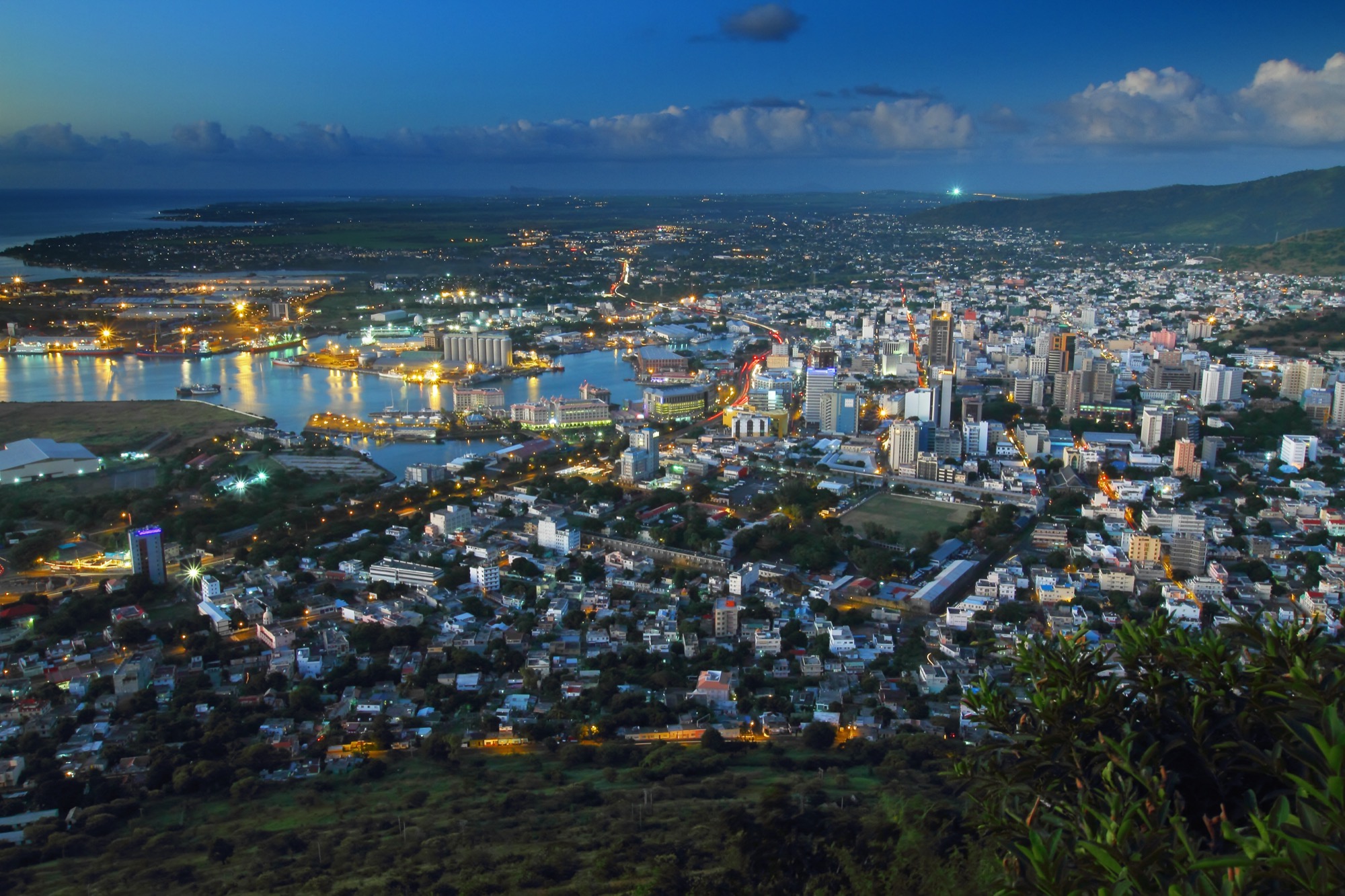
The Stock Exchange of Mauritius is situated in the heart of Port Louis’s administrative and judicial quarter, on Jules Koenig Street between the Supreme Court complex and St. Louis Cathedral. This location places the exchange within the dense colonial-era grid that the French East India Company governor Bertrand-François Mahé de La Bourdonnais laid out in the 1730s, a compact waterfront capital designed to serve as the administrative and commercial hub of the Île de France. As Auguste Toussaint documented in “History of Mauritius” (Macmillan, 1977), Port Louis grew as a natural harbor town where sugar warehouses, counting houses, and colonial government offices clustered within walking distance of the port. The SEM’s address is approximately 500 meters from the Place d’Armes, the ceremonial boulevard lined with royal palms that leads from the waterfront to Government House—the axis along which French and British colonial authority projected its commercial ambitions. The Bank of Mauritius Tower, at 124 meters the tallest structure in the country, rises nearby, anchoring a modern financial corridor that includes the Mauritius Commercial Bank (founded 1838) and the State Bank of Mauritius. The Caudan Waterfront, a mixed-use commercial development opened in 1996 on reclaimed harbor land, added retail, hotel, and entertainment facilities adjacent to the historic port area. Port Louis ranks as the second most prominent financial center in Africa after Johannesburg, a status reinforced by its role as an international financial centre with over 20,000 global business entities and the largest network of double taxation avoidance treaties with African countries. The exchange’s urban positioning—between colonial heritage architecture and modern financial towers—mirrors Mauritius’s broader economic trajectory from plantation colony to diversified services economy.
The Stock Exchange of Mauritius was incorporated on 30 March 1989 under the Stock Exchange Act 1988, a legislative instrument drafted with extensive technical assistance from the French authorities and expertise from the Bourse de Paris. SEM’s first chairman, George Ramet, modeled the new institution on the Bourse de Lyon, establishing a connection to the Franco-Mauritian cultural ties that had shaped the island since French colonization in 1715. The exchange opened for trading in July 1989 with just five listed companies—Mauritius Commercial Bank, Mon Trésor Mon Désert Ltd, MDIT, UBP, and Mauritius Stationery Manufacturers—and a total market capitalization of USD 70 million. As Arvind Subramanian and Devesh Roy argued in “Who Can Explain the Mauritian Miracle: Meade, Romer, Sachs, or Rodrik?” (IMF Working Paper, 2001), the timing of the exchange’s creation coincided with the broader “Mauritian economic miracle,” a period of rapid diversification from sugar monoculture into export processing zones, tourism, and financial services. The Securities Act 2005, proclaimed in September 2007, modernized the regulatory framework by establishing the Financial Services Commission as primary regulator. SEM joined the World Federation of Exchanges in 2005 and in 2010 received “Recognised Stock Exchange” status from the UK’s HMRC. The Development & Enterprise Market (DEM) launched in 2006 to serve small and medium enterprises, and by 2018 the SEM had inaugurated a Green Bond Initiative. In December 2024, the SEMx platform was launched for high-growth African enterprises. Today the exchange lists over 180 securities with a market capitalization exceeding USD 8.5 billion and a market-cap-to-GDP ratio above 60 percent, serving over 100,000 retail shareholders.
The Stock Exchange of Mauritius trades a diversified range of instruments reflecting the island’s transformation from sugar plantation economy to international financial hub. At its founding in 1989, the five listed companies were dominated by sugar conglomerates—Mon Trésor Mon Désert (now Omnicane Limited, tracing its origins to the 1850s), and banking institutions like the Mauritius Commercial Bank (founded 1838). The exchange classified listed companies into seven sectors: banks and insurance, industry, investments, sugar, commerce, leisure and hotels, and transport. As Sunil Bundoo documented in “The Mauritius Stock Exchange: An Assessment” (University of Mauritius Research Journal), sugar companies remained central to market capitalization, with foreign investors initially restricted to a maximum 15 percent individual holding in sugar firms. The official lifting of foreign exchange controls in 1994 opened the market to international investors. Today the SEM operates as a multi-asset, multi-currency platform—the only exchange in Africa capable of listing and trading securities in Mauritian rupees, US dollars, euros, British pounds, and South African rand. Traded instruments include equities on the Official Market and the Development & Enterprise Market, government and corporate bonds, exchange-traded funds (ETFs), exchange-traded notes (ETNs), structured products, depositary receipts, and derivatives. Three green bonds are listed under SEM’s 2018 sustainability initiative. The SEM Sustainability Index (SEMSI) tracks 19 companies assessed under Global Reporting Initiative criteria adapted to the Mauritian context. Over 55 international issuers are listed, and the exchange has raised over USD 6.5 billion in capital, positioning Mauritius as what Jeffrey Frankel described in “Mauritius: African Success Story” (Harvard Kennedy School Working Paper, 2012) as a credible gateway for investment into the African continent.
Images will be added as the project develops. Photographs by Larry Ng and from research sources.