Pittsburgh Stock Exchange
Pittsburgh, USA · Established 1864
This site requires authorization to access.
To request access, contact
william.goetzmann@yale.edu
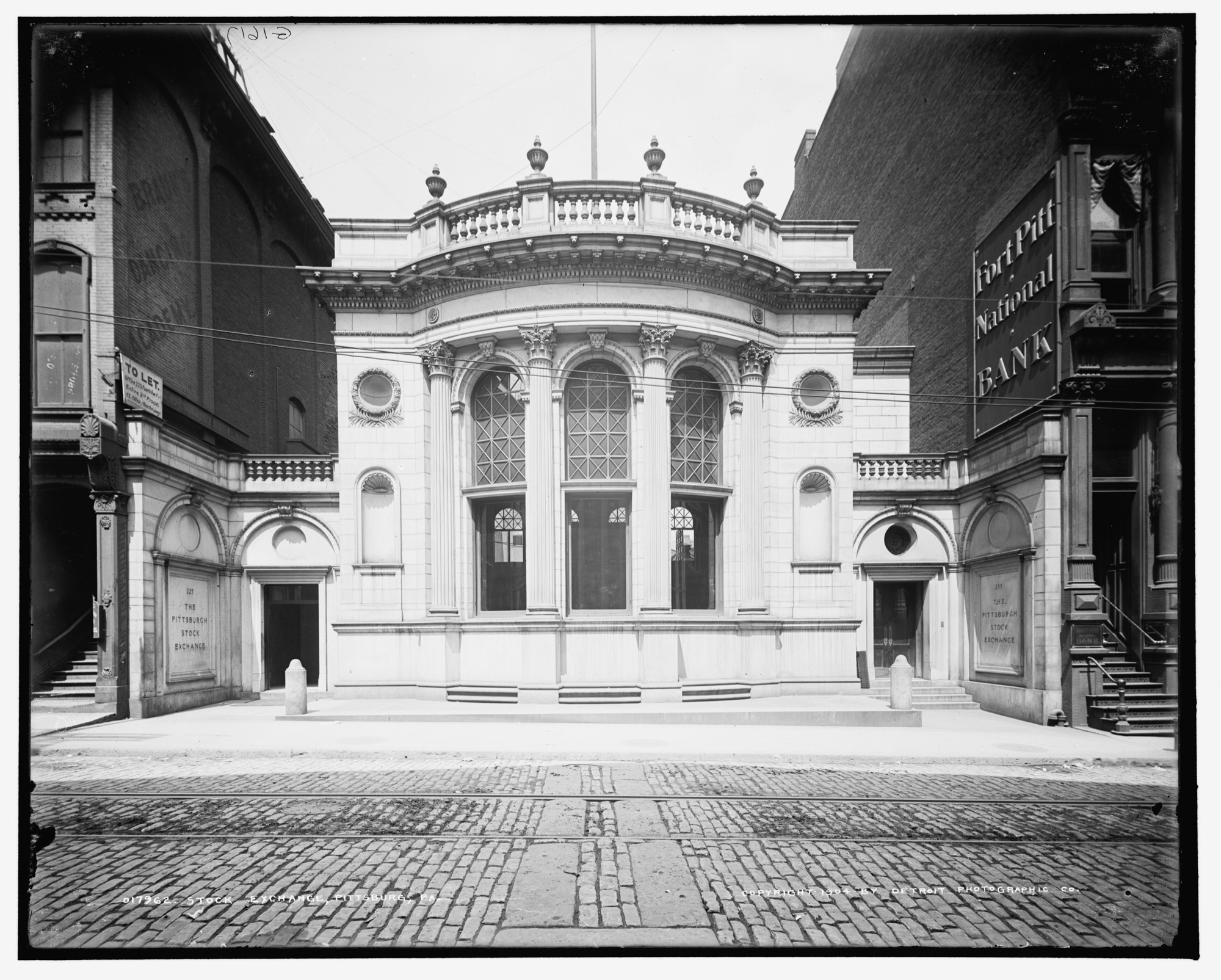
The Pittsburgh Stock Exchange occupied three successive locations along Fourth Avenue, the city’s storied financial corridor. From its earliest years as Thurston’s Oil Exchange, founded on November 11, 1864, the institution operated in rented quarters on Fourth Street before settling into the Pittsburgh Bank for Savings building at the corner of Fourth Avenue and Smithfield Street. In 1902 the exchange secured permanent quarters at 229 Fourth Avenue, housed within a commercial structure that served it for six decades. Its most architecturally distinguished home, however, was the building at 333 Fourth Avenue, designed by German-trained Pittsburgh architect Charles M. Bartberger and completed in 1903, originally as the Industrial Bank. The Society of Architectural Historians’ Archipedia describes Bartberger’s design as “one of the most confident handlings of Beaux-Arts classicism in the city,” a two-story neo-classical “swagger bank” whose facade is dominated by a monumental granite arch with sharply cleft voussoirs breaking through the horizontal coursing, crowned by three deep-set windows in a dwarf mezzanine. Inside, the main floor was lined with marble and flanked by massive brass Palladian windows, with a marble-and-brass staircase ascending to the second floor. The Pittsburgh History and Landmarks Foundation’s Fourth Avenue Walking Tour (2017 edition) notes that Bartberger, son of the prolific mid-nineteenth-century architect Charles F. Bartberger, inherited his father’s practice and brought a refined European sensibility to Pittsburgh’s commercial architecture. The exchange occupied this 8,500-square-foot structure from October 1962 until its final closure on August 23, 1974. The building survives today, owned by Point Park University, its neo-classical facade still presiding over what the National Register of Historic Places designation of 1985 recognized as a district of exceptional architectural significance.
The decorative program of the Pittsburgh Stock Exchange’s final home at 333 Fourth Avenue epitomized the ornamental ambition of Fourth Avenue’s banking palaces. Charles M. Bartberger’s 1903 design employed a rich palette of granite, marble, and brass to convey institutional gravitas within a compact two-story envelope. The monumental arched entrance, executed in rusticated granite with precisely cut voussoirs, framed the approach to an interior where green Cipollino marble columns supported coffered ceilings adorned with silver-dollar motifs—a playful reference to the building’s financial purpose. Brass Palladian windows admitted generous light onto the marble-clad trading floor. The broader Fourth Avenue streetscape constituted an outdoor gallery of late-nineteenth and early-twentieth-century bank architecture. As the Pittsburgh History and Landmarks Foundation’s walking tour guide documents, the Dollar Savings Bank at 340 Fourth Avenue, completed in 1871 by Philadelphia architect Isaac H. Hobbs, featured a brownstone facade of 14,000 tons of Portland, Connecticut stone accented with pink Quincy granite, its entrance flanked by two monumental lions carved on site from single blocks of quarry-bedded brownstone by sculptor Max Kohler. Nearby, James T. Steen’s 1889 Richardsonian Romanesque building contributed rough-faced granite and ornamental carving, while the 1901–1902 construction boom added the Arrott Building, Peoples Savings Bank, Colonial Trust Company, and Keystone Bank building (by MacClure and Spahr), all designed by Pittsburgh’s most distinguished architectural firms including Alden and Harlow, Janssen and Cocken, and Frederick J. Osterling. A circa-1904 photograph of the exchange interior, preserved in the Library of Congress Detroit Publishing Company Collection (LC-DIG-det-4a12152), captures the trading room’s original character during the height of Fourth Avenue’s financial activity.
The Pittsburgh Stock Exchange sat at the heart of Fourth Avenue, the narrow twenty-five-foot-wide street that served as Pittsburgh’s Wall Street from the 1870s through the mid-twentieth century. The Fourth Avenue National Register Historic District nomination of 1985 (expanded in 2013) documents that between 1890 and 1905 more than forty-nine new banks were established in Pittsburgh, with the majority concentrated in the 200 and 300 blocks of Fourth Avenue between Market and Smithfield Streets. The exchange’s position within the Golden Triangle—the wedge of land at the confluence of the Allegheny and Monongahela rivers, whose joining forms the Ohio River—placed it at the geographic nexus of an extraordinary industrial hinterland. The Allegheny carried crude oil downstream from the Oil Creek fields near Titusville, while the Monongahela transported coal and coke from the Connellsville region that fueled the steel furnaces lining both river valleys. Railroad connections through the Pennsylvania Railroad and the Baltimore and Ohio linked Pittsburgh’s financial district to eastern capital markets and western commodity sources alike. The city’s economic geography made Fourth Avenue a natural clearinghouse for the securities of the steel, glass, aluminum, and energy companies that dominated southwestern Pennsylvania. By the early twentieth century, skyscrapers began transforming the Golden Triangle’s skyline: the Union Trust Building (1915–1917, by Frederick J. Osterling), the Mellon National Bank Building at 525 William Penn Place (completed 1951), and eventually the U.S. Steel Tower (1970, at 841 feet the city’s tallest) all rose within blocks of the exchange. The Pittsburgh History and Landmarks Foundation notes that Fourth Avenue’s architectural concentration—from a Greek Revival building of 1836 to cast-iron-front structures of the 1870s and 1880s to a majestic quartet of early-twentieth-century skyscrapers—constitutes one of America’s finest ensembles of financial architecture.
The Pittsburgh Stock Exchange traces its origins to November 11, 1864, when George A. Thurston formally opened Thurston’s Oil Exchange on Fourth Street to trade the petroleum securities that flooded Pittsburgh during the Civil War oil boom following Colonel Edwin Drake’s 1859 strike at Titusville. As the American Oil and Gas Historical Society has documented, Pittsburgh’s position at the terminus of the Allegheny River made it the natural marketplace for Oil Creek crude, and Thurston’s exchange was among the first oil stock exchanges in the world. The institution evolved with Pittsburgh’s shifting industrial base: it was rechartered as the Pittsburgh Coal Exchange on May 27, 1870, reflecting the rise of river-transported coal; renamed the Pittsburgh Oil Exchange on July 21, 1878 (with 180 members); and finally adopted the title Pittsburgh Stock Exchange in the spring of 1894, formally operating under that name from July 25, 1896, as it opened to general stock and bond trading. The archival records of the exchange, spanning 1894–1972 and preserved in twelve boxes at the Senator John Heinz History Center (Historical Society of Western Pennsylvania, MSS 150), document its administrative operations, transactions, and correspondence with other regional exchanges. At its peak in 1929, a total of 204 issues traded on the exchange—159 capital, common, and preferred stocks plus 45 bonds—representing the great Pittsburgh industrial companies. Andrew Carnegie’s consolidation of his steel empire, Henry Clay Frick’s domination of the Connellsville coke fields, and Andrew Mellon’s banking dynasty all operated within the orbit of Fourth Avenue finance. The 1929 crash devastated the exchange: as Matt Strauss, chief archivist at the Heinz History Center, has observed, “the busiest days of the Pittsburgh Stock Exchange were in the 1920s. It never got back to its pre-crash levels after 1929.” By 1959 the exchange handled only 0.08 percent of NYSE volume. On December 24, 1969, the Philadelphia-Baltimore-Washington Stock Exchange purchased the Pittsburgh Stock Exchange, maintaining an auxiliary trading floor on Fourth Avenue. But computerization and the centralization of trading rendered regional exchanges obsolete: on August 23, 1974, with only three companies still listed—Pittsburgh Brewing Company, Williams and Company, and Westinghouse—the exchange closed its doors for the last time.
The Pittsburgh Stock Exchange served as the primary regional marketplace for the securities of southwestern Pennsylvania’s industrial colossus. In its earliest incarnation as Thurston’s Oil Exchange (1864), it traded oil company stocks and lease certificates spawned by the Pennsylvania petroleum rush. After broadening to general securities in the 1890s, the exchange became the clearing house for stocks and bonds of the great Pittsburgh companies. Steel dominated the listings: Carnegie Steel Company shares (before the 1901 consolidation into U.S. Steel), Jones and Laughlin Steel Company stock, and Allegheny-Ludlum Steel were cornerstone issues. Glass manufacturers including Pittsburgh Plate Glass Company (PPG) and aluminum giant Alcoa (founded in Pittsburgh in 1888 as the Pittsburgh Reduction Company) also listed on the exchange. Coal and coke companies, Harbison-Walker Refractories, and electrical manufacturer Westinghouse Electric and Manufacturing Company rounded out the industrial roster. Financial institution stocks—including Bank of Pittsburgh and Mellon-affiliated banks—traded alongside retail concerns such as Joseph Horne and Company, Pittsburgh’s premier department store, and Consolidated Ice Company. By 1929, the exchange listed 204 issues, comprising 159 equity securities (capital, common, and preferred stocks) and 45 bond issues. Trading was conducted through an open-outcry auction system on the exchange floor, with prices relayed via ticker tape to brokerage offices throughout the region. The exchange’s records at the Heinz History Center document transactions in these local securities, revealing how the institution facilitated capital formation for Pittsburgh’s signature industries—steel, glass, aluminum, coal, coke, and electrical equipment—before the consolidation of American securities trading into national electronic markets rendered regional exchanges like Pittsburgh’s a relic of an earlier era of decentralized finance.
Images will be added as the project develops. Photographs by Larry Ng and from research sources.