Port of Piraeus (Deigma)
Piraeus, Greece · Established 5th century BC
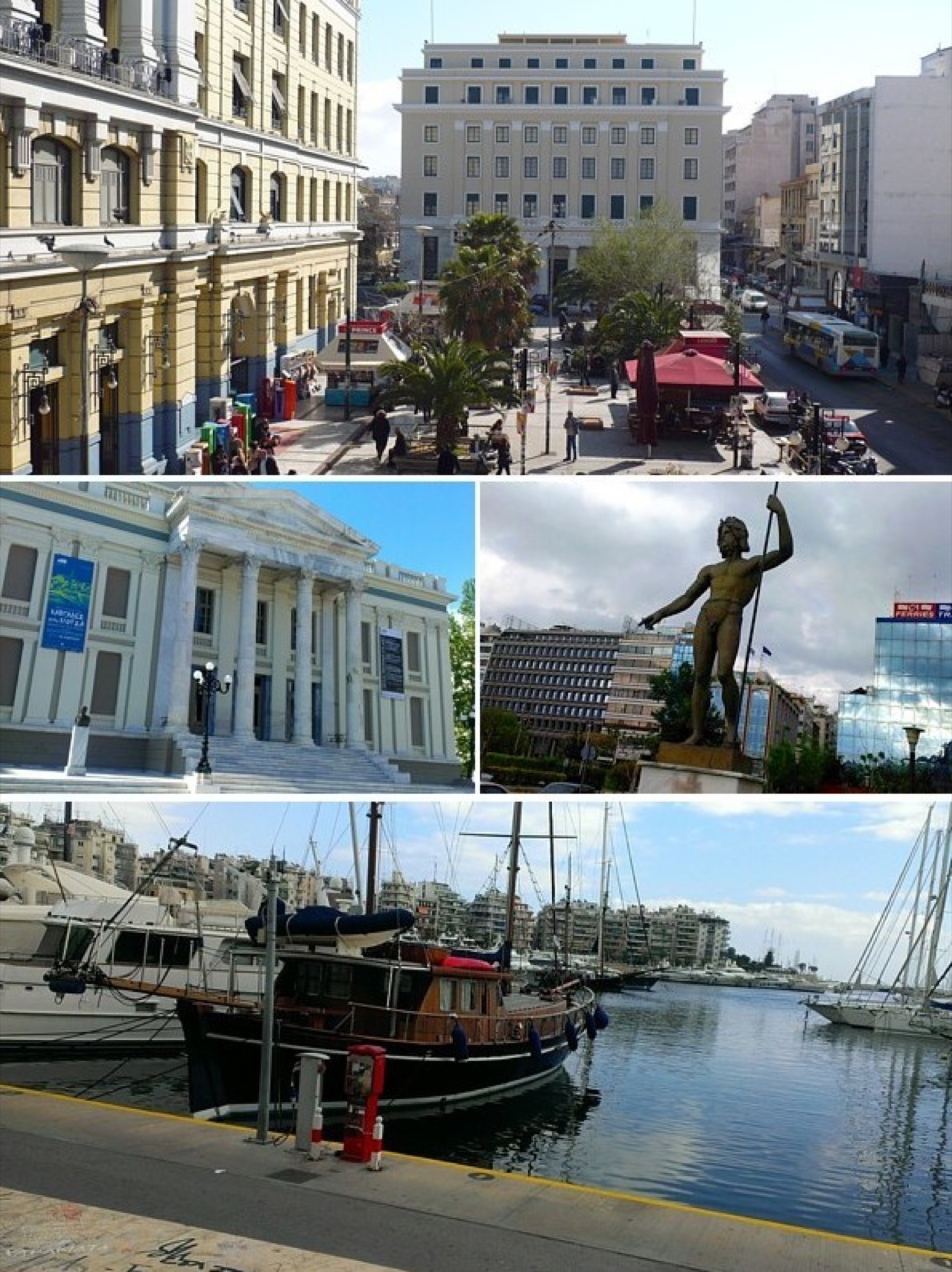
This site requires authorization to access.
To request access, contact
william.goetzmann@yale.edu
The Deigma at Piraeus was among the earliest purpose-built commercial exchange spaces in the ancient world. Literary sources place it within the emporion, the regulated commercial district lining the waterfront of the great harbor of Kantharos, the largest of the three natural harbors of the Piraeus peninsula. The term deigma means "sample" or "display," and the structure served as a portico or stoa where merchants exhibited samples of their cargoes to prospective buyers, a practice described by Alain Bresson in The Making of the Ancient Greek Economy (2016) as a critical institutional innovation that allowed prices to be established for commodities "sight unseen," reducing transaction costs in long-distance maritime trade. According to the Greek Travel Pages archaeological summary, drawing on the work of Panagos (1968) and Steinhauer (2000), the emporion district contained five porticoes used for mercantile exchange and storage, among them the Makra Stoa (Long Portico), built in the age of Pericles as a grain market, and the Deigma itself, positioned at the center of the emporion according to an inscription found in situ. Foundations from three of these porticoes have been identified in excavation, allowing partial reconstruction of the ancient coastline. Robert Garland, in The Piraeus: From the Fifth to the First Century B.C. (Duckworth, 1987), describes the port infrastructure in detail: in addition to these commercial stoas, the harbor district contained numerous quays, warehouses, arsenals, dry docks, and over 300 shipsheds (neosoikoi) serving the Athenian fleet. The Zea Harbour Project, directed by Bjorn Loven under the auspices of the Danish Institute at Athens since 2001, has excavated and surveyed hundreds of thousands of square meters of shipshed structures dating to the early fifth century BCE, revealing that the shipshed complexes at Zea alone covered more than 55,000 square meters, with the total across all three harbors approaching 110,000 square meters (Loven, The Ancient Harbours of the Piraeus, 2011). Near the harbor of Zea stood the Skeuotheke, the great naval arsenal designed by the architect Philon around 330 BCE. An inscribed marble stele discovered in 1888 preserves a remarkably detailed building specification: the structure measured 130 meters long by 18 meters wide, with an interior divided lengthwise by two rows of pillars into a central corridor flanked by two-story storage sections with shelving for the hanging tackle of triremes -- sails, ropes, ladders, and tents. Vitruvius later cited Philon's work on the arsenal in his own architectural treatise.
The visual and material culture associated with the Piraeus and its commercial life survives principally through Attic pottery, port-related inscriptions, and archaeological finds from the harbor district. Black-figure and red-figure vase paintings from the sixth and fifth centuries BCE frequently depict maritime scenes -- merchant vessels under sail, harbor activity, and the loading of cargo -- providing a visual record of the commercial world centered on ports like Piraeus. The Metropolitan Museum of Art has documented the range of these scenes in Athenian vase painting, noting that maritime and commercial subjects appear alongside mythological and everyday life depictions on both black-figure and red-figure ware. Graffiti scratched onto the undersides of exported Attic pottery by merchants and traders offer direct archaeological evidence of the commercial networks radiating from the Piraeus. The most celebrated archaeological discovery from the site is the group of monumental bronze statues unearthed in 1959 near the Agia Triada Church during sewer construction. The excavation, led by John Papademitriou of the Greek Archaeological Service and Mastrokostas Euthymios, revealed five bronze figures -- an archaic Apollo (the Piraeus Apollo, c. 530-520 BCE), a large Athena (the Piraeus Athena, c. 340 BCE), two statues of Artemis, and a large theatrical mask, possibly of Dionysus -- all carefully arranged, likely hidden in antiquity during the sack of Athens by Sulla in 86 BCE. These bronzes, now the centerpieces of the Archaeological Museum of Piraeus, are among the most important survivals of Greek bronze sculpture, as described by Steinhauer in The Monuments and the Archaeological Museum of Piraeus. Beyond sculpture, the port has yielded significant epigraphic material: inscriptions recording harbor regulations, commercial leases, dedications by merchants and shipowners, and the detailed building specifications of the Skeuotheke of Philon. Maritime dedicatory reliefs -- stone plaques showing ships, anchors, and merchant activity -- have been recovered from sanctuaries in the harbor district, reflecting the religious dimension of commercial life at sea.
Piraeus occupies a rocky peninsula roughly eight kilometers southwest of central Athens, projecting into the Saronic Gulf with three natural harbors: Kantharos (the Great Harbor) to the west, used for commercial shipping; Zea (modern Pasalimani) to the east, primarily for naval vessels; and Munychia (modern Mikrolimano), the smallest and most sheltered, also serving the navy. As the ancient historian Thucydides recorded, it was Themistocles who first recognized the strategic potential of this triple-harbor geography. In 493 BCE, Themistocles initiated the fortification of the Piraeus, and after the Persian Wars he oversaw the construction of the great circuit walls (completed c. 471 BCE), transforming the port from a minor coastal settlement into the preeminent military and commercial harbor of the eastern Mediterranean. The Long Walls, constructed under Cimon and Pericles between 461 and 445 BCE, secured the overland connection between Athens and Piraeus with two parallel fortified corridors roughly 200 yards apart, creating an effectively impregnable supply corridor to the sea, as described by Garland (The Piraeus, 1987). Within the walls, Piraeus was laid out according to the revolutionary grid plan of Hippodamus of Miletus, making it one of the earliest known examples of rational urban planning in the Western world. Aristotle credited Hippodamus with inventing the division of cities into functional zones, and the Piraeus embodied this principle: the emporion district along the Kantharos waterfront was a distinct commercial zone, separated from the residential quarters and the civic center at the Hippodameian agora in the heart of the peninsula. Pausanias, writing in the second century CE, noted that Piraeus had two agoras -- one inland (the Hippodameia) and one beside the sea -- with certain public buildings duplicated between the two zones. By the mid-fifth century the port city had grown into a substantial urban center in its own right, covering some 300 hectares and housing a diverse population of citizens, metics (resident aliens), and slaves who served the Athenian fleet and the vast commercial apparatus of the port.
The transformation of Piraeus from a fishing village into the commercial heart of the Athenian empire began in the early fifth century BCE under Themistocles, who understood that naval power required a defensible deep-water port. After the Greek victories over Persia at Salamis (480 BCE) and Plataea (479 BCE), Athens used its growing fleet and maritime revenues to build the port infrastructure that would underpin its imperial economy. The emporion at Piraeus became the central node in a far-flung trading network, and it was within this district -- at or near the Deigma -- that some of the most sophisticated financial innovations of the ancient world took shape. Maritime lending, known as nautikon daneion or bottomry loans, allowed merchants and shipowners to borrow capital for trading voyages, with the ship and cargo pledged as security; if the vessel was lost at sea, the debt was extinguished, making these loans an early form of risk transfer closely resembling insurance. Interest rates on such loans were high, reflecting the risk: Demosthenes' legal speeches record rates of 22.5 percent for a peacetime round trip to the Bosphorus and 30 percent in wartime. As Edward Cohen demonstrated in Athenian Economy and Society: A Banking Perspective (Princeton, 1992), the trapezitai (bankers) who operated at the Piraeus pursued financial transactions that, though technologically distant from modern banking, were identical in financial essence to the lending and deposit-taking of modern institutions. The most famous of these bankers was Pasion (c. 440-370 BCE), a former slave, probably of Syrian origin, who had served as chief clerk at the bank of Antisthenes and Archestratus at the Piraeus. After manumission, Pasion inherited the bank, accumulated a fortune of approximately 80 talents, donated a trireme and a thousand shields to the city, and was ultimately rewarded with Athenian citizenship -- an extraordinary ascent documented extensively by Cohen and by the forensic speeches of Isocrates and Demosthenes. When Pasion retired, his successor was another former slave, Phormion, who married Pasion's widow to keep the bank in the family. In the mid-fourth century BCE, Athens established the dikai emporikai, specialized commercial courts that heard disputes arising from maritime trade. As Cohen further analyzed in Ancient Athenian Maritime Courts (Princeton, 2006), these courts were remarkable for their rapidity, their supranational character -- extending legal standing to foreigners, metics, and even slaves -- and their requirement that disputes be grounded in written contracts. Demosthenes' Oration 35, Against Lacritus, preserves the only surviving text of an ancient maritime loan contract, detailing the terms, obligations, and penalties governing a trading voyage to the Pontus. Xenophon, in his treatise Poroi (Ways and Means, c. 355 BCE), proposed measures to attract more traders to the Piraeus emporion, including fair management of disputes and the construction of additional commercial facilities, recognizing that the port's institutional framework was itself a source of competitive advantage. William Goetzmann has situated these Athenian innovations in the broader history of financial development in Money Changes Everything: How Finance Made Civilization Possible (Princeton, 2016), arguing that Greek maritime finance -- with its pooling of capital, detailed written contracts, and functional courts for dispute resolution -- represented a critical step in the emergence of market-based economic institutions.
The Deigma at Piraeus functioned as a sample exchange: merchants displayed representative portions of their imported cargoes in the portico, and buyers contracted for bulk quantities on the basis of these samples -- a system that Bresson (The Making of the Ancient Greek Economy, 2016) identifies as a key mechanism for reducing information asymmetry and transaction costs in long-distance trade. The single most critical commodity passing through Piraeus was grain. Athens depended on massive grain imports to feed its population, with Demosthenes reporting that Attica imported approximately 800,000 medimnoi of wheat annually, roughly half of it from the Black Sea region, as Alfonso Moreno documented in Feeding the Democracy: The Athenian Grain Supply in the Fifth and Fourth Centuries BC (Oxford, 2007). The state regulated this trade intensively: the sitophylakes (grain guardians) -- originally five for Athens and five for Piraeus, later expanded to twenty and fifteen respectively -- supervised sales to prevent hoarding and price manipulation, with dereliction of duty punishable by death. Any grain vessel entering Piraeus was required to unload at least two-thirds of its cargo for the Athenian market, and since the time of Solon, grain export from Attica was banned. Beyond grain, the Piraeus handled a vast array of Mediterranean and Black Sea commodities: timber from Macedonia and Thrace essential for shipbuilding, slaves from various regions, wine and olive oil from Attica and the islands, metals (silver from the Laurion mines was Athens's chief export), dried fish from the Pontus, hides, linen, and luxury goods from Egypt and the Near East. As C. M. Reed argued in Maritime Traders in the Ancient Greek World (Cambridge, 2003), the development of maritime loans beginning around the mid-fifth century opened trading to men of modest means, who came to dominate long-distance commerce by the fourth century. These nautikai syngrapha (maritime loan contracts) were themselves traded instruments: a lender advanced capital at high interest for a specific voyage, bearing the risk of shipwreck in exchange for substantial returns -- interest rates between 12 and 30 percent depending on the route and season -- making them the earliest known form of venture finance blended with insurance. The emporion was a regulated commercial zone: the epimelitai tou emporiou (overseers of the import market) enforced rules requiring all seaborne trade to be conducted within its boundaries, while the commercial courts (dikai emporikai) provided legal enforcement of contracts, giving Athens's port a unique institutional advantage in attracting international trade.
Images will be added as the project develops. Photographs by Larry Ng and from research sources.