Merchants' Exchange Building
Philadelphia, USA · Established 1832
This site requires authorization to access.
To request access, contact
william.goetzmann@yale.edu
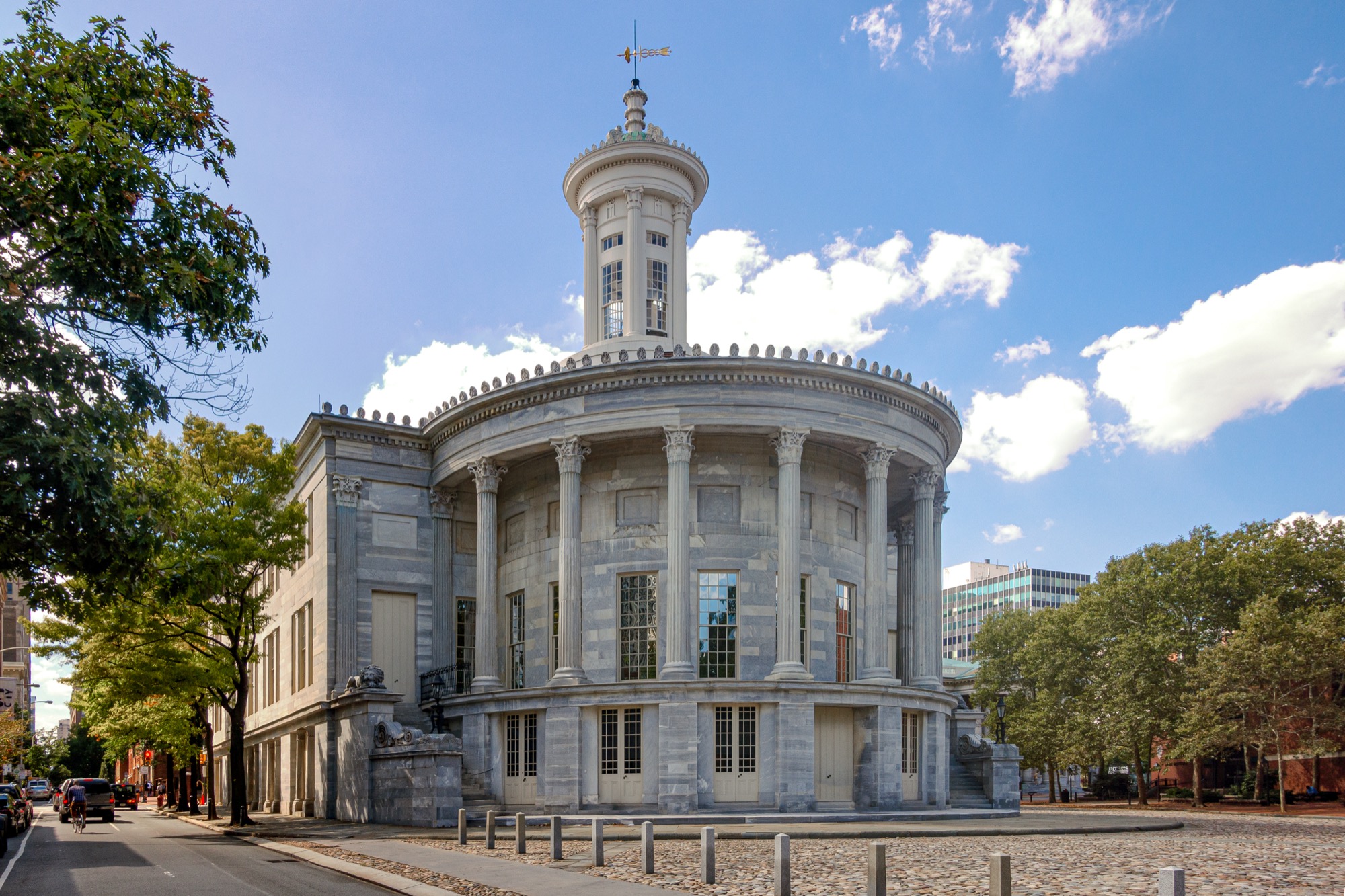
The Merchants’ Exchange Building, erected between 1832 and 1834 on a triangular lot bounded by Third, Walnut, and Dock Streets in Philadelphia’s Old City, stands as one of the masterworks of the Greek Revival in America. Designed by William Strickland (1788–1854), who had studied under Benjamin Henry Latrobe and already gained national renown for his Second Bank of the United States (1818–24), the Exchange was commissioned by the Philadelphia Exchange Company, a consortium of leading merchants organized in 1831 under the patronage of the financier Stephen Girard, then the wealthiest man in the nation. As Agnes Addison Gilchrist documented in her definitive monograph William Strickland: Architect and Engineer, 1788–1854 (University of Pennsylvania Press, 1950), nine architects submitted proposals in a public competition, and Strickland won the first premium. The building’s most celebrated feature is the semicircular Corinthian colonnade on the eastern (Dock Street) elevation—eight fluted columns and two pilasters rising two stories—which Strickland devised to fill the acute angle where Dock Street curved into Walnut Street, transforming an awkward triangular site into an architectural triumph. The column capitals, carved from Carrara marble imported from Italy, were modeled on the plates of the Corinthian order at the Choragic Monument of Lysicrates published by James Stuart and Nicholas Revett in The Antiquities of Athens (1762), the sourcebook that, as Talbot Hamlin argued in Greek Revival Architecture in America (Oxford University Press, 1944), furnished the principal vocabulary for the entire movement. Crowning the semicircular portico is a lantern tower freely adapted from the Lysicrates monument itself—an enlarged cylindrical drum ringed by engaged Corinthian columns supporting a conical roof. The body of the building is faced in blue-gray Pennsylvania marble, and the Walnut Street facade presents a tetrastyle Corinthian portico flanked by massive columnar piers whose austere scale, as the Society of Architectural Historians’ Archipedia entry observes, contrasts dramatically with the delicacy of the Italian-carved capitals. A barrel-vaulted vestibule led to the principal Exchange Room on the second floor, housed within the great rotunda behind the colonnade: a domed chamber supported on marble columns, with a mosaic floor and frescoed walls and ceiling executed by the Italian-born artist Nicola Monachesi. The National Park Service acquired the building in 1952 as part of Independence National Historical Park and undertook a meticulous exterior restoration in 1964–65, reconstructing the lantern tower, reproducing the eastern staircase, reinstalling the marble lions, and cleaning the marble facades to return the structure to its original appearance. The building was designated a National Historic Landmark in 2001.
The decorative program of the Merchants’ Exchange embodied the civic and commercial aspirations of Jacksonian Philadelphia through a synthesis of classical ornament and functional artistry. The Corinthian capitals of the semicircular colonnade—carved in Carrara marble by Italian craftsmen—reproduced with scholarly precision the acanthus-leaf order of the Choragic Monument of Lysicrates as published in Stuart and Revett’s Antiquities of Athens (1762), and were intended, as Robert Douglass Russell Jr. argues in William Strickland and the Creation of an American Architecture (University of Tennessee Press, 2017), to harmonize visually with the Corinthian capitals on the nearby First Bank of the United States. The principal interior space, the Exchange Room occupying the rotunda behind the colonnade on the second floor, received an elaborate decorative treatment: a mosaic floor of geometric pattern, a coffered dome supported on freestanding marble columns, and an extensive fresco cycle by Nicola Monachesi (1795–1851), the Roman-trained painter who had executed murals in several of Philadelphia’s Catholic churches and whose work at the Exchange represented one of the earliest fresco programs in an American commercial building. The lip of the semicircular portico was ornamented with carved shells in a Minoan design, an unusual archaeological reference that distinguished Strickland’s eclecticism. In 1838, a pair of recumbent marble lions were installed on the portico steps—gifts from a local merchant—sculpted by Signor Fiorelli of Philadelphia after the celebrated models by Antonio Canova for the tomb of Pope Clement XIII in Saint Peter’s Basilica in Rome. These lions, removed during the building’s degraded years as a produce warehouse but restored to their positions by the National Park Service in the 1960s restoration, signaled the mercantile community’s self-conscious identification with the grandeur of European commercial culture. Beyond sculpture, the building’s tower lantern itself functioned as a piece of both art and technology: modeled on a Greek choragic monument commemorating a choral victory, it housed an optical telegraph—a heliograph system of mirrors on towers across the Delaware River to New Jersey—that could relay market information from New York in under five minutes, fusing classical form with commercial utility in a manner that epitomized the Greek Revival’s ambition to clothe modern enterprise in ancient dignity. The building’s decorative ensemble was tragically degraded after the exchange closed: when the structure served as a wholesale produce warehouse in the early twentieth century, the mosaic floor, frescoed dome, and interior marble columns were lost or covered over. The Kreilick Conservation firm’s reports on the 2009 and 2014 exterior conservation campaigns document the painstaking treatment of surviving stone ornament, including repointing of the marble colonnade and stabilization of the carved capitals.
The Merchants’ Exchange occupies a site of deep commercial significance at the historic nexus of Philadelphia’s waterfront economy. Dock Street, which forms the curving eastern boundary of the lot, traces the course of Dock Creek—the small tidal inlet that William Penn identified in 1682 as a natural harbor for wintering vessels and where he established one of the city’s two earliest public landings. As the National Park Service study Scenic Stream to City Sewer: Dock Creek from 1682 to 1849 documents, the creek attracted tanneries, breweries, and slaughterhouses along its banks before being progressively covered over by 1784 and converted into Dock Street, which by the early nineteenth century was the commercial spine connecting the Delaware River wharves to the interior city. The Exchange stood barely two blocks from the waterfront, within sight of the masts crowding the Delaware, and its tower lantern afforded telescopic views down the river, enabling merchants to announce arriving ships and commence trading their cargoes before vessels were moored. Robert E. Wright, in The First Wall Street: Chestnut Street, Philadelphia, and the Birth of American Finance (University of Chicago Press, 2005), demonstrates that the blocks surrounding the Exchange constituted America’s first financial district: Chestnut Street, one block north, housed the First Bank of the United States (1797), the Second Bank of the United States (1824, also by Strickland), the Bank of North America (1781), the Philadelphia Bank, and the Insurance Company of North America, alongside scores of brokerage offices, insurance underwriters, and law firms. The City Tavern (also known as the Merchants’ Coffee House) at Second and Walnut Streets, where the Board of Brokers had conducted securities auctions since 1790, stood just steps away—and it was a fire at the Coffee House in March 1834 that precipitated the brokers’ permanent relocation to the new Exchange. The building thus anchored the southeastern corner of a dense institutional cluster that also included Carpenters’ Hall, the Library Company, and the American Philosophical Society, placing commercial exchange in direct adjacency to the civic and intellectual life of the early republic. By the 1830s, however, New York’s ascendancy as a port and capital market was already undermining Philadelphia’s primacy, a shift sealed when Andrew Jackson vetoed the recharter of the Second Bank in 1832, and the financial center of gravity migrated permanently to Wall Street—a transition that Domenic Vitiello and George E. Thomas trace in The Philadelphia Stock Exchange and the City It Made (University of Pennsylvania Press, 2010).
The Merchants’ Exchange Building is inseparable from the history of organized securities trading in the United States. Philadelphia’s Board of Brokers, founded in 1790 at the Merchants’ Coffee House (City Tavern) at Second and Walnut Streets, was the first stock exchange in the nation—predating New York’s Buttonwood Agreement of 1792 by two years. As Domenic Vitiello and George E. Thomas document in The Philadelphia Stock Exchange and the City It Made (University of Pennsylvania Press, 2010), the Board of Brokers initially traded government bonds, notes, and bills issued under Alexander Hamilton’s plan to fund the national debt, alongside shares in the Bank of North America (chartered 1781), the First Bank of the United States (chartered 1791), and the Insurance Company of North America (founded 1792). In 1831, Stephen Girard (1750–1831), the Franco-American banker and merchant who was then the richest private citizen in the country, organized the Philadelphia Exchange Company with the object of erecting a purpose-built commercial exchange to replace the cramped coffeehouse. Girard died on December 26, 1831, struck by a horse and wagon the previous year, and did not live to see the building completed, but his initiative attracted sufficient capital to fund Strickland’s design. Construction proceeded from 1832 to 1834, and the Board of Brokers moved into the Exchange Room following the fire that damaged City Tavern in March 1834. The Exchange served as the center of Philadelphia’s securities market through the antebellum period, handling not only government bonds but also the rapidly proliferating stocks of canal companies, railroads, and banks that were transforming the American economy. In 1875 the Board of Brokers formally reorganized as the Philadelphia Stock Exchange, and the institution moved briefly to the rear of the old Girard Bank (formerly the First Bank of the United States) in 1876. The firm of Furness and Hewitt made alterations to the Merchants’ Exchange interior in 1871, and architect Louis Hickman renovated the building again in 1902 when the Stock Exchange returned. After the Stock Exchange departed permanently for new quarters in 1913, the building fell into commercial use as a wholesale produce warehouse, and its interior decorative scheme was largely destroyed. The National Park Service acquired the structure in 1952, undertook exterior restoration in 1964–65, and designated it a National Historic Landmark in 2001 in recognition of its status as the oldest surviving stock exchange building in the United States and a monument to the birth of American capital markets.
The securities and commodities traded at the Merchants’ Exchange reflected Philadelphia’s role as the financial capital of the early American republic. When the Board of Brokers established operations in 1790, the principal instruments were federal government bonds—the six-percent and three-percent “sixes and threes” issued under Treasury Secretary Alexander Hamilton’s 1790 plan to assume and fund Revolutionary War debts—along with state government securities and bills of exchange. As Robert E. Wright demonstrates in The First Wall Street: Chestnut Street, Philadelphia, and the Birth of American Finance (University of Chicago Press, 2005), these early debt instruments circulated not only regionally but nationally and internationally, with Philadelphia acting as the principal clearinghouse for the young republic’s public credit. Bank stocks formed the second major category: shares in the Bank of North America (the first commercial bank in the United States, chartered 1781), the First Bank of the United States (chartered 1791 with a capitalization of $10 million—then the largest corporation in America), and the Philadelphia Bank were actively quoted. Insurance company equities, particularly those of the Insurance Company of North America (founded 1792) and the Pennsylvania Company for Insurance on Lives and Granting Annuities (chartered 1812), also traded regularly. By the 1820s and 1830s, as the transportation revolution gathered momentum, canal stocks became a major asset class: shares in the Schuylkill Navigation Company, the Lehigh Coal and Navigation Company, the Chesapeake and Delaware Canal, and the Union Canal linked the Exchange to the internal improvement projects that were opening the Appalachian interior. Railroad securities soon followed—the Philadelphia, Germantown and Norristown Railroad (chartered 1831) and the Reading Railroad (chartered 1833) were early listings. Coal mining companies, whose anthracite fueled Philadelphia’s growing manufacturing sector, were also prominent. The Exchange Room additionally functioned as a maritime intelligence center: the tower’s optical telegraph relayed shipping reports from down the Delaware, and real-estate transactions, cargo auctions, and marine insurance contracts were negotiated on the trading floor alongside securities. Vitiello and Thomas note in The Philadelphia Stock Exchange and the City It Made (2010) that by the 1850s the exchange was financing the capital-intensive railroad and coal enterprises that would make Philadelphia the workshop of industrial America, even as the center of national finance was shifting irreversibly toward New York.
Images will be added as the project develops. Photographs by Larry Ng and from research sources.