Stock Exchange of Perth (Perth Stock Exchange)
Perth, Australia · Established 1889
This site requires authorization to access.
To request access, contact
william.goetzmann@yale.edu
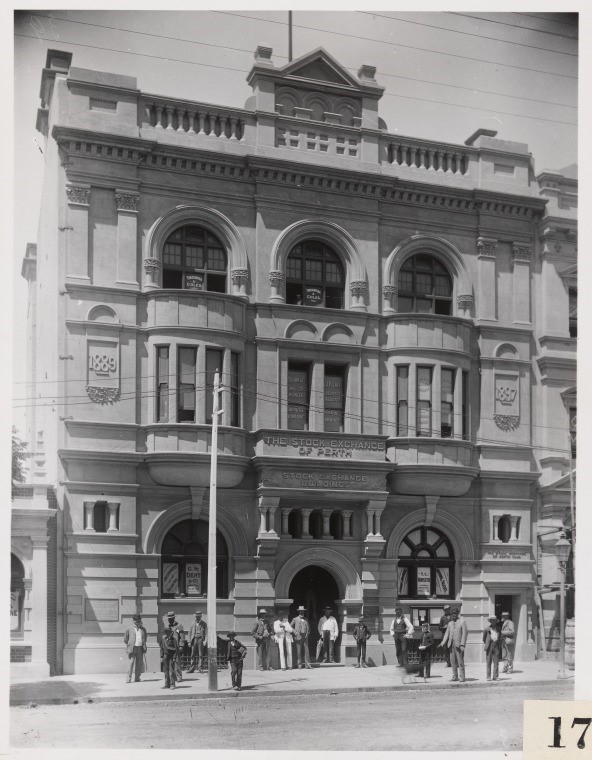
The Stock Exchange of Perth was housed in the purpose-built Stock Exchange Buildings at 49 St George's Terrace, the first major commission of the partnership of Drake & Whitwell, formed in mid-1896 when Felix Joseph James Whitwell (1859-1936), a London-trained architect, left the colonial public service to go into private practice with the ex-Sydney architect William Adams Drake (Australian Institute of Architects, biographical file on Whitwell, Felix Joseph James; Freotopia, "Architects" database). The foundation stone was laid by the Premier of Western Australia, Sir John Forrest, on 22 October 1896, and the building was completed the following year, the dates 1889 and 1897 being carved into cartouches on the facade to commemorate both the exchange's founding and its new home (Wikipedia, "Stock Exchange of Perth"). The three-storey rendered masonry front was designed in the ornate Late Victorian and Federation Free Classical manner then fashionable along the Terrace: a rusticated, arcaded ground floor pierced by round-arched openings, projecting bay windows lighting the upper floors, an enriched cornice and a balustraded parapet broken by a central pedimented gable, with the legend "THE STOCK EXCHANGE OF PERTH" set boldly across the first floor. Like most of the speculative commercial architecture thrown up on St George's Terrace during the gold-boom decade, the building did not survive the twentieth-century redevelopment of central Perth, when, as the State Heritage Office notes, the inter-war and post-war expansion of commerce swept away nearly all of the city's early commercial stock (Heritage Council of Western Australia, inHerit database, "St Georges Terrace Commercial Group").
Artistically the Stock Exchange Buildings were a work of applied facade ornament rather than of fine art, in keeping with their character as a speculative commercial chambers. The decorative interest lay in the modelled render of the front elevation: classical pilasters and cornices, the rusticated arcading of the ground floor, urns and balusters along the parapet, and above all the two carved date cartouches reading 1889 and 1897 that flanked the central bay, framing the inscribed name of the exchange (photograph, State Library of Western Australia, BA533/55, 28 May 1901). No program of murals, statuary or allegorical sculpture of the kind found in the great European bourses is recorded for the building, and contemporary photographs show plain trading and office interiors. The chief surviving visual record of the building's appearance is the 1901 photograph taken for the Kalgoorlie Western Argus and now held by the State Library of Western Australia, which captures the carved facade, the "FOR SALE" notices in the windows and brokers gathered on the pavement outside.
The building stood on St George's Terrace, the principal commercial and financial spine of central Perth, which by the 1890s was rapidly filling with banks, broking chambers, insurance offices and company-promotion premises as the colony's gold rushes poured capital into the small port-and-government town. Its situation among the banks of the Terrace - the building itself also accommodated the Commonwealth Bank and other businesses - placed the exchange at the heart of the network that connected Perth and Fremantle to the remote Eastern Goldfields and, through them, to investors in Melbourne, Adelaide and London (Wikipedia, "Stock Exchange of Perth"; Freotopia, "Architects"). The gold-boom architecture of which it formed part was, however, almost entirely erased during the office-tower redevelopment of St George's Terrace from the 1960s onward, so that the Heritage Council of Western Australia today identifies only a small "St Georges Terrace Commercial Group" of later buildings as the sole extant early-twentieth-century cluster on the street (Heritage Council of Western Australia, inHerit database).
The Stock Exchange of Perth was the last of Australia's six colonial stock exchanges to be founded, following those of Melbourne (1861), Sydney (1871), Hobart (1882), Brisbane (1884) and Adelaide (1887). It emerged from the brokers' meetings of the late 1880s and commenced in July 1889, an earlier Perth Stock Exchange having been convened under Alexander Forrest in October 1888; the new body began with a small membership who paid an entrance subscription of about twelve guineas (MarketsWiki, "Perth Stock Exchange"; Wikipedia, "Stock Exchange of Perth"). Its timing was extraordinarily fortunate, for within a few years the discoveries at Coolgardie (1892) and on the Kalgoorlie "Golden Mile" (1893) transformed Western Australia from the least-populated Australian colony into one of the world's great gold producers, and the exchange became the principal local instrument for floating and trading the hundreds of mining companies that the rush spawned. The exchange operated for nearly a century, latterly adopting the uniform national listing requirements agreed among the Australian exchanges in 1972, before merging with the five other Australian securities exchanges to form the Australian Stock Exchange (now ASX), which commenced operations on 1 April 1987 (MarketsWiki, "Perth Stock Exchange"). Records of the exchange survive in the J. S. Battye Library in Perth and in the Noel Butlin Archives Centre at the Australian National University.
The Stock Exchange of Perth was overwhelmingly a market in mining and pastoral securities, and above all in gold-mining shares. In the boom of the mid-1890s it provided the mechanism for channelling the enormous capital required to develop the remote Eastern Goldfields, with hundreds of West Australian gold-mining companies floated in 1895-1896 alone, ranging from substantial producers on the Kalgoorlie Golden Mile to purely speculative prospecting ventures (MarketsWiki, "Perth Stock Exchange"; Wikipedia, "Stock Exchange of Perth"). Trading was conducted by the traditional "call" system, in which an official called over the names of the listed companies in successive sessions and members bid and offered in turn; in the post-war decades this gave way to a "post" or board system, with bids and offers chalked on blackboards through the trading day. Beyond gold the exchange listed pastoral companies, banks and other West Australian enterprises, but its fortunes remained tied to mining, and it carried that resource-sector orientation into the national market when it was absorbed into the ASX in 1987.
Images will be added as the project develops. Photographs by Larry Ng and from research sources.