Paris Bourse de Commerce
Paris, France · Established 1763 (as Halle aux Blés)
This site requires authorization to access.
To request access, contact
william.goetzmann@yale.edu
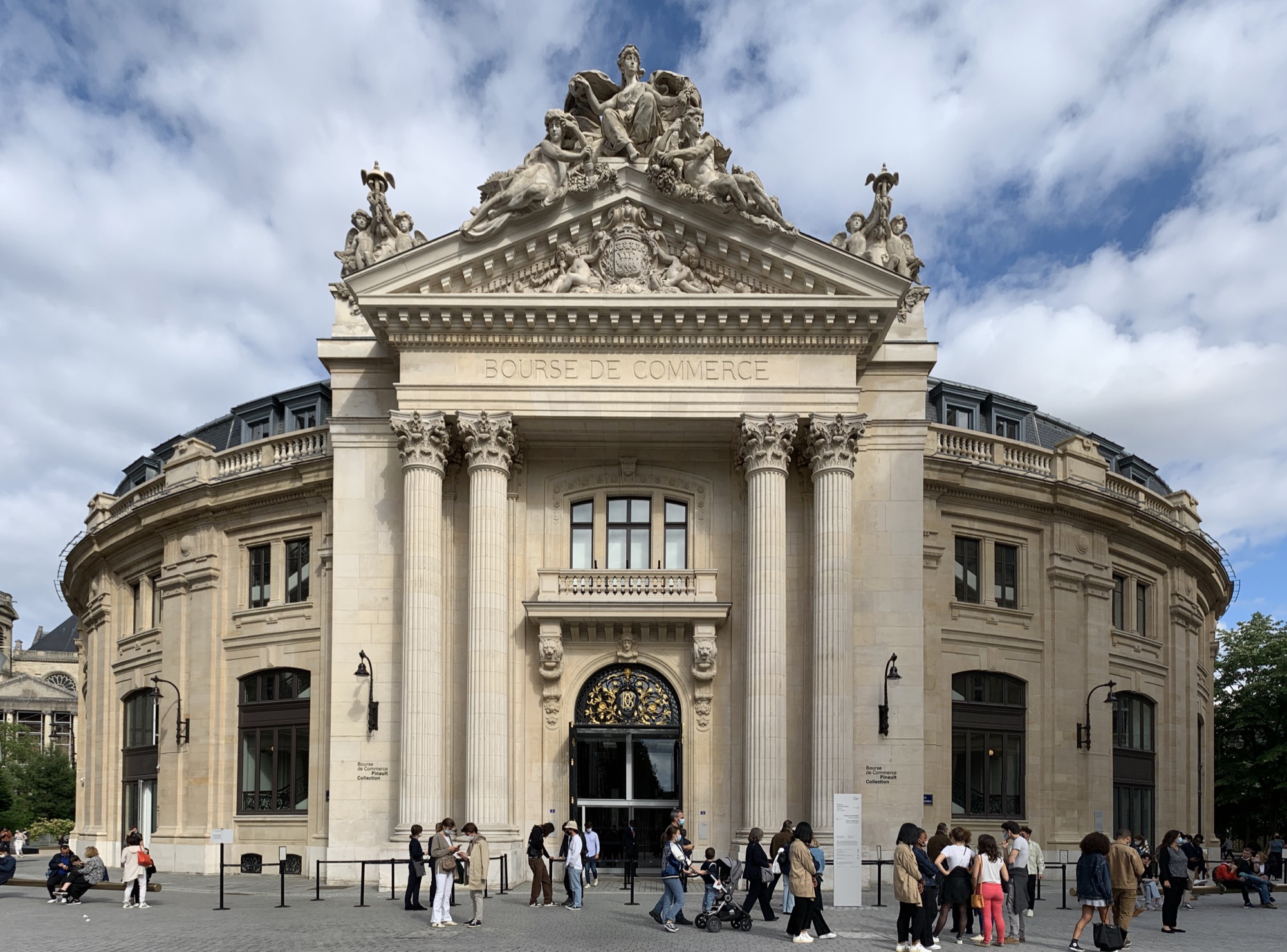
The Bourse de Commerce is a circular building with an exterior diameter of 68.19 meters, originally constructed between 1763 and 1767 by architect Nicolas Le Camus de Mezieres as the Halle aux Bles, a grain exchange featuring 25 arcades, an open central courtyard, and double concentric galleries supported by Tuscan-order columns. In 1782-1783, architects Jacques-Guillaume Legrand and Jacques Molinos capped the open courtyard with an innovative wooden dome constructed by carpenter Andre-Jacob Roubo, a structure Thomas Jefferson called 'the most superb thing on earth' during his time as American ambassador to France. After fire destroyed the wooden dome on 16 October 1802, engineer Francois Belanger and Francois Brunet designed a revolutionary iron dome covered in copper sheets with a diameter of more than 39 meters, completed in 1811--one of the earliest large-scale iron-framed structures in the world. In the major reconstruction of 1885-1889, architect Henri Blondel transformed the building into the Bourse de Commerce, preserving the internal circular wall and dome while replacing the iron and copper cladding with cast iron and glass to flood the interior with natural light.
The interior of the rotunda is crowned by a monumental painted panorama, the 'Panorama du Commerce,' executed during Blondel's 1889 renovation by a team of five painters coordinated by Alexis-Joseph Mazerolle, the most academically accomplished of the group and a decorator of the Paris Opera. The panoramic mural depicts the history of trade between the five continents: Evariste-Vital Luminais painted America; Desire-Francois Laugee depicted Russia and the North; Georges-Victor Clairin rendered Asia and Africa; and Hippolyte Lucas portrayed Europe. Mazerolle unified the composition by adding allegorical figures for each cardinal direction--Europe symbolized by the arts and architecture, Africa by a lion and the hunt, Asia by hookah and elephants, and the North by a polar bear. The murals and cupola were classified as a historical monument on 15 January 1975, and were carefully restored in 1998 and again during the Pinault Collection renovation.
The Bourse de Commerce stands in the 1st arrondissement of Paris in the historic Les Halles district, positioned between the Louvre and the Centre Pompidou, with its entrance giving onto the rue du Louvre. Attached to the building's south side stands the enigmatic Medici Column, a hollow fluted Doric column 31 meters tall attributed to architect Jean Bullant and erected in 1574 for Catherine de Medici, containing a spiral staircase of 147 steps that led to an observation platform believed to have been used for astrological observations by the queen's astrologer, Cosimo Ruggieri. The circular form of the building has been a distinctive landmark in the Parisian streetscape for over 250 years, its dome visible from surrounding streets and serving as a geographic anchor for the commercial heart of the city.
The site's commercial history begins in 1763 when the City of Paris commissioned the Halle aux Bles as a centralized grain market, replacing the chaotic open-air trading that had long characterized Parisian provisioning. The building's innovative dome attracted international attention: its design influenced public buildings in Britain and the United States, and Jefferson proposed adapting the Delorme dome technique for the U.S. Capitol, the White House, and other American structures. In 1885, the grain exchange was converted into the Bourse de Commerce for the Universal Exhibition of 1889, and the Syndicat General de la Bourse de commerce de Paris, created in 1854, oversaw commodities trading there for over a century. The City of Paris sold the building to the Paris Chamber of Commerce for one symbolic franc in 1949; commodities trading ended in 1998 with the computerization of futures markets; and in 2021, the building reopened as the Bourse de Commerce-Pinault Collection, a private contemporary art museum designed by Pritzker Prize-winning architect Tadao Ando, who inserted a striking 29-meter-wide, 9-meter-tall concrete cylinder within the historic rotunda.
Originally built for the storage and sale of wheat, the Halle aux Bles served as the central grain market of Paris, where flour, rye, and oats were traded in the circular courtyard. After its transformation into the Bourse de Commerce in 1889, the building became the principal commodities exchange of Paris, with futures markets operating under syndicates for wheat, flour, oil, sugar, alcohol, and rubber. Following World War II, the futures markets expanded to international trading in white sugar, cocoa, coffee, potatoes, soybean meal, and rapeseed. The exchange operated continuously until 1998, when the computerization of futures markets rendered the physical trading floor obsolete, ending over two centuries of commercial activity on the site.
Images will be added as the project develops. Photographs by Larry Ng and from research sources.