Hôtel de Ville and Place de Grève (Rentes sur l'Hôtel de Ville)
Paris, France · Established 1522 (first rentes sur l'Hôtel de Ville issued under François Ier; municipal seat at the Maison aux Piliers from 1357)
The rentes of the French crown were for more than two and a half centuries tied to a single building: the town hall of Paris on the Place de Grève, the seat of the prévôt des marchands and the échevins who issued, registered and paid them. The municipality's first permanent home on the site was the Maison aux Piliers, a house carried on an arcade of pillars that Étienne Marcel, prévôt des marchands, acquired for the city in July 1357. Antoine Le Roux de Lincy's Histoire de l'Hôtel de Ville de Paris (1846), still the foundational documentary history of the building, traces how this modest Gothic house served as the seat of the prévôté until the sixteenth century. It was therefore in the Maison aux Piliers that the first rentes of 1522 were sold and administered.
After François Ier gave the city leave to rebuild in 1529, the first stone of a new Renaissance Hôtel de Ville was laid on 15 July 1533 by the prévôt Pierre Viole. The design is traditionally given to the Italian Domenico Bernabei da Cortona, called Boccador, who had come to France under Charles VIII. Historians have long argued over how much of the executed building was his and how much belonged to the French master mason Pierre Chambiges, who directed the works. That question remains open and should not be settled by assertion. The southern half was built under François Ier and Henri II, roughly 1533 to 1551. The Wars of Religion then halted construction, and the northern half was raised only under Henri IV and Louis XIII, from about 1605 to 1628. The result was a long two-storey façade of French Renaissance type facing the square, with corner pavilions, high roofs and a central belfry. Its ornament of niches, pilasters and sculpture showed the Italianate taste of the 1530s, joined to the steep French roofline.
The rentes were run through this building. Registers of constitutions were kept there, and the payeurs des rentes paid arrears there, each quarter or half-year, to crowds of holders. The administration of the rentes was in practice an institution lodged inside the town hall, not a separate building. Louis-Philippe's architects Étienne-Hippolyte Godde and Jean-Baptiste Lesueur enlarged the building between 1837 and 1848 and kept the Renaissance façade. On 23–24 May 1871, during the Semaine sanglante, the Communards set it on fire, and the archives and library of the city were destroyed with it. Many original registers of the Paris rentes were lost in that fire. Historians of the debt therefore depend heavily on the Archives nationales (series H, Bureau de la Ville, and the notarial Minutier central) and on printed edicts. The present Hôtel de Ville is a free reconstruction of 1874–1882 by Théodore Ballu and Édouard Deperthes. Its façade recalls the lost Renaissance building, but it is not that building.
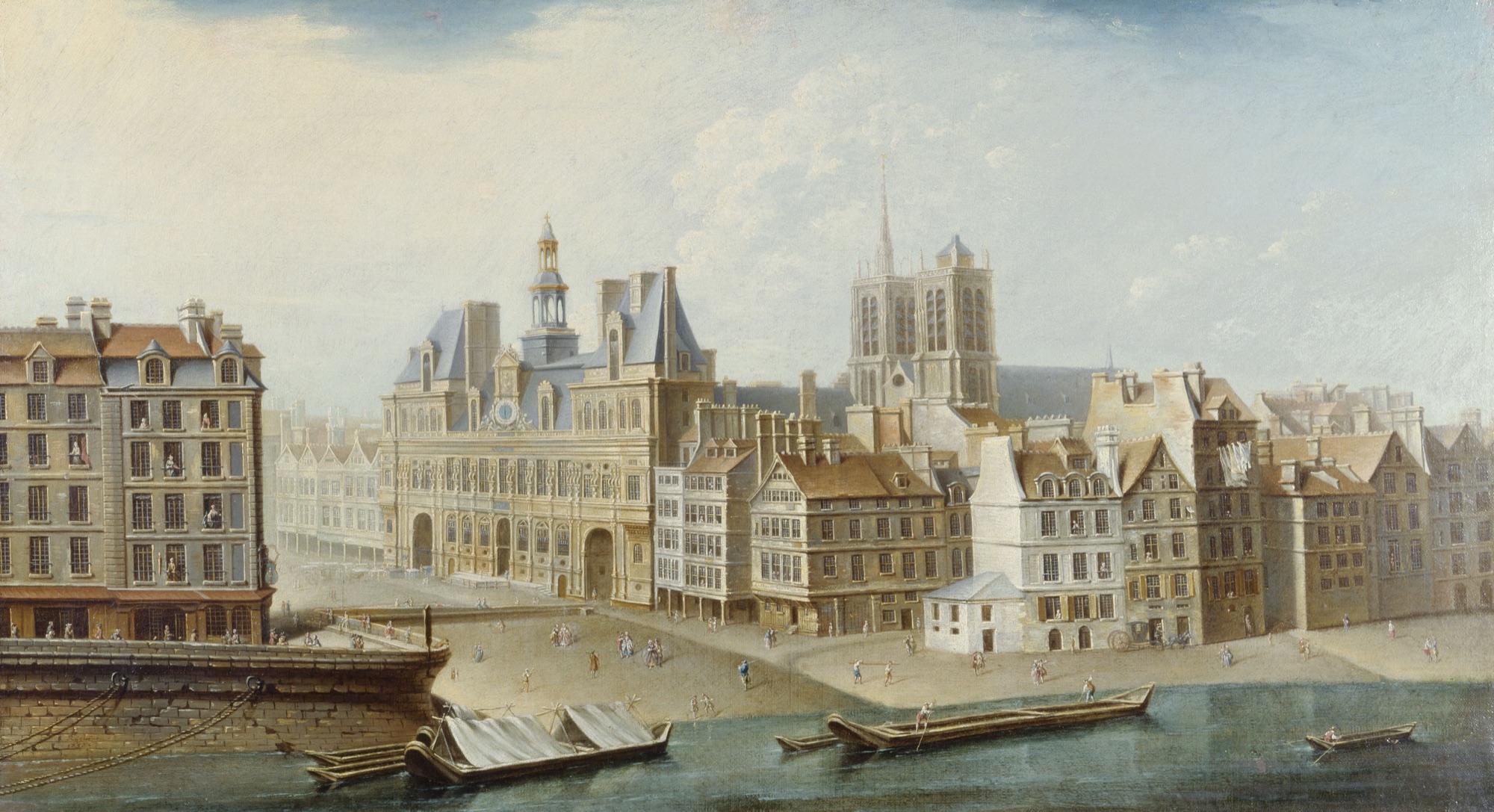
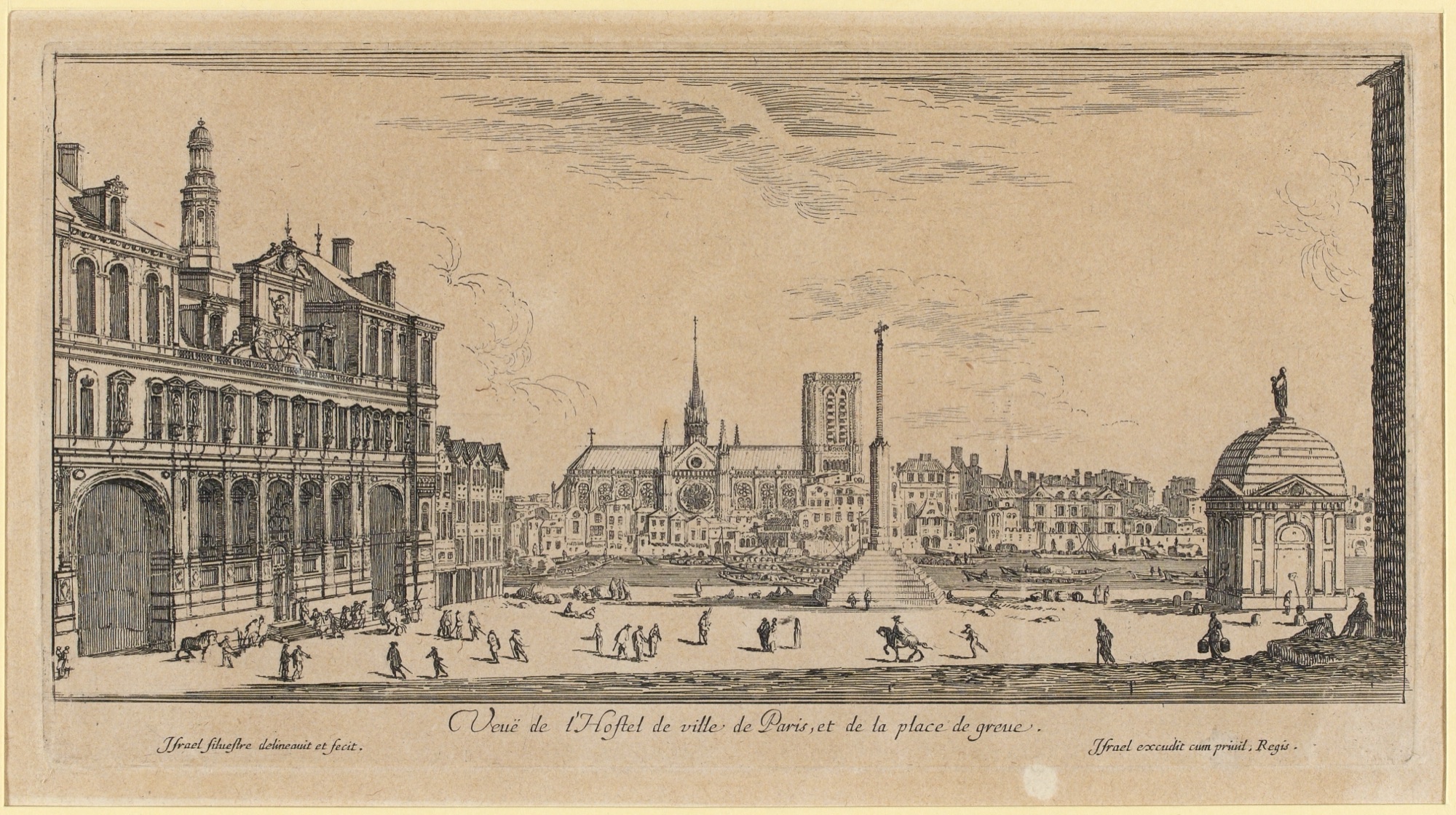
The Hôtel de Ville and the Place de Grève are among the most frequently depicted sites of early-modern Paris. The Musée Carnavalet holds the richest body of views, and the Paris Musées collections now publish many of them under a CC0 licence. Among the seventeenth-century prints are Israël Silvestre's etched Vue de l'Hostel de ville de Paris, et de la place de greve, published by Israël Henriet before 1655 (Carnavalet G.13257), and the anonymous Veue de l'Hostel de Ville de Paris, whose lettering recalls the tradition that the Maison aux Piliers had been the house of the Dauphin Charles, regent for King Jean. These prints show the completed Renaissance façade, the open sloping square running down to the Seine, and the river port. They are the best visual evidence for the setting where rentiers queued for their quartiers, although none of them shows a payment of rentes as such.
The two great eighteenth-century views are by Nicolas-Jean-Baptiste Raguenet, L'Hôtel de Ville et la place de Grève, dated 1752 and 1753 (Carnavalet P284 and P285). His topographical canvases show the square crowded with carts, porters and boats at the Port de Grève, the façade of the Hôtel de Ville closing the view, and in some versions the temporary architecture built for municipal fireworks. Workshop versions also survive (Carnavalet P773).
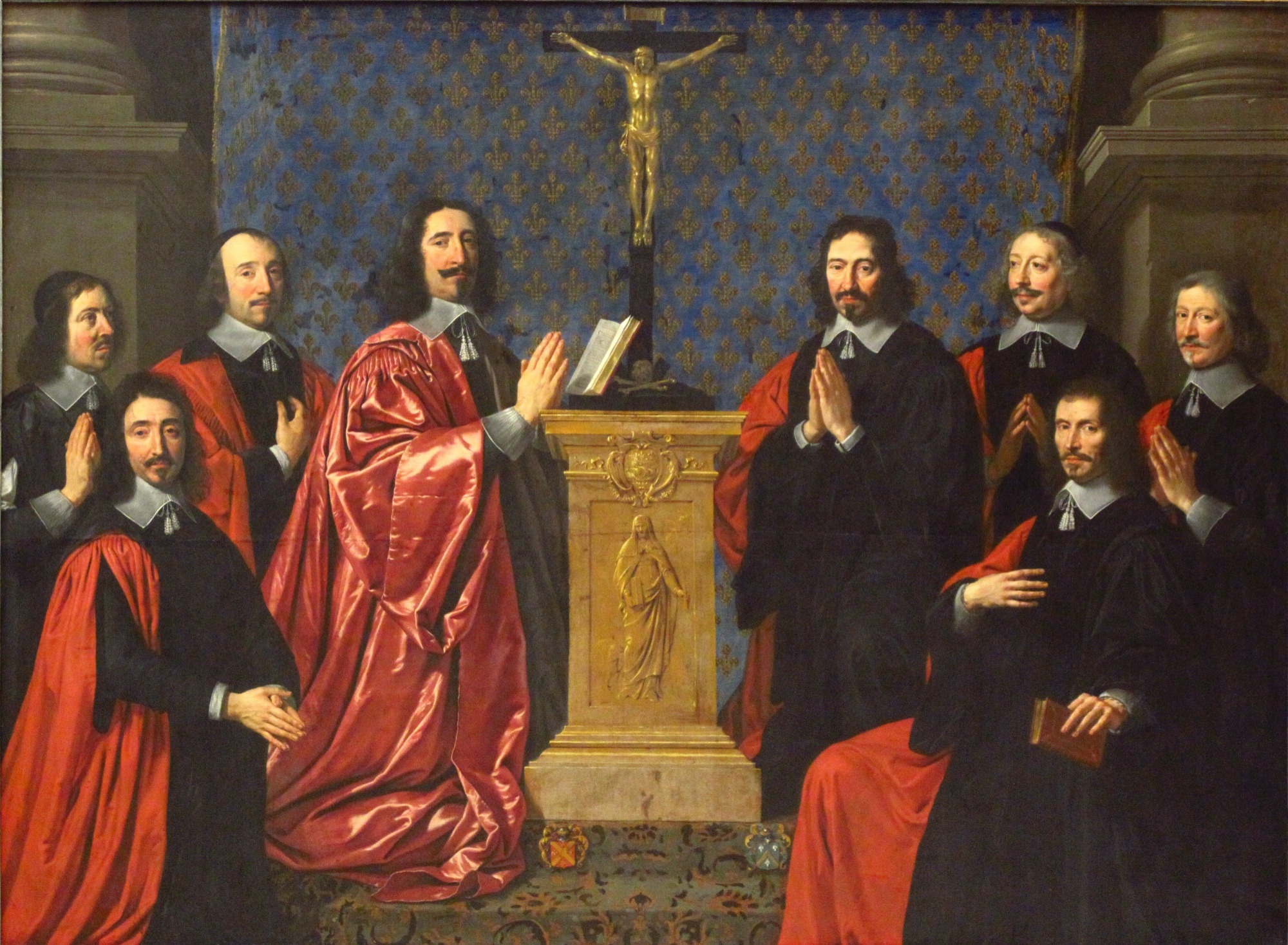
The municipality commissioned its own image in the corporate portraits of the prévôt des marchands and échevins, the officials who signed the contracts of the rentes. Philippe de Champaigne's Le Prévôt des marchands et les échevins de la ville de Paris (1648; Louvre, MI 911; oil on canvas, about 2.1 by 2.7 m) was painted in the year the Fronde began. It shows the city magistrates as a sober collective body in their parti-coloured robes. Nicolas de Largillierre's group of 1689, of which a sketch survives in the national collections, and Jean-Baptiste Deshays's allegory of the prévôt and échevins celebrating the Treaty of Paris of 1763 (Carnavalet P1712) continue the genre. Many of these pictures hung in the Hôtel de Ville itself, and much of the original decoration of the building was lost in 1871.
For the crash of John Law's System the essential images are satirical. The Dutch compilation Het groote tafereel der dwaasheid (The Great Mirror of Folly, 1720) includes many prints of the speculators of the Rue Quincampoix, a source analysed in William N. Goetzmann, Catherine Labio, K. Geert Rouwenhorst and Timothy Young (eds.), The Great Mirror of Folly: Finance, Culture, and the Crash of 1720 (Yale University Press, 2013). Eighteenth-century prints of the crowded Quincampoix are held by the Carnavalet and the Bibliothèque nationale. Executions on the Place de Grève, above all that of Damiens in 1757, produced their own popular print literature, unrelated to finance.
The Place de Grève was named for the sandy, gravelly strand (grève) on the right bank of the Seine, opposite the Île de la Cité. It was the city's chief river port long before it became a financial address. The Port de Grève received wood, wine, grain and hay brought downriver, and the merchant water-guild of Paris, the marchands de l'eau, controlled that traffic. The prévôté des marchands grew out of the guild, and its municipal seal of a ship became the arms of Paris. It is therefore not surprising that the city's government settled on the port square. Debt administration, river commerce and municipal jurisdiction over the Seine trade were all lodged in one place. The square was also Paris's labour exchange: unemployed workers gathered there to be hired, which gave French the expression faire grève, first "to stand on the Grève waiting for work" and later "to strike". It was also the principal place of public execution under the Ancien Régime. François Ravaillac was put to death there in 1610 and Robert-François Damiens in 1757. On 25 April 1792 the guillotine was used there for the first time, on Nicolas-Jacques Pelletier. Rentiers coming to collect their arrears thus crossed a square that served at once as port, hiring hall and scaffold. The square was renamed Place de l'Hôtel-de-Ville in 1803.
The Hôtel de Ville was where rentes were issued and paid, not where they were traded. Trading in Paris took place elsewhere, and the venue moved westward over time. The changers of the medieval city had been established on the Grand Pont, later called the Pont au Change, a few hundred metres west of the Grève. According to the eighteenth-century geographer Expilly (Dictionnaire géographique, historique et politique des Gaules et de la France, 1768), merchants and bankers met until about 1700 at a "place du Change" in the courtyard of the Palais on the Île de la Cité, near the Conciergerie. During Law's System of 1719–20 the market moved to the narrow Rue Quincampoix in the Saint-Martin quarter, north of the Grève. After an ordinance of March 1720 closed it, the market went briefly to the Place Vendôme and then to sheds in the garden of the Hôtel de Soissons. The arrêt du Conseil of 24 September 1724 finally gave it a regulated Bourse in the Hôtel de Nevers on the Rue Vivienne, where it remained until the Revolution; see the entry on the Palais Brongniart for its later homes. Notaries were the essential intermediaries of the rente market, and their offices were scattered across the city. As Hoffman, Postel-Vinay and Rosenthal show in Priceless Markets (2000), they formed a dense network that matched lenders and borrowers without any central floor.
The rentes sur l'Hôtel de Ville began in 1522, when François Ier, short of money for the Italian wars, had the city of Paris sell perpetual annuities on his behalf. The interest was assigned on royal tax revenues collected in Paris, chiefly the aides on wine, livestock and other goods, and the prévôt des marchands and échevins administered the issue. Bernard Schnapper's Les rentes au XVIe siècle: histoire d'un instrument de crédit (1957) remains the standard account of this sixteenth-century origin. The terms of the first issue are reported differently. Many accounts give a capital of 200,000 livres at the denier douze (8⅓ per cent). Raphaël-Georges Lévy (Revue des Deux Mondes, 1916), however, summarises letters patent of September 1522 that authorised commissioners to sell up to 25,000 livres of annual rente at 10 per cent or less, secured on the aides, gabelles and impositions. The figure of 200,000 livres at the denier douze also appears in a royal permission of 1557. The discrepancy has not been resolved. The two figures may describe different things, a ceiling of annual rente authorised in 1522 and a capital sum attached to the first issue only in later retellings, but that is a conjecture; the letters patent of 1522, read against Schnapper's tables of the early issues, are where the question would be settled, and neither figure should be repeated as the terms of the first loan until then. The model, as Joël Félix notes in a review of Béguin (La Vie des idées, 2012), came from the Italian city-states and the towns of Flanders. Its key advantage was that the city's credit, and its guarantee as intermediary, let the crown borrow more cheaply than from merchant bankers.
The crown later broke its promises repeatedly. The arrears of the civil-war decades were heavily written down under Henri IV and Sully, whose verification of titles ended in 1604 and, according to Lévy, cut annual debt service by some six million livres. Katia Béguin's Financer la guerre au XVIIe siècle: la dette publique et les rentiers de l'absolutisme (2012) shows how war finance under Richelieu and Mazarin multiplied the rentes, and how the crown gradually "royalised" an instrument the city had once controlled. In the same years, collusion between tax farmers and payeurs delayed payments by years. When the government suspended and cut arrears in 1648, the rentiers became an organised political force. Their assemblies and elected syndics at the Hôtel de Ville were one strand of the Fronde, and on 4 July 1652 the building itself was attacked and set on fire by a crowd during the Princes' Fronde. After 1661 Colbert's chambre de justice and his reductions of 1663–65 forcibly cut both interest and capital, while standardising the titles. Louis XIV's later wars made the debt grow again. Félix's reading of Béguin puts the number of holders at about 164,000 at the end of the reign, less than one per cent of the population.
John Law's System (1716–20) tried to end the rentes altogether. The Compagnie des Indes undertook in 1719 to lend the king enough to redeem the funded debt. Rentiers were paid off in banknotes and encouraged to put the proceeds into Mississippi shares, as Antoin E. Murphy explains in John Law: Economic Theorist and Policy-Maker (1997). When the System collapsed in 1720, the debt was restructured through the visa of 1721–22. François Velde's reconstruction ("What We Learn from a Sovereign Debt Restructuring in France in 1721," Economic Perspectives, Federal Reserve Bank of Chicago, 2016) shows holders submitting some 2.2 billion livres of claims, nearly half a million in number, after an order in council of 26 January 1721. Annuities were cut by about 7 per cent in aggregate and other securities by 41 per cent, and the main outlet for settled claims was life annuities at 4 per cent, with perpetual rentes at 2 per cent also available. Between 1720 and 1724 the interest burden fell by some 36 per cent. In the eighteenth century the crown relied increasingly on life annuities and loans repayable over fixed terms. The abbé Terray's partial default of 1770, which included suspensions and forced reductions, was the last great retranchement before the Revolution, which turned the Ancien Régime debt into the Grand Livre de la dette publique (1793). Michael Sonenscher's Before the Deluge (2007) shows how the political argument over this debt shaped the coming of the Revolution.
The instrument was the rente constituée, a contract in which the lender (crédirentier) handed over a capital sum in exchange for a perpetual annual payment. Legally the capital was alienated: the lender could never demand repayment, while the borrower could redeem at will by repaying the principal. Because there was no loan of money repayable at term, the contract escaped the canonical prohibition of usury. Fifteenth-century papal bulls, notably those of Martin V (1425) and Calixtus III (1455), had confirmed that such contracts were lawful. Royal ordinances set the maximum rate, which fell over time from the denier douze (8⅓ per cent) of the sixteenth century to the denier vingt (5 per cent) of 1665. Under the Coutume de Paris, rentes counted as immovable property. They could be mortgaged, inherited, divided among heirs and used for dowries and charitable foundations, as Hoffman, Postel-Vinay and Rosenthal stress in Priceless Markets: The Political Economy of Credit in Paris, 1660–1870 (2000). Private rentes between individuals, drawn up by notaries, were by far the largest credit market in Paris. The rentes sur l'Hôtel de Ville were the public form of the same contract.
A holder received arrears (arrérages), paid by quartiers, from the payeurs des rentes, venal officers created from 1594 to take payment over from the city's receiver. Each payeur served a block of contracts and paid at the Hôtel de Ville. Payment ran in alphabetical order, and arrears often fell years behind, so that a "quartier" might be paid long after it was due. Intermediaries called procureurs collected arrears for clients and sometimes advanced money against them (Félix on Béguin, 2012). The office of payeur itself was a valuable asset passed down in families (Mathieu Marraud, Histoire, économie & société, 2019). Mathilde Moulin's study of the rentes under Louis XIV (Histoire, économie & société, 1998) describes the administration in that period.
Rentes changed hands by notarial transfer. A sale or transport was drawn up before notaries and then registered with the payeur, so the main marketplace for the rentes was the notary's office rather than an exchange floor. Under Colbert and again in the 1770s, procedures for selling rentes clear of mortgages were simplified, which made the secondary market more liquid. Prices moved with expectations of payment: a rente on a secure revenue such as the gabelle sold for more than one on an insecure source. In the eighteenth century the Bourse on the Rue Vivienne quoted public securities. François R. Velde and David R. Weir, "The Financial Market and Government Debt Policy in France, 1746–1793" (Journal of Economic History, 1992), built yield series from these prices and showed that yields rose sharply with the 1770 default and the fiscal crises of the 1780s. During Law's System, rentes and other debt claims were converted into Compagnie des Indes shares traded in the Rue Quincampoix, the most dramatic episode in which the old debt met a speculative equity market. For the nineteenth-century successor market, see Pierre-Cyrille Hautcœur (ed.), Le marché financier français au XIXe siècle (2007).