Palermo Dogana and the Merchant Loggias of the Cala
Palermo, Italy · Established c. 1250-1650 (merchant nations at the Cala from the Norman period; loggias documented from 1320; Porta della Dogana 1520; municipal Tavola 1 February 1552)
No building survives that can be identified as the customs house of fourteenth-century Palermo, and its site is not securely known. The best-known literary account of a Palermo dogana, Boccaccio's in Decameron VIII.10, describes a custom that is general to all ports, not a particular building. Vito Cusumano, in Storia dei banchi della Sicilia, vol. I: I banchi privati (1887), the first archival history of Sicilian banking, cites a privilege of Alfonso the Magnanimous of 1417 ordering a depot in Palermo "in quo omnes merces et bona ... tam extraendo quam immittendo prius deponantur", in which all goods, outgoing and incoming, had first to be deposited (Archivio di Stato di Palermo, Conservatoria del Registro, Mercedes 1414-1439). He adds that sixteenth-century bankers asked to deposit goods there and withdraw them later, so a fiscal warehouse also worked as a deposit warehouse. He does not say where it stood. A site on the Cala, the old harbour, is plausible, but no published document places it there.
Firmer evidence begins in the sixteenth century. According to Gaspare Palermo's Guida istruttiva (1816, vol. V), a Porta della Dogana was opened in the sea wall of the Cala in 1520 so that seaborne goods could pass to the royal customs warehouses and pay the royal and civic duties. It stood beside Santa Maria della Catena, the late-Gothic church built from the 1490s by Matteo Carnilivari on the spot where the harbour chain had been made fast. The gate was rebuilt in 1628 under the viceroy Alburquerque and officially renamed Porta Alburquerque, though people kept calling it the Porta della Dogana or Doganella. Palermo gives it as 60 by 40 palmi. It was demolished around 1852. Some secondary sources, citing Rosario La Duca's La città perduta, date its opening to 1570 instead.
The Steri (Hosterium Magnum) on Piazza Marina is the building most often linked with the customs. Manfredi I Chiaramonte built it in the early fourteenth century: the conventional date of 1307 comes from the old guidebooks, while the University of Palermo gives 1330. It was confiscated by the crown after Andrea Chiaramonte was beheaded in front of it in 1392. It served as a royal and viceregal residence until 1517 and housed the Inquisition from 1600 to 1782. The local guidebooks of Gaspare Palermo and Vincenzo Mortillaro (1836) place the Regia Dogana on its ground floor only after 1800, with courts on the floors above; popular sources claiming customs use straight after 1517 are not supported by them. The Chiaramonte chapel attached to the palace is known as Sant'Antonio Abate "alla Dogana". That name records the customs presence, but not when it began.
The merchant loggias are better attested. Vincenzo Di Giovanni's Palermo restaurato (c.1615, ed. G. Di Marzo, 1872) describes two loggias side by side in the Loggia quarter. The Genoese loggia was a sunken, paved space with benches and a fountain pouring from ten bronze spouts. The Catalan loggia was a covered hall raised four steps, enclosed by iron grilles across four arches on marble columns, with an inner court planted with orange trees. Fulvia Scaduto (Espacio, Tiempo y Forma VII, 18-19, 2005-06) has shown that the "facade of Sant'Eulalia dei Catalani" on Via Argenteria is the surviving fragment of a new Catalan loggia, begun in the late 1530s and perhaps never finished. San Giorgio dei Genovesi (1576-96) is the Genoese nation's monumental church near the Cala.
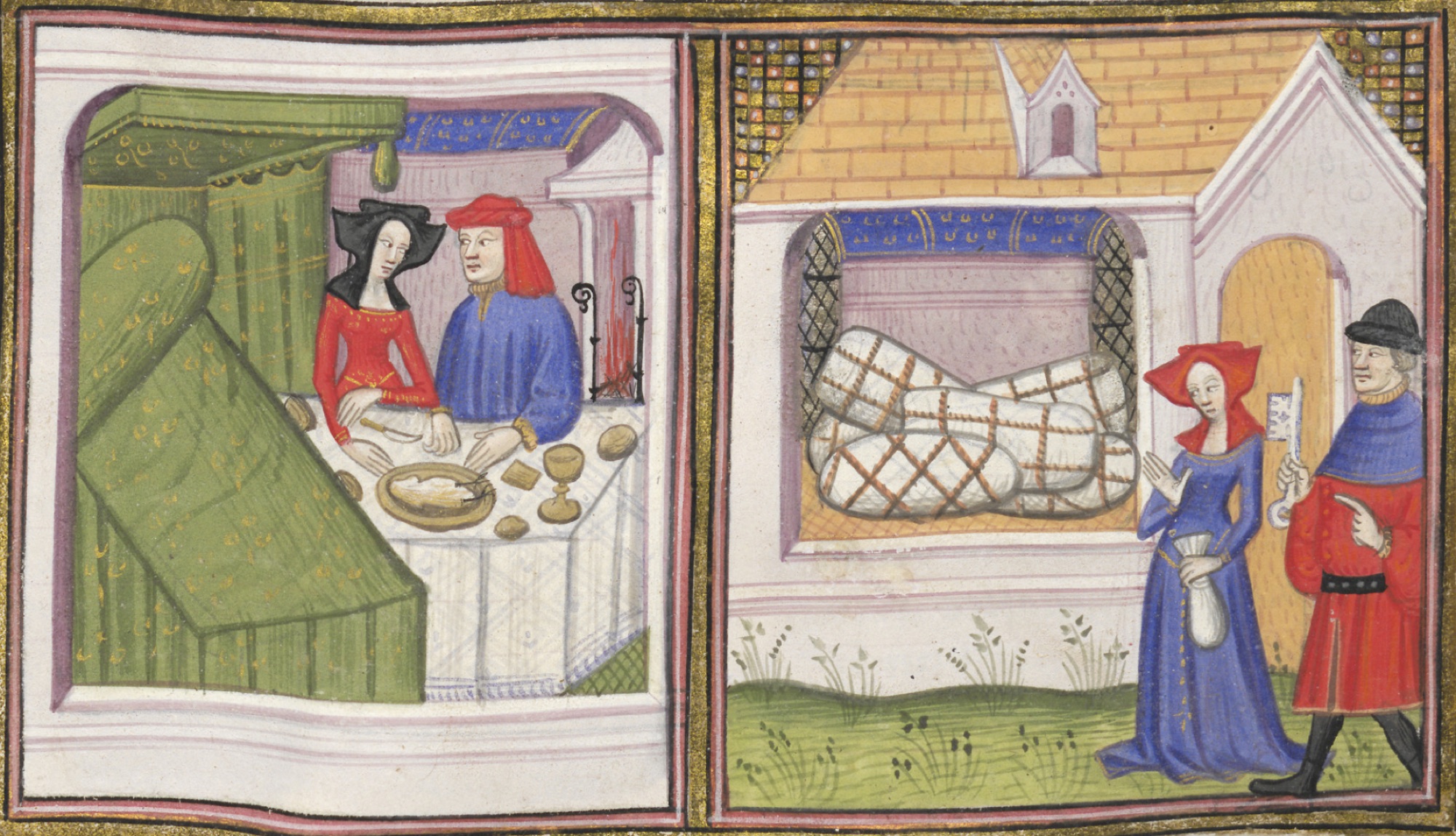
The richest images of the Palermo dogana are in manuscripts, not on buildings. Fifteenth-century illuminated copies of the Decameron show Salabaetto's tale. In Vienna, Österreichische Nationalbibliothek Cod. 2561 (fol. 314v), painted by a French miniaturist around 1425-50, sets a banquet scene beside a storeroom stacked with corded bales. Outside it a man holds up a large key and a woman carries a purse. The Ente Boccaccio catalogue, following C. Bozzolo in Boccaccio visualizzato (ed. V. Branca, 1999, no. 86), reads the scene as Salabaetto having the storeroom key handed to him for safekeeping. The image puts the key to the magazzino and the cash loan in the same frame, and both are central to the story's credit transaction. Copies in the Bibliothèque nationale de France (MSS fr. 239, fr. 12421 and it. 63) also illustrate VIII.10, though they do not all show the warehouse.
The loggias themselves were decorated architecture. Di Giovanni's description of c.1615 names their elements: a public fountain of ten bronze spouts in the Genoese loggia, and marble columns, iron grilles and a marble fountain in the Catalan one. A fountain still stands in Piazza Garraffello, the old centre of the Vucciria market. It is dated to 1591 and commonly given to the Gagini workshop, an attribution that rests on tradition more than on documents. Scaduto reads the Sant'Eulalia fragment, with its classicising order, as a deliberate statement of all'antica magnificence by the Catalan community and its bankers after Charles V's triumphal entry into Palermo in 1535. The nation's chapel contained paintings by Vincenzo degli Azani da Pavia and a Madonna of 1582 by Giuseppe Sirena, now in the Museo Diocesano. Maria Giuseppina Mazzola has traced the patronage of the Catalan consul Francesco Bertrola (in Arredare il sacro, ed. Di Natale and Vitella, 2015).
The Genoese answered with San Giorgio dei Genovesi, designed by Giorgio Di Faccio. Its chapels were patronised family by family. They include the Stoning of St Stephen by Bernardo Castello (1581), an Annunciation by Palma il Giovane (1594) and a Madonna, Patroness of Genoa by Domenico Fiasella, and the church is crowded with the tomb slabs and marble aediculae of the banking families (Gaspare Palermo, 1816; Gioacchino Di Marzo). These are the art of a merchant nation competing for status in a foreign capital.
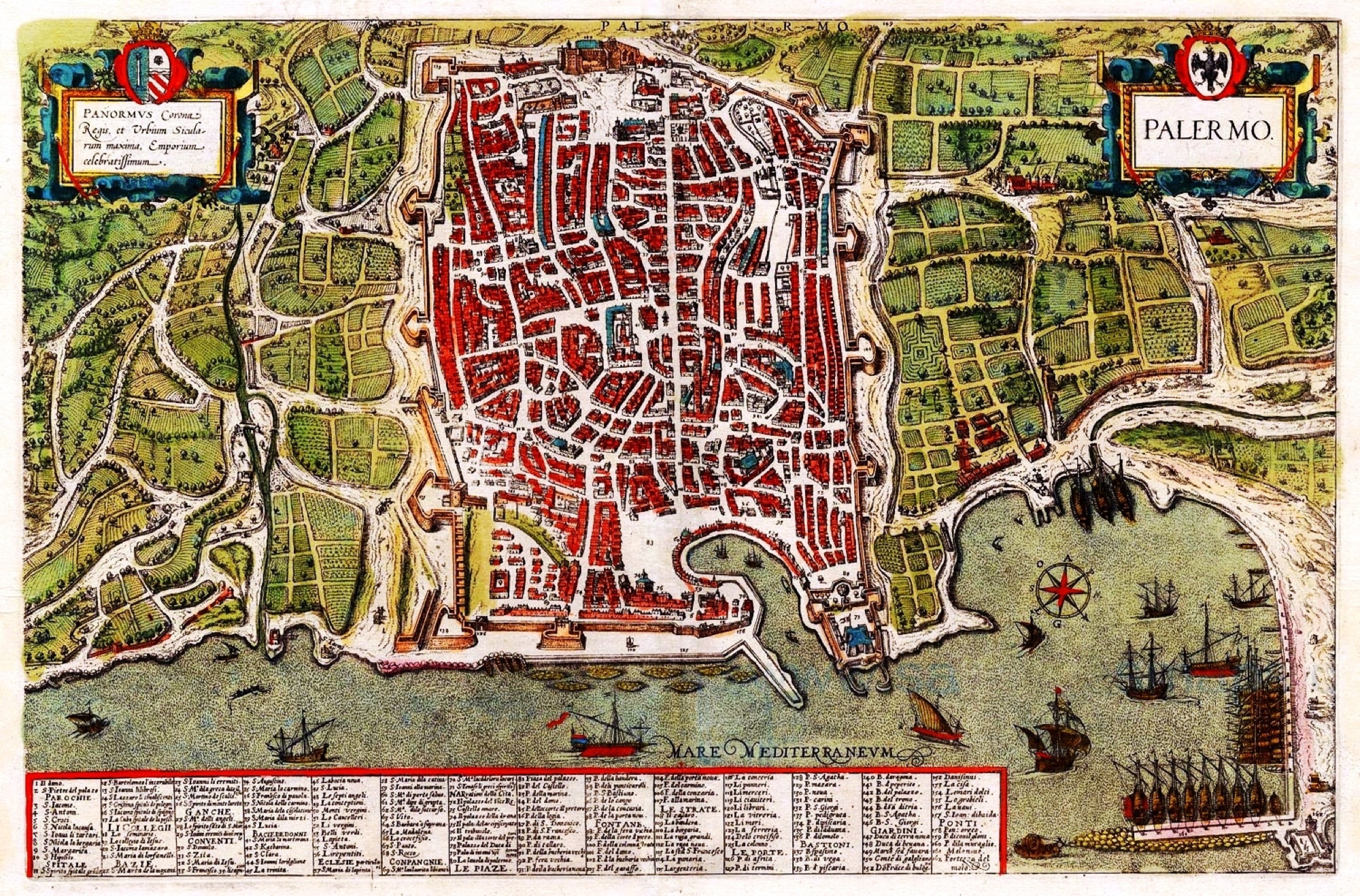
The best general image of the commercial city is the plate of Palermo in Braun and Hogenberg's Civitates orbis terrarum, vol. IV (Cologne, 1588-97). Its cartouche calls Palermo "Emporium celeberrimum" and shows the Cala, the Castello a Mare and the new mole. Renato Guttuso's La Vucciria (1974), now in the Steri, is treated in the companion entry on Palermo's Arab-Norman markets.
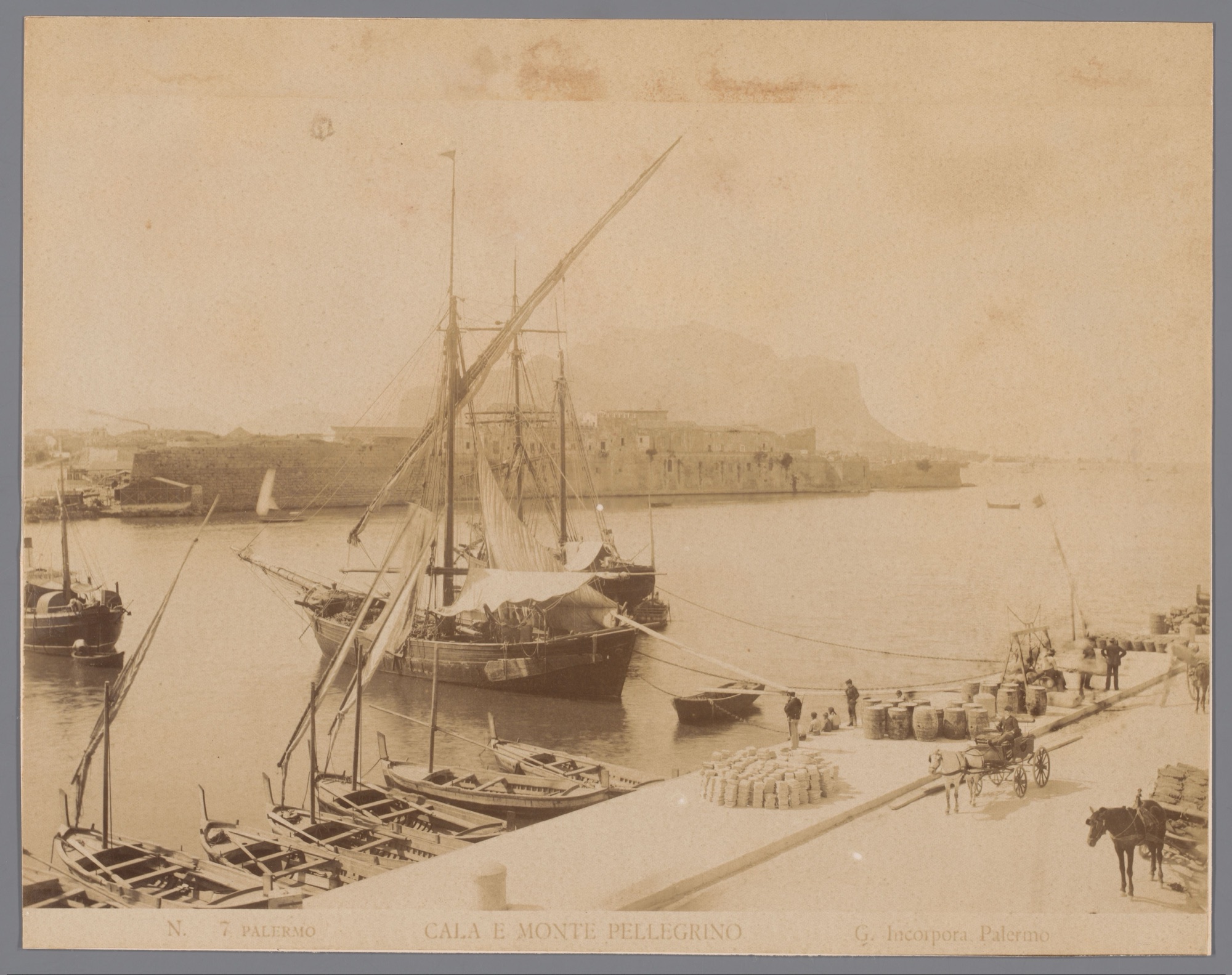
The commercial city of the later Middle Ages grew around the Cala, the inlet at the mouth of the Kemonia and Papireto streams that was Palermo's harbour until the sixteenth century. The Castello a Mare guarded its northern side. A chain closed it from a point near the later church of Santa Maria della Catena; Gaspare Palermo records a mention of it in 1326. Behind the waterfront, between the Cala and the Cassaro (the main street, today's Via Vittorio Emanuele), lay the quarter that took its name from the merchants' loggias. Cusumano (1887) explains the name: Palermo had loggias of the Genoese, Pisans and Catalans, and they gave their name to the city's busiest trading district, the Quartiere della Loggia. The quarter later became one of the four historic mandamenti, today Castellammare or Loggia, with the Vucciria market at its heart.
Topographic memory of the foreign nations survives in street and church names. Cusumano identifies the medieval ruga Pisanorum with the present Via della Loggia and records the Amalfitan quarter that preceded it. The Amalfitans' church of Sant'Andrea, near San Domenico, had a confraternity documented from 1346 and was taken over by the apothecaries' guild in 1579. The Venetians rebuilt a church of San Marco in the Seralcadi quarter. The Genoese worshipped first in a chapel at San Francesco, then at San Luca (whose confraternity is documented in 1424), and finally at San Giorgio dei Genovesi. The Catalans had Sant'Eulalia on Via Argenteria, facing the Garraffello. In Di Giovanni's account of c.1615 the street to the loggias was lined with drapers' shops, and the loggias were surrounded by rich mercers, perfumers and notaries. Exact plots for the medieval loggias are not established. Popular accounts that place the Genoese loggia "a few metres from" the Garraffello fountain may be right but rest on no published documentation.
South-east of the Loggia, Piazza Marina was reclaimed from marshland connected to the Cala. It became the city's ceremonial and penal square, overlooked by the Steri, where Andrea Chiaramonte was executed in 1392 and the Inquisition later held its autos-da-fé. Thus the customs (at least from 1800), royal justice and the Holy Office all came to share one palace on the harbour square.
Palermo was one node in an island-wide system. Grain went out through the caricatori of the coast. Messina, with its Loggia dei Mercanti and its Piazza dei Banchi, was the island's other commercial capital and the outlet for Sicilian silk. Maurice Aymard ("Commerce et production de la soie sicilienne aux XVIe-XVIIe siècles", MEFR 77, 1965) traced Messina's role as a silk exporter, especially to the Levant. In the sixteenth century Palermo's port activity moved north from the silting Cala toward a new mole, and Braun and Hogenberg's plate shows it already in place.
Foreign merchants organised as "nations" go back to the Norman kingdom. David Abulafia's The Two Italies (Cambridge, 1977) reconstructs the treaties by which Genoa, Pisa and Venice obtained privileges in the Norman realm from the 1150s. He sees in them the start of a lasting division of labour: northern merchants took out southern raw materials and brought back cloth. After the Vespers of 1282 and the Aragonese succession, Catalans joined Genoese and Pisans in Palermo. Henri Bresc's Un monde méditerranéen: économie et société en Sicile, 1300-1450 (2 vols., 1986) documents the grain-for-cloth exchange in detail. Stephan R. Epstein's An Island for Itself (Cambridge, 1992) disputes the "dependency" reading: institutions and regional specialisation inside Sicily, more than foreign merchants, shaped late-medieval growth.
The institutions of the merchant city are visible early. Cusumano (1887) cites the Consuetudines of Palermo, whose chapter 77 required money-changers (campsores) holding deposits to give sureties. He also cites a petition of 1320 in which a Palermo debtor had undertaken to pay "in August and in the Loggia of the Genoese" and to place the money "in the bank". So the loggia was already a recognised place of settlement, and bank deposit was already a recognised way of paying. Boccaccio, writing the Decameron around 1349-53, set VIII.10 among Florentine merchants and shows the dogana, the brokers and the bathhouse in daily use. His adviser-figure, Pietro dello Canigiano, is the historical Piero Canigiani. According to the Dizionario Biografico degli Italiani, Canigiani was associated with the Acciaiuoli in Naples and served as treasurer to Catherine of Valois-Courtenay, titular empress of Constantinople (d.1346). That places the tale's world in the 1330s-40s. After the conquest of Pisa by Florence in 1406, Pisan merchant families emigrated to Sicily in numbers (Giuseppe Petralia, Banchieri e famiglie mercantili nel Mediterraneo aragonese, Pisa, 1989). Cusumano prints certified extracts (fedi) from the books of Palermo bankers of this period, among them Guglielmo Aiutamicristo, whose name is attached to a sale of 600 salme of wheat to the crown in 1478. Carmelo Trasselli's Note per la storia dei banchi in Sicilia nel XV secolo is the basic study of these banks.
The sixteenth century brought a cycle of bank failures, which Cusumano lists from the city's Atti, bandi e provviste. When the bank of the heirs of Battista Lambardi closed on 28 January 1514, the crowd at the door was so large that the praetor and jurats feared a riot and promised quick repayment of deposits under 2 onze. Later failures included the Agliata brothers (1522), Antonio Sanchez and Benedetto Ram (liabilities of 310,000 florins), Giovan Pietro Zavatteri (1541), and, in 1550 alone, Lorenzo Mahona, Antonio Xirotta and Ottobono Lomellino. A pragmatic of 1543 had already required bills of exchange to be paid through banks, "as has always been observed from ancient times among merchants in the Loggia of this city of Palermo and in the Piazza delli Banchi of Messina". Against this background the Senate of Palermo founded the municipal Tavola on 1 February 1552 (SIUSA, Fondazione Sicilia archive), and Messina followed with its own Tavola in 1586-87. Cusumano stresses that the Tavola never had a monopoly. Its own capitoli of 1552 (cap. XXII) forbade it to keep accounts with private banks, yet the Senate itself went on using them. Only Marcantonio Colonna's capitoli of 1582 required the farmers of civic taxes to pay into the Tavola alone. The Banco di Sicilia (so named in 1867) traditionally traces its descent to the Tavola, and the Tavola's archive was deposited with the bank in 1948 (it is now held by the Fondazione Sicilia). The customs' own registers survive in quantity from the late sixteenth century. Nicole Gotteri reconstructed ships, people and goods at the Palermo dogana for 1600-05 from the Secrezia's Responsali series (MEFR 81, 1969). Valentina Vigiano (MEFRIM 120, 2008) dates a dedicated Caricatore of Palermo, under royal control, to the 1630s.
Decameron VIII.10 opens with the most precise literary description of a medieval Mediterranean dogana as a market institution (text of the Laterza edition, Bari, 1927, on it.wikisource):
"Soleva essere, e forse che ancora oggi è, una usanza in tutte le terre marine che hanno porto, così fatta, che tutti i mercatanti che in quelle con mercatantíe capitano, faccendole scaricare, tutte in un fondaco, il quale in molti luoghi è chiamato «dogana», tenuta per lo comune o per lo signor della terra, le portano: e quivi, dando a coloro che sopra ciò sono, per iscritto tutta la mercatantía ed il pregio di quella, è dato per li detti al mercatante un magazzino nel quale esso la sua mercatantía ripone, e serralo con la chiave; e li detti doganieri poi scrivono in sul libro della dogana a ragione del mercatante tutta la sua mercatantía ... E da questo libro della dogana assai volte s'informano i sensali e delle qualitá e delle quantitá delle mercatantíe che vi sono, ed ancora chi sieno i mercatanti che l'hanno; con li quali poi essi ... ragionan di cambi, di baratti e di vendite e d'altri spacci. La quale usanza, sí come in molti altri luoghi, era in Palermo in Cicilia."
In translation: "There used to be, and perhaps there still is, a custom in every seaport town. All merchants arriving with goods have them unloaded and carry them into a fondaco, which in many places is called a 'dogana', kept by the commune or the lord of the place. There they give the officials a written statement of all the goods and their value, and are assigned a storeroom, which they lock with a key. The customs officers then write all the goods in the book of the dogana to the merchant's account ... And brokers often consult this book to learn the quality and quantity of the goods there, and who owns them, and then, as occasion arises, they negotiate exchanges, barters, sales and other dealings with them. This custom, as in many other places, obtained in Palermo in Sicily."
Boccaccio thus describes a public register of stocks, a sealed private storeroom, and duties payable on withdrawal. The register doubled as an information source for brokers and, in the story, for swindlers as well. Iancofiore reads the customs book to choose her targets. Salabaetto's first loan of 500 florins to her cannot be recovered at first, because he has "neither writing nor witness". She repays it later only as bait. His revenge turns the dogana into a collateral machine. He returns with bales and twenty casks declared at over 2,000 florins and registered to his account. He then borrows 1,000 florins from a broker at "trenta per centinaio" (30 percent), pledging the goods "in dogana, faccendola scrivere in colui che i denar gli prestasse", that is, by having them re-entered in the name of the lender of record, a broker fronting for Iancofiore. He keeps the storeroom key and has "scritte e contrascritte" (written instruments and counter-instruments) drawn up. The casks held seawater under a layer of oil, and the bales held tow, worth under 200 florins in all. The tale is thus a literary witness to warehouse-receipt credit: a ledger entry, not physical possession, carried title and security. Its weakness was that nobody checked what the entry stood for.
Grain was the island's great export. The Sicilian caricatori (Castellammare del Golfo, Agrigento, Sciacca, Termini, Licata, Terranova and others) were public warehouses where grain waited for export licences (tratte) issued by the maestro portulano. Cusumano, following Picone (1866) and Bianchini (1841), records that depositors received polizze, "lettere d'ordine che si negoziavano" (orders that could be traded), so that grain in store "si vendeva e si girava", was sold and transferred, without moving. Ida Fazio (2021) describes a speculative market in the tratte themselves. Bankers and warehousemen overlapped: Francesco Bonconti, public magazziniere of the Licata caricatore, was the deputy of the banker Lorenzo Mahona and failed with him (Cusumano). See also Simona Laudani (MEFRIM 120, 2008). In the loggias the main goods were Tuscan and Catalan woollen cloth (Salabaetto's cloth, left over from the Salerno fair, was worth about 500 florins), along with Sicilian grain, sugar, silk and cotton. Settlement was by bank transfer and bill of exchange.