Oslo Stock Exchange (Oslo Børs)
Oslo, Norway · Established 1819
This site requires authorization to access.
To request access, contact
william.goetzmann@yale.edu
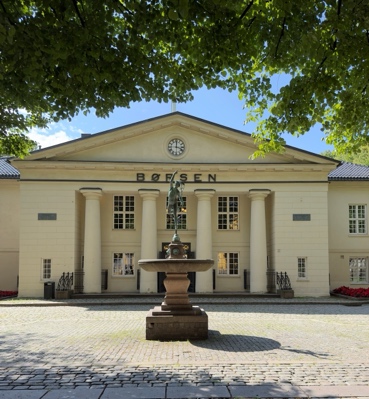
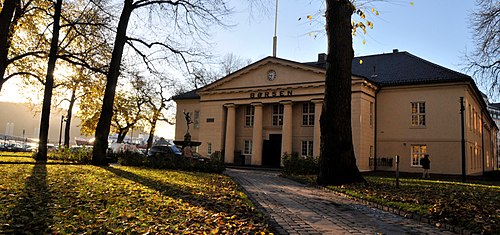
Designed by Christian Heinrich Grosch and erected between 1826 and 1828, the Oslo Bors was hailed upon completion as Norway's first monumental building -- a powerful statement of national ambition just fourteen years after the country adopted its constitution. The neoclassical facade, rendered in the austere Doric Empire style that Grosch absorbed from his training under C. F. Hansen in Copenhagen, features a pedimented portico supported by Greek Doric columns that lend the structure a gravity appropriate to its civic purpose. In 1909-1911, architect Carl Michaelsen extended the building with side wings executed in a sympathetic neoclassical and Empire idiom, adding new trading halls to accommodate the exchange's expanding activity. The interior preserves original solid materials -- terrazzo floors, stately columns, and generous proportions in the central atrium -- that have been sensitively maintained through successive renovations, most recently by Tuvalu Arkitekter in 2022.
The most iconic artistic element within the Oslo Bors is a bronze statue of Mercury, the Roman god of commerce and good fortune, which has presided over the exchange's interior for more than a century and remains a potent symbol of the building's mercantile purpose. In 1912, the celebrated Norwegian artist Gerhard Munthe -- a leading figure in National Romanticism whose decorative commissions ranged from tapestries to murals -- was engaged to ornament the expanded interior, contributing to the rich layering of symbolic and decorative elements found throughout the historic rooms. The atrium and principal halls display a broad mix of ornamentation, from classical detailing on columns and cornices to sculptural accents and carefully preserved period furnishings that reflect successive eras of Norwegian design.
The Oslo Bors stands at Tollbugata 2 in the heart of Kvadraturen, the historic city center laid out on a rectangular grid by King Christian IV after the great fire of 1624, when he relocated the city closer to the protective walls of Akershus Fortress. The building was erected on a site called Gronningen, which had served as Christiania's first public park, and it remains surrounded by Borshagen park -- Oslo's oldest public green space, established in the 1820s. Its position within Kvadraturen places it among the city's most venerable institutions and architecture, within walking distance of Akershus Fortress, Christiania Torv, and the modern financial and commercial offices that continue to cluster in this district.
Established by statute on September 18, 1818, the Christiania Bors opened for trading on April 15, 1819, just five years after Norway's constitution inaugurated an era of economic independence following centuries of Danish rule. For its first six decades the exchange functioned primarily as a commodity and mercantile meeting place; it was not until March 1, 1881, that formal securities quotations began, with an initial listing of 16 bond series and 23 stocks including Norges Bank. The exchange was privatized in 2001 and merged with the central securities depository Verdipapirsentralen (VPS) in 2008 to form Oslo Bors VPS Holding ASA. Following a contested takeover battle between Nasdaq and Euronext, the European exchange group Euronext completed its acquisition on June 18, 2019, making Oslo Bors a cornerstone of Euronext's Nordic operations.
In its earliest decades, the Christiania Bors served as a meeting place where merchants auctioned ships, shares in ships, timber, and foreign currencies -- instruments that reflected Norway's dependence on its vast forests and growing maritime fleet. The transition to formal securities trading in 1881 brought listings dominated by railway bonds, bank shares, insurance companies, and steamship firms, mirroring the infrastructure demands of a rapidly industrializing Nordic economy. From 1920 to 1936, whaling shares accounted for roughly half of total turnover, a remarkable testament to the outsized role of the Norwegian whaling industry in the interwar global economy. Today, the exchange is particularly strong in energy, shipping, and seafood sectors, continuing a centuries-long alignment between Norway's natural resource wealth and its capital markets.