Osaka Securities Exchange Building (Osaka Exchange)
Osaka, Japan · Established 1878
This site requires authorization to access.
To request access, contact
william.goetzmann@yale.edu
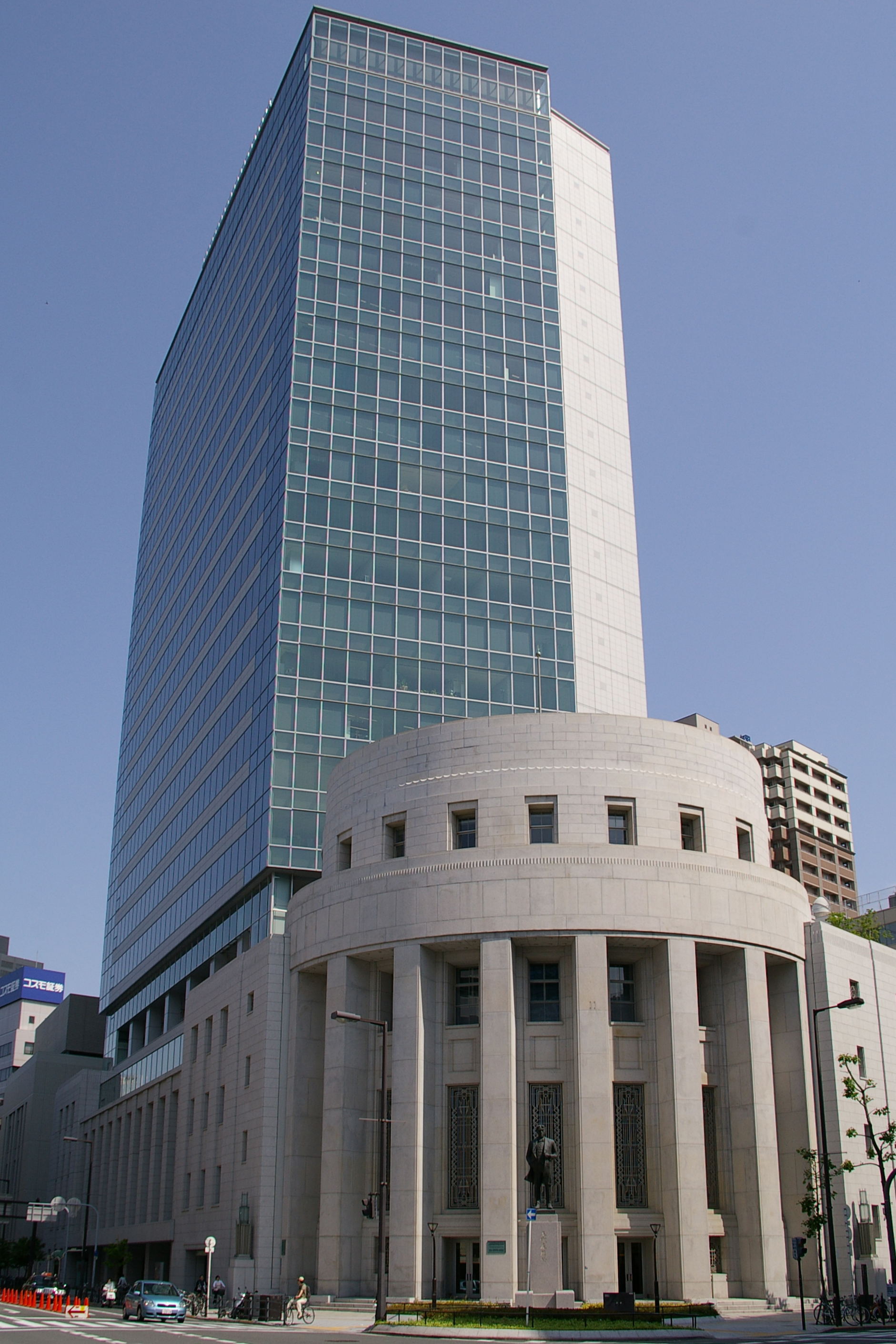
The landmark exchange building at Kitahama was completed in 1935 to designs by Hasebe-Takekoshi Architects (長谷部竹腔建築事務所), the firm founded in 1933 by Eikichi Hasebe and Kenzo Takekoshi after the two architects and some twenty-seven colleagues left the dissolved works department of the Sumitomo conglomerate — an office that, after a 1944 re-merger, became the direct ancestor of the present-day Nikken Sekkei (Japanese Wikipedia, '長谷部竹腔建築事務所'). The design is a confident statement of early Japanese modernism with restrained Art Deco detailing: a tall cylindrical corner tower, faced in pale scratch tile (スクラッチタイル), anchors the intersection at Kitahama 1-chome, its curved masonry base set against the crisp verticals of its window grilles and lighting. Osaka tourism documentation describes the structure as a 'magnificent cylindrical white exterior' with a lobby of stained glass, and notes the survival of original interior fabric including patterned elevators and a first-floor hall with frosted, carved stained glass (Osaka Convention & Tourism Bureau, 'Osaka Exchange,' osaka-info.jp). By the early 2000s the 1935 fabric had badly deteriorated, and in 2004 it was replaced by a 24-storey high-rise that faithfully reproduced the cylindrical dome facade and both flanking wings, with the trading 'securities plaza' set inside the preserved dome (Osaka City / Naniwa Discovery, 'Osaka Securities Exchange Building,' osaka-chushin.jp).
The building's decorative programme is modest by the standards of European bourses, consistent with its inter-war modernist idiom, but it is not without ornament. Its most celebrated artistic feature is the stained glass of the entrance hall, whose frosted central panels carry carved geometric patterns, complemented by curved Deco light fittings and geometric window grilles that the architectural illustrator Yui Kojima has singled out as the building's signature flourishes (Kojima Yui, 'Kitahama 1-chome no shinboru: Osaka Shoken Torihikijo Biru,' 140B.jp). The principal public artwork, however, stands outside: a bronze statue of the exchange's founder, the Meiji entrepreneur Godai Tomoatsu, presides over the forecourt, commemorating the man who anchored Osaka's financial district. The interior is otherwise valued for preserved craftsmanship — original elevator patterns, buttons and floor indicators — rather than for a dedicated decorative cycle.
The exchange sits at 1-8-16 Kitahama, Chuo-ku, on the south bank of the Tosabori River just below the Naniwa Bridge (popularly the 'Lion Bridge'), at the heart of Osaka's historic Kitahama financial quarter. After the Meiji Restoration the exchange was established on the site of the former gold-exchange market, and Kitahama grew up around it as the city's banking and broking district, a counterpart to Tokyo's Nihonbashi (Naniwa Discovery, 'Kitahama & Yodoyabashi: The Financial Heart of the City,' osaka-chushin.jp). Today the white drum of the exchange remains a defining landmark of the intersection, surrounded by the offices of banks and securities houses and served directly by Kitahama Station on the Osaka Metro Sakaisuji Line and the Keihan Main Line, a short walk from the Bank of Japan's Osaka branch and the surviving early-modern architecture of the Semba district.
Securities trading in Osaka descends from the city's role as the commercial capital of Tokugawa Japan, where the Yodoya rice market and, from 1697, the Dojima Rice Exchange — licensed for standardised 'cho-ai-mai' futures in 1730 — are widely regarded as the world's first organised futures market (Osaka Dojima Exchange; en.wikipedia.org). The modern institution was founded in June 1878 as the Osaka Stock Exchange Company by Godai Tomoatsu, one of the Satsuma students smuggled to Britain in 1865 who returned to become a leading entrepreneur of the early Meiji era and the founder also of the Osaka Chamber of Commerce (Wikipedia, 'Godai Tomoatsu'). Reorganised after the Second World War as the Osaka Securities Exchange Co. on 1 April 1949, it became one of the two great pillars of Japanese capital markets alongside Tokyo. It demutualised in 2001, listed on its own Hercules startup market in 2004, and in January 2013 merged with the Tokyo Stock Exchange under the new Japan Exchange Group holding company; renamed Osaka Exchange, Inc. in 2014, it now operates as JPX's derivatives arm (MarketsWiki, 'Osaka Exchange'; Wikipedia, 'Osaka Exchange').
From its 1878 founding the exchange dealt in the shares and bonds of the joint-stock companies that Godai and his contemporaries created to finance Meiji industrialisation — textiles, mining, shipping, railways and banking — mobilising the savings of Osaka's merchant wealth into the new corporate economy (MarketsWiki, 'Osaka Exchange'). For most of the twentieth century it traded equities and bonds as the western counterpart to the Tokyo exchange. Following the 2013 consolidation of Japan's bourses, cash-equity trading was concentrated in Tokyo while Osaka inherited the 'Dojima DNA' and was made the group's derivatives marketplace: today the Osaka Exchange is Japan's largest derivatives venue, trading stock-index futures and options (notably the Nikkei 225 contracts), Japanese government bond futures, and, since 2020, commodity futures including gold (Wikipedia, 'Osaka Exchange'; MarketsWiki, 'Osaka Exchange').
Images will be added as the project develops. Photographs by Larry Ng and from research sources.