Dojima Rice Exchange
Osaka, Japan · Established 1697
This site requires authorization to access.
To request access, contact
william.goetzmann@yale.edu
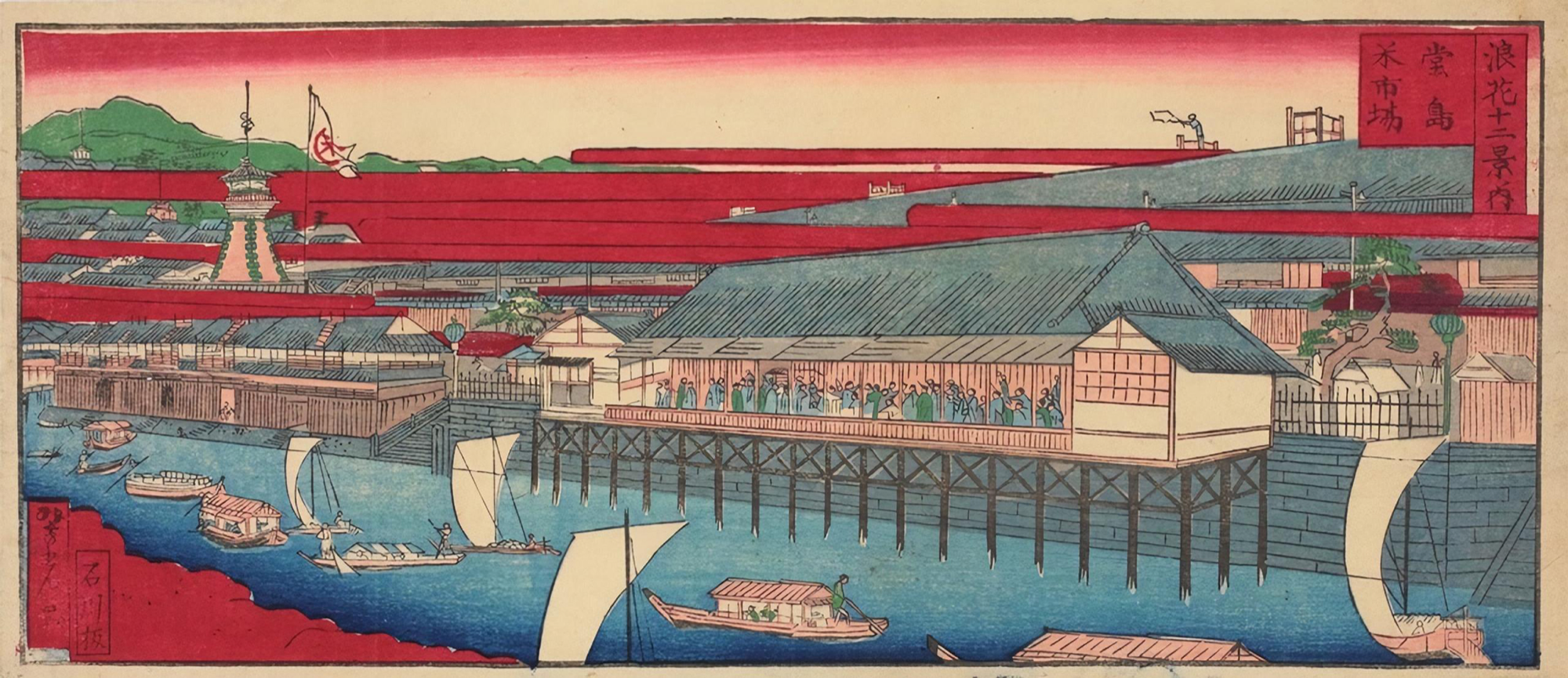
The Dojima Rice Exchange occupied the northern bank of the Dojima River in Osaka's Dojima Hamadori 1-chome district, where rice trading had congregated since the 1650s around the courtyard of the powerful Yodoya merchant house. When the market formally relocated to Dojima in 1697, the exchange area comprised an open-air trading floor along the riverbank roads, flanked by rows of traditional timber-framed rice warehouses (kura). A distinctive wooden building straddled the river itself, serving as the central exchange hall. Trading hours were governed by an ingenious timing device: each morning at eight, a fuse cord (hinawa) was lit inside a wooden box hung from the ridgepole of the exchange building, and when the fuse burned out after roughly five to ten minutes of final trading, the prevailing price became the official closing quotation, called the hinawa-nedan or 'fuse cord price.' Watermen (mizukata) then splashed and ultimately hurled buckets of water over the trading crowd to enforce the session's end. Behind the exchange, over 110 kurayashiki — warehouse-residences maintained by feudal domains — lined the banks of Nakanoshima and Dojima, each equipped with private harbors called funa-iri connected by small canals to the river for unloading cargo directly from barges. The exchange was reorganized in 1868 under the Meiji government and dissolved in 1939 when it was absorbed into the Government Rice Agency. No original structures survive. Today the site lies beneath the Hanshin Expressway; a rice-shaped stone monument and, since 2018, a memorial sculpture titled 'A Grain of Light' designed by the architect Tadao Ando mark the location.
The most important artistic record of the Dojima Rice Exchange is Utagawa Hiroshige I's woodblock print 'Rice Market at Dojima' (Dojima kome akinai), from his series 'Famous Views of Osaka' (Naniwa meisho zue), created in the 1830s. Now held in the William S. and John T. Spaulding Collection at the Museum of Fine Arts, Boston, the print depicts dense crowds of merchants and brokers thronging the open-air trading area along the riverbank roads, capturing the kinetic energy of Edo-period commodity trading. A later print by Yoshimitsu Sasaki (c. 1880) shows the wooden exchange buildings spanning the Dojima River, with a flag being raised to signal rice prices to relay stations — a visual record of the remarkable semaphore communication network that transmitted Dojima's closing prices across hundreds of kilometers to Kyoto, Nara, and Edo. This flag-signal system, developed around 1745 by rice brokers using telescopes, coded flag movements, smoke signals, lanterns, and hand towels, constituted one of the earliest high-speed information networks in financial history. At the former exchange site today, the Tadao Ando-designed 'A Grain of Light' memorial, unveiled in 2018 by the Osaka Exchange to mark the 30th anniversary of equity index futures trading in Japan, provides a contemporary sculptural tribute to the birthplace of derivatives trading.
Dojima sits at the heart of Osaka's extraordinary riverine commercial geography. The narrow island of Nakanoshima, a three-kilometer sandbank dividing the old Yodo River into the Tosabori and Dojima rivers, became the logistical nucleus of Tokugawa Japan's national economy. By the early 1800s, more than 110 kurayashiki lined Nakanoshima and its neighboring islands, each maintained by a feudal domain (han) as a combined warehouse, administrative office, and merchant residence for storing, managing, and selling tax rice. Barges carrying rice bales from domains across western Japan navigated the river network to these warehouses, where they unloaded through private canal harbors (funa-iri) connected to the main waterways by small bridges (funa-iribashi). This extraordinary concentration of stored wealth earned Osaka the epithet 'tenka no daidokoro' — the kitchen of the nation — a title referring not to cuisine but to the city's unparalleled commercial and logistical authority over Japan's most essential commodity. The Dojima rice market, just north of Nakanoshima across the Dojima River, became the pricing center for the entire national rice economy. Closing prices formed at Dojima were transmitted by relay couriers on horseback and, from the 1740s, by flag semaphore stations positioned on hilltops stretching to Kyoto, Otsu, and beyond, reaching distant markets within hours.
Rice trading in Osaka dates to approximately 1640, when warehouses stood near the site of the present Sumitomo Building. During the Joo and Kanbun eras (1652-1673), the merchant Yodoya Saburozaemon emerged as the most powerful rice broker in the city, conducting auctions at his mansion on the south bank of what is now Yodoyabashi Bridge. In 1697, the market relocated to Dojima Hamadori 1-chome, receiving a license from the Tokugawa shogunate and establishing the Dojima Rice Market with a formal membership system. Initially a spot market, trading evolved rapidly. By 1710, forward contracts called nobemai (deferred rice) appeared. In 1730, Shogun Tokugawa Yoshimune formally authorized both a spot market (shomi, or 'true rice') for trading rice warehouse receipts issued by kurayashiki, and a separate futures market for standardized book-entry contracts known as cho-ai-mai (literally 'book-balanced rice'), in which no physical rice changed hands. These cho-ai-mai contracts were standardized at lots of 100 koku, priced through auction, freely transferable, and could be offset through reverse trades before expiration — fulfilling essentially every criterion of modern futures contracts. The exchange developed a three-part organizational structure separating exchange operations, administrative functions, and clearing operations. It maintained a formal membership system, enforced margin requirements, imposed daily price limits functioning as circuit breakers, and operated a clearinghouse. By 1749, trading volume had become spectacularly detached from physical supply: 110,000 bales of rice were traded on the exchange while only 30,000 bales existed in all of Japan. The exchange survived the Meiji Restoration of 1868 and continued operating until 1939, when it was dissolved and absorbed into the wartime Government Rice Agency.
Rice was the foundation of Tokugawa Japan's political economy. Feudal lords (daimyo) collected tax revenues in rice, and samurai stipends were denominated in koku (approximately 180 liters, enough to feed one person for a year). Since rice functioned as de facto currency, the mechanisms for pricing, storing, and transferring rice claims became the backbone of Japanese finance. At Dojima, three distinct instruments traded. First, physical rice (shomi or 'true rice') was bought and sold in spot transactions, with bales delivered from the kurayashiki warehouses lining Nakanoshima. Second, rice warehouse receipts — known as kome-kitte or kome-kippu (rice tickets) — circulated as negotiable paper claims on specific quantities of rice held in domain warehouses. These receipts were actively traded and functioned much like warehouse warrants in later Western commodity markets. Third, and most innovatively, cho-ai-mai ('book rice') futures contracts allowed traders to buy and sell standardized quantities of representative rice brands recorded only in books of account, with settlement by payment of price differences rather than physical delivery. Trading was organized into three annual contract periods (spring, summer, and autumn), each lasting several months. Econometric analysis by Shigeru Wakita using price data from 1760 to 1864 has shown that the summer market was strongly characterized by producers' hedging behavior, while the spring and autumn sessions in the mid-Tokugawa era functioned as genuinely financial markets satisfying the unbiasedness hypothesis of rational expectations theory.
Images will be added as the project develops. Photographs by Larry Ng and from research sources.