Oil City Oil Exchange
Oil City, United States · Established chartered 1874; exchange building opened 1878
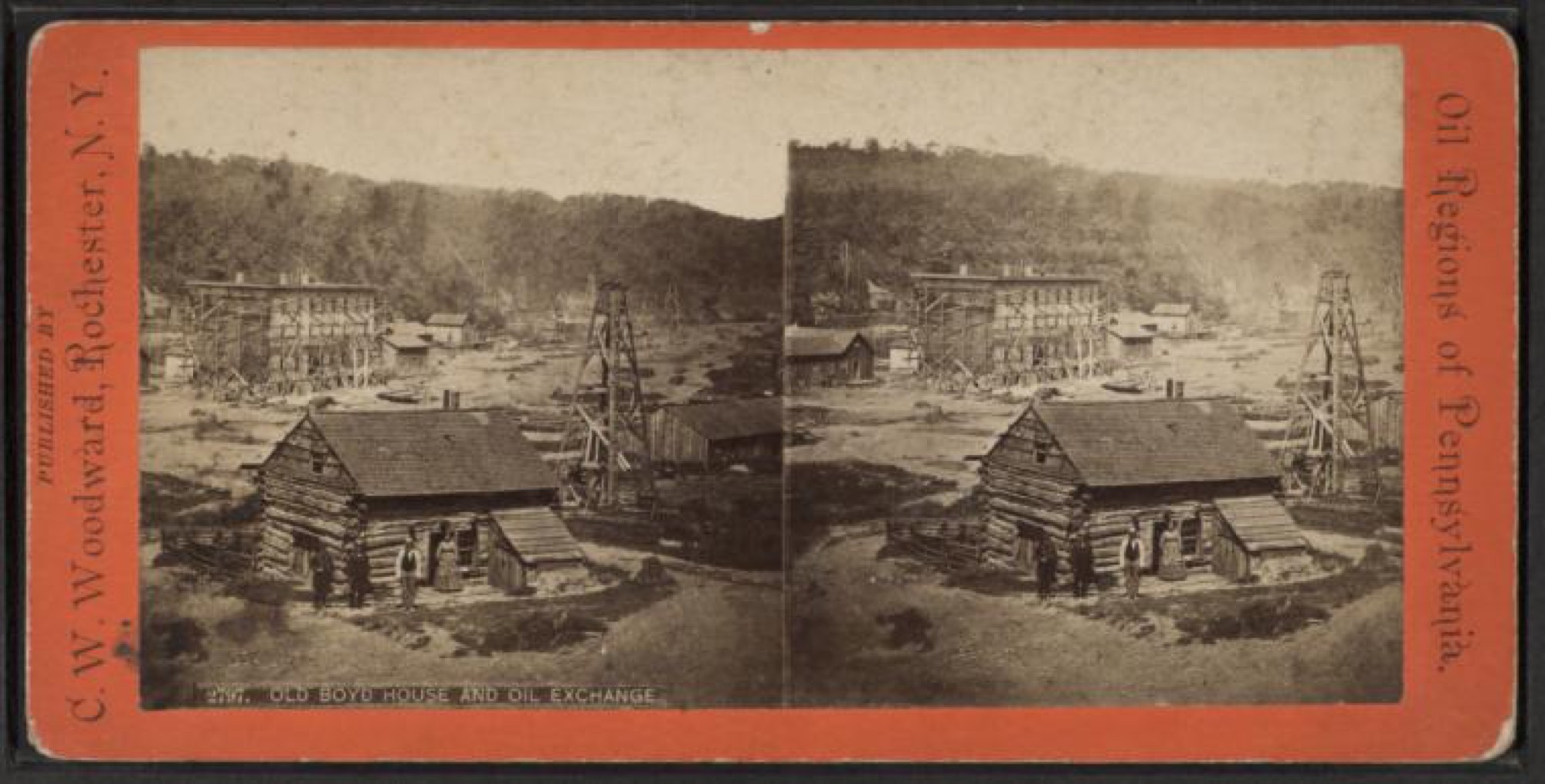
This site requires authorization to access.
To request access, contact
william.goetzmann@yale.edu
The Oil City Oil Exchange occupied a purpose-built three-story commercial block at the corner of Center and Seneca Streets, on which construction began in July 1877 and which opened for trading in April 1878 at a cost of roughly $65,000 (Oil Region Library Association, "The Oil Exchange & National Transit"). The building committee of the exchange — William Hasson, A. J. Greenfield, William Parker, and John Mawhinney — selected J. M. Budge of Meadville as architect (Oil Region Library Association). Executed in brick and stone in what contemporaries called a plain "modern style of architecture, unadorned with gingerbread work," the structure was finished with iron cornices and a decorative railing rather than ornate detailing, an austerity that signaled the businesslike character of the institution it housed. The exchange was owned outright by its membership — some 400 brokers and oil men — and was enlarged by a second annex erected in 1883 for about $40,000 (Oil Region Library Association). The building stood directly opposite Standard Oil's National Transit Building (1890) on Seneca Street, the two structures together forming the architectural heart of Oil City's late-nineteenth-century petroleum economy.
The principal decorative set-piece was on the trading floor itself: a central fountain known as "the Aquarium," encircled by a nickel-plated circular railing supplied by Tiffany & Co. of New York, around which brokers gathered during the trading day (Oil Region Library Association, "The Oil Exchange & National Transit"). Rather than monumental sculpture or allegorical murals of the kind found in the great metropolitan bourses, the Oil Exchange's interior expressed prosperity through fittings and comfort — marble-topped washstands, bronze radiators, a reading parlor, a telegraph office, a billiard hall, and a barber shop — appointments that made the exchange as much a gentleman's club for the oil trade as a marketplace. The Tiffany railing around the Aquarium was the building's single conspicuous luxury and its best-remembered ornamental feature.
Oil City lies at the confluence of Oil Creek and the Allegheny River in Venango County, northwestern Pennsylvania, at the downstream end of the valley where the modern petroleum industry was born after Edwin Drake's 1859 well at nearby Titusville. The exchange stood in the dense commercial core that grew up around Seneca and Center Streets, the same blocks that now form part of Oil City's Downtown Commercial Historic District (livingplaces.com, Downtown Commercial Historic District). This district was repeatedly reshaped by disaster — most catastrophically in the combined flood and fire of June 1892, when lightning struck oil tanks upstream and Oil Creek carried a mass of burning oil into the city, killing some sixty people and destroying more than a million dollars of property (search of contemporary district histories). The exchange site at the corner of Center and Seneca sat opposite the National Transit Building, and today the 1926 former Oil City National Bank tower (now "100 Seneca") occupies the ground where the exchange once stood (100seneca.com, "The History of 100 Seneca").
The Oil Exchange was chartered in April 1874, during the speculative ferment that followed the spread of pipelines and negotiable certificates through the Pennsylvania oil region, and moved into its own building in 1878. By 1877 the Oil City exchange was reputed to be the third-largest financial exchange of any kind in the United States, behind only New York and San Francisco (American Oil & Gas Historical Society, "End of Oil Exchanges"; Oil Region Library Association). It was one of a cluster of regional oil exchanges — alongside those at Titusville (established 1871), Petroleum Center, and elsewhere — that set crude prices for the nation. Its decline followed the consolidation of the industry under John D. Rockefeller's Standard Oil: controlling roughly 90 percent of production, Standard announced in January 1895 that it would buy oil only at posted world-market prices, deliberately bypassing the exchanges' quotations and draining the speculative life from the trade (American Oil & Gas Historical Society). The Oil City Derrick wrote in 1896 that speculation had been "greatly eliminated from the oil business," reducing the exchange to "a shadow of its former greatness." The exchange building was sold to the Oil City National Bank in 1909 and demolished in 1926 to make way for a new bank tower (Oil Region Library Association; 100seneca.com).
The exchange dealt in crude petroleum from the Pennsylvania fields, and its rise was bound up with the spread of the pipeline certificate — a negotiable instrument representing a stated number of barrels of oil held in a pipeline for delivery in kind. These certificates turned crude oil into a fungible, tradable commodity and made organized speculative trading possible, much as warehouse receipts did for grain at the Chicago Board of Trade (American Oil & Gas Historical Society, "End of Oil Exchanges"). On the Oil City floor brokers transacted very large volumes — contemporary accounts describe daily turnover running into the millions of barrels — earning a commission of ten cents per barrel from buyers and five cents from sellers (Oil Region Library Association). The prices fixed in the exchange's trading room were telegraphed across the country and effectively set the national price of crude until Standard Oil's posted-price system supplanted the exchange mechanism in the mid-1890s.
Images will be added as the project develops. Photographs by Larry Ng and from research sources.