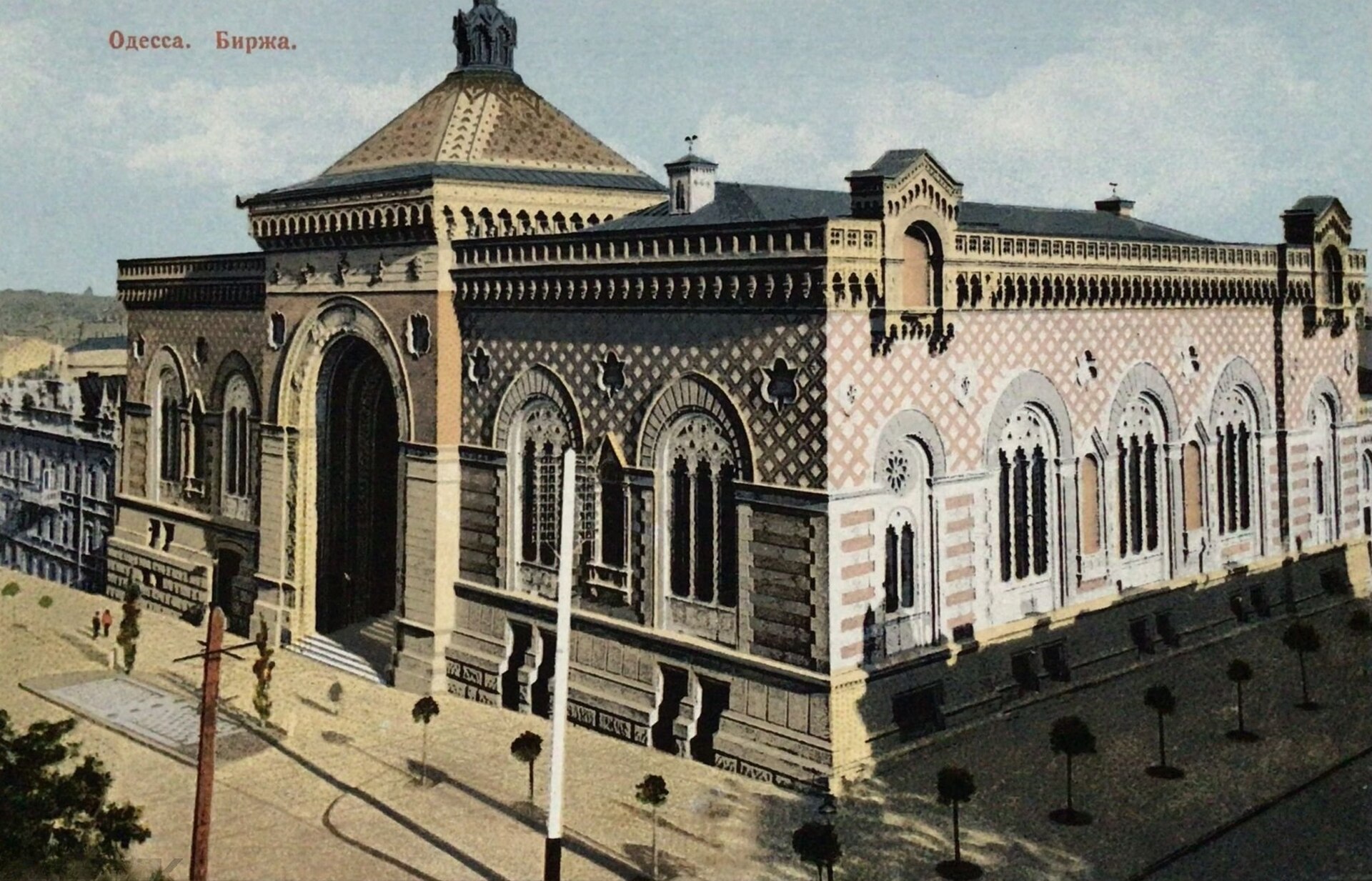
Odessa New Exchange (Nova Birzha), now the Odesa Philharmonic Theater
Odessa (Odesa), Ukraine · Established Exchange chartered 1796; "New Exchange" building 1894-1899
This site requires authorization to access.
To request access, contact
william.goetzmann@yale.edu
The New Exchange was the product of an international architectural competition launched in 1894 to mark the centenary of Odessa's founding, with its cornerstone laid on 3 September 1894, the day after the city's centennial celebrations. The winning entry came from the Czech architect Vikenty (V. J.) Prohaska, an admirer of the Italian Renaissance, but the design was reworked and executed by the city's general architect Alexander Bernardazzi (1831-1907), a Russian-born descendant of a Swiss-Ticino family of builders who had served as city architect of Chisinau before settling in Odessa in 1878; the rebuilding was so thorough that Bernardazzi is conventionally credited as sole author, and the project is regarded as his masterpiece (Swiss National Museum, 'Ticino architects in Odesa,' 2022; Archivio degli architetti ticinesi in Ucraina). Completed between 1894 and 1899 at a cost exceeding one million rubles, an enormous sum for the period, the building is an eclectic composition in polychrome brick that blends Venetian Gothic and Moorish (Oriental) Revival motifs with Florentine Renaissance detailing, its silhouette and arcaded facade consciously evoking the Doge's Palace in Venice, while large traceried windows recall those of Orsanmichele in Florence and a monumental arch over the entrance staircase lends a Middle Eastern flavor. Its centerpiece was a vast trading hall of roughly 910 square metres rising some 15 metres without a single supporting column, a structurally ambitious and costly feat, lined with smaller rooms for the conduct of commercial transactions.
The artistic program of the New Exchange was concentrated in its great hall, which was crowned by an elaborate coffered ceiling of dark Lebanese cedar and lit through windows set in white Carrara marble, the same marble used for the grand entrance staircase. The principal decorative feature was a cycle of six painted panels by the Russian artist and illustrator Nikolay Karazin (1842-1908) depicting commerce across successive epochs of history, an allegorical celebration of trade appropriate to a bourse, while the loggia ceiling carried the signs of the zodiac. The ornament is otherwise restrained relative to the building's lavish exterior, with the polychrome brickwork, marble, and cedar themselves supplying much of the decorative richness; the conversion of the structure to a concert hall in the twentieth century altered the interior, and the surviving Karazin scheme is documented chiefly through period descriptions and photographs rather than as an intact ensemble.
The New Exchange stands at 17 Pushkinska/Italiiska Street in the historic center of Odessa, the planned Black Sea port that Catherine the Great had founded in 1794 to capture the southern grain trade. It belonged to a generation of monumental civic and commercial buildings that gave the young city an architectural physiognomy out of proportion to its age, succeeding the earlier exchange built by Francesco Boffa (which became the city hall). Bernardazzi was among the architects most responsible for shaping that late-nineteenth-century cityscape, and the New Exchange ranks among Odessa's most striking landmarks, set within the gridded neoclassical center near Pushkinska Street and the city's prosperous commercial quarter. The building suffered damage in a Russian missile strike on 31 January 2025, and an Italian-supported restoration of the structure has since been undertaken.
Odessa possessed a commodity exchange from 1796, only two years after the city's foundation, reflecting how completely the new port was conceived as an engine of trade. Through the nineteenth century the exchange served the merchants who made Odessa the chief grain-exporting harbour of the Russian Empire, and by the 1890s the booming commercial elite required a building to match their ambitions, hence the lavish New Exchange erected for the centenary. The merchant exchange occupied the building only briefly before relocating, and after the Revolution the structure passed to cultural use: it became home to the Odessa Philharmonic, conventionally dated to 1937, and has functioned as the Odesa Philharmonic Theater and concert hall ever since (Patricia Herlihy, 'Odessa: A History, 1794-1914,' Harvard, 1986). Its trajectory from imperial bourse to Soviet and then independent-Ukrainian concert hall mirrors the broader fate of Odessa's once-cosmopolitan commercial institutions.
The Odessa exchange was, above all, a grain market. Founded to exploit the wheat of the Ukrainian steppe, the port grew into the Russian Empire's principal cereal exporter, shipping southern wheat across the Black Sea to western Europe and setting prices for that trade; at its nineteenth-century height Odessa handled in a year volumes that the rising American ports would soon export in a week (Scott Reynolds Nelson, 'Oceans of Grain,' 2022). The grain business was strikingly cosmopolitan, dominated successively by Greek and then Jewish merchant houses, with Jewish-owned firms reported to control the great majority of grain exports by the early twentieth century (P. Herlihy, 'Greek Merchants in Odessa in the Nineteenth Century'). Alongside grain, the exchange handled the wholesale, shipping, banking, and insurance business that grew up around the export trade, the smaller rooms flanking the great hall serving as the venues where such mercantile transactions were concluded.
Images will be added as the project develops. Photographs by Larry Ng and from research sources.