Corn Exchange, Nottingham
Nottingham, United Kingdom · Established 1850
This site requires authorization to access.
To request access, contact
william.goetzmann@yale.edu
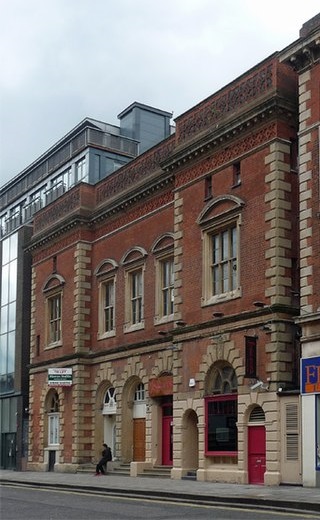
The Nottingham Corn Exchange was designed by the prolific local architect Thomas Chambers Hine (1813–1899), built in 1849–50, and officially opened on 6 April 1850 at a cost of about £3,000 (Historic England List Entry 1255190; Corn Exchange, Nottingham, Wikipedia). Hine, who had arrived in Nottingham in 1837 and would go on to shape much of the Victorian town — the Park Estate, the Great Northern Railway station, and the restoration of Nottingham Castle — worked here in a restrained Italianate idiom. The two-storey street front to Thurland Street presents a five-window range, with a recessed three-bay centre flanked by projecting end bays articulated by quoins. The fabric is red brick dressed with ashlar and terracotta; the openings carry round arches with rusticated surrounds, while the upper-storey cross casements are crowned with segmental pediments. A string course enriched with strapwork, a modillion cornice and a parapet of patterned brickwork complete the elevation, giving the building the dignified mercantile character expected of a purpose-built exchange. Behind the facade lay the great exchange room, roughly 77 feet by 55 and nearly 40 feet high, together with a clerk's office, a news room and ancillary offices. The building is listed at Grade II on the National Heritage List for England, designated on 30 November 1995 as the 'Corn Exchange and Clinton Rooms'.
The Corn Exchange is a work of commercial architecture rather than civic monument, and its decorative interest lies in the disciplined classical ornament of its Italianate envelope rather than in commissioned sculpture or painting. The Historic England listing singles out the strapwork enrichment of the upper string course, the modillion cornice, and the patterned brickwork of the parapet as the principal external ornamental features, set off against ashlar and terracotta dressings (Historic England List Entry 1255190; British Listed Buildings). The round-arched, rusticated window surrounds and the segmental pediments over the first-floor casements lend the elevation a rhythmic, palazzo-like quality characteristic of the mid-Victorian Italianate then favoured for exchanges and banks. Inside, the principal rooms retain moulded cornices on the ground floor, though much of the interior was refitted in the late twentieth century when the building was adapted as the Clinton Rooms concert and events venue.
The Corn Exchange stands on Thurland Street in Nottingham's Lace Market quarter, a short distance east of the medieval market place and the Exchange (now the Council House) where corn dealers had earlier gathered. The site itself carries deep historical resonance: it was previously occupied by Thurland Hall, a great house dating from 1458 and long associated with the Clinton family, Dukes of Newcastle, which was demolished in the 1830s (Corn Exchange, Nottingham, Wikipedia; Thoroton Society itinerary of Thurland Street). When the Nottingham Corn Exchange Company sought a site for a dedicated trading hall, Henry Pelham-Clinton, 4th Duke of Newcastle, granted use of the land in 1845 — a connection commemorated in the later name 'Clinton Rooms'. Thurland Street and the surrounding streets developed in the mid-nineteenth century into a district of commercial and banking premises, several of them by Hine himself, so that the Corn Exchange took its place among a cluster of confident Victorian business architecture at the heart of the town.
Before the exchange was built, Nottingham's corn merchants traded in the north-west corner of the old Nottingham Exchange in the market place. Dissatisfied with these cramped quarters, a group of local businessmen formed the Nottingham Corn Exchange Company in the early 1840s to finance a purpose-built trading hall (Corn Exchange, Nottingham, Wikipedia). With land secured from the Duke of Newcastle in 1845, Hine's building rose on the site of Thurland Hall and opened to trade on 6 April 1850. The exchange quickly became a focus of the town's commercial life: in 1863 the newly founded Nottingham Chamber of Commerce established itself in the building, where it kept offices for many years. As the open-market grain trade declined in the later nineteenth and twentieth centuries, the building's function shifted; it was eventually adapted for use as a concert and events venue known as the Clinton Rooms, the name under which it was Grade II listed in 1995. It survives today as a well-preserved monument to the mid-Victorian provincial corn trade.
As its name declares, the building was a corn exchange — a marketplace where corn factors, millers, maltsters and farmers of the surrounding agricultural districts met to buy and sell grain and other cereals by sample. Trading was conducted in the great top-lit exchange room on regular market days, the dealers handling small bagged samples of wheat, barley, oats and other produce against which bulk quantities were bought and sold. Such corn exchanges were the institutional backbone of the nineteenth-century grain trade in English provincial towns, providing a fixed, weatherproof and reputable venue for price formation in the staple commodity of the regional economy. The presence from 1863 of the Nottingham Chamber of Commerce broadened the building's role into a wider centre of mercantile organisation and commercial intelligence for the town.
Images will be added as the project develops. Photographs by Larry Ng and from research sources.