Nizhny Novgorod Fair & Main Fair Building (Нижегородская ярмарка / Главный ярмарочный дом)
Nizhny Novgorod, Russia · Established 1817 (Makaryev Fair from mid-16th c.; relocated to Nizhny Novgorod 1817; fair exchange committee from 1848)
This site requires authorization to access.
To request access, contact
william.goetzmann@yale.edu
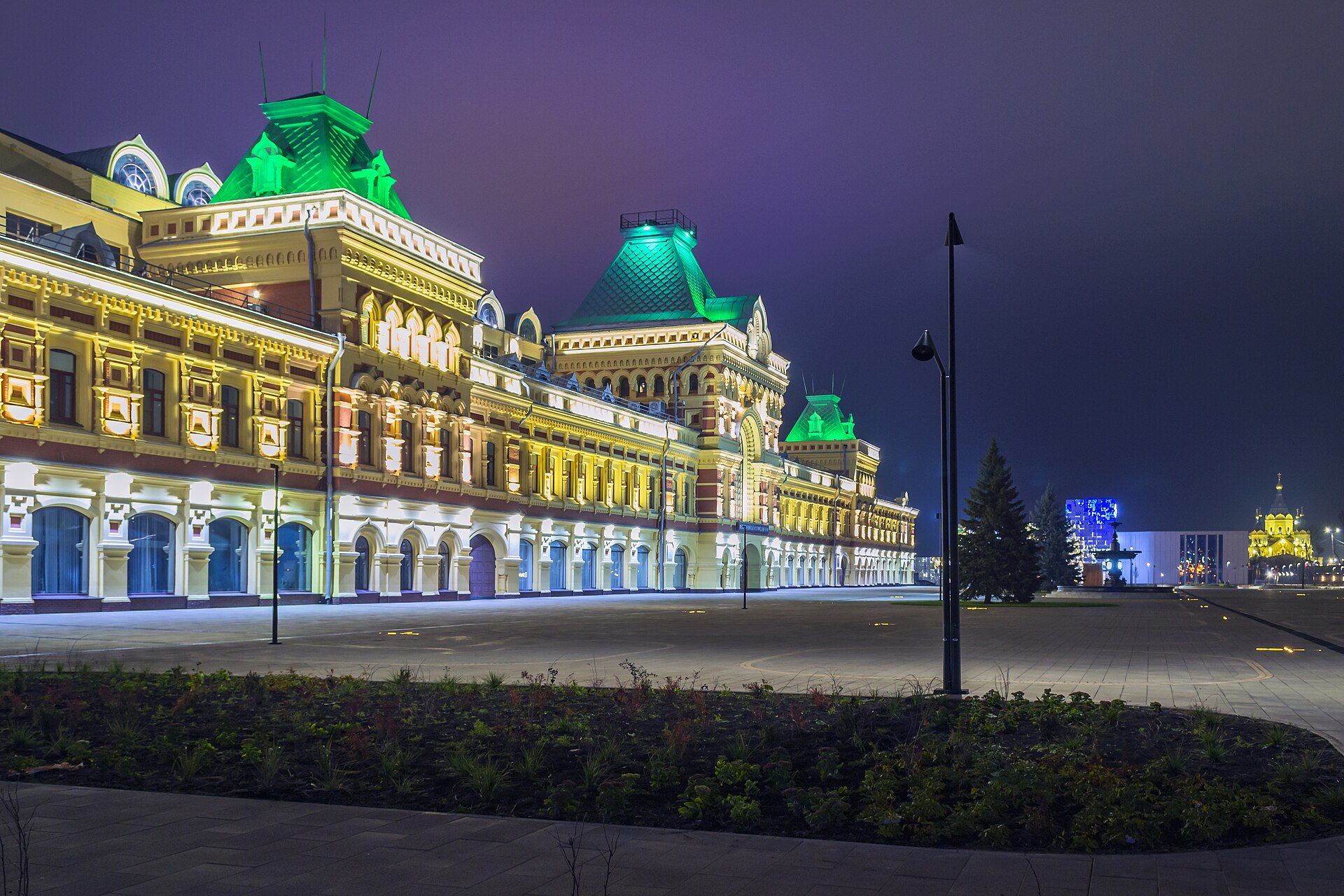
The present Main Fair Building (Glavny yarmarochny dom) is the second monumental structure to crown the Nizhny Novgorod Fair. The original ensemble was laid out from 1817 and built between roughly 1818 and 1822 by the engineer Augustin de Betancourt, who chaired the imperial Committee for Buildings and Hydraulic Works, with the young French-born architect Auguste de Montferrand (later architect of St Isaac's Cathedral) preparing the drawings; their fair was a vast neoclassical complex of a two-storey administrative house, dozens of trade rows, four 'Chinese' pagoda-roofed pavilions and a cathedral, ringed by a protective 'Betancourt canal' against fire and flood (Harvard Imperiia Project, K. M. Gordon, 'A Fair Place for Industry'). By the 1880s the Montferrand building had decayed, and an all-Russian competition drawing twenty-six designs from ten cities was won by the project of Karl V. Treiman, Alexander I. von Gogen and Alexei E. Trambitsky, which had taken a prize at a St Petersburg competition in 1882. The foundation was laid on 22 June 1889 and the new building opened on 15 July 1890, rebuilt within a single season in the fashionable neo-Russian (pseudo-Russian) style evoking sixteenth- and seventeenth-century Muscovite architecture. As the Russian Wikipedia and the regional heritage descriptions note, the terracotta-yellow brick structure massed like a fairy-tale terem town, with towers under tall tent roofs, closely set arched and barrel-vaulted windows, ornamental stonework and forged-iron cresting; a 2017 restoration recovered the original terracotta-yellow colour. The building, covering some 12,700 square metres, is today a federal cultural-heritage monument (registry no. 521410272890006).
The decorative programme is modest by the standards of a great bourse, concentrated in the building's stylized neo-Russian ornament rather than in commissioned painting or sculpture: terracotta-yellow facades dressed with arches, columns that are at once structural and ornamental, and forged-iron finials in a deliberate revival of Old Russian craft, conceived (in the words of the fair's own historical account at yarmarka.ru) as a 'fabulous terem' inspired by the wooden towers of Rostov and Novgorod. The principal interior accent is the Coat-of-Arms Hall (Gerbovy zal), whose walls carry the heraldic arms of the provinces of the Russian Empire arrayed as an emblem of imperial unity, and which is admired for its acoustics. The wider fair grounds carried the artistic weight that the trading house itself lacked, above all in the Saviour 'Old Fair' (Spassky) Cathedral begun in 1816 in late classicism and the Alexander Nevsky 'New Fair' Cathedral of 1868–1881, both raised with merchant money and both, with the Main Fair Building, surviving as federal heritage monuments.
The fair occupies the low Strelka, the spit of land in the Kanavino district on the left bank where the Oka meets the Volga opposite the historic hilltop kremlin of Nizhny Novgorod, the present Main Fair Building standing at Sovnarkomovskaya Street 13. The site embodied the fair's reason for being: Nizhny Novgorod lay at the hinge of the Volga–Oka river system linking the Baltic and Moscow to the Urals, Siberia, the Caspian and Central Asia, a position captured in the nineteenth-century saying that 'Petersburg is Russia's head, Moscow its heart, and Nizhny Novgorod its purse' (Harvard Imperiia Project). The original Montferrand layout, with its administrative house, horseshoe of trade rows and encircling canal, imposed a planned, almost Parisian order on a seasonal city of merchants that swelled enormously each July, while the Saviour and Alexander Nevsky cathedrals gave the riverside ensemble its skyline. The fair was the engine of the city's later transformation into a heavy-industrial centre, home to the Sormovo works and, in the Soviet period, the Gorky automobile plant.
The fair descended from the medieval Makaryev Fair held each July beside the Makaryev Monastery downstream on the Volga from the mid-sixteenth century, established by the Muscovite princes to draw commerce away from the Tatar fair at Kazan. After a great fire in 1816 the fair was relocated to Nizhny Novgorod and reopened on the new site in 1822, keeping the Makaryev name for decades. It grew into the largest fair in the Russian Empire and effectively an all-Russian wholesale exchange: turnover rose from about 24 million rubles at the 1817 relocation to roughly 57 million by the mid-1840s, drawing on the order of 15,000 merchants a year in the 1840s, among them several hundred from Western Europe and America and others from Persia, Khiva and Bukhara (gw2ru.com; Harvard Imperiia Project). Crucially, from 1848 a fair exchange and a fair exchange committee operated within the complex, and the prices struck at Nizhny Novgorod each summer effectively set wholesale commodity prices across the empire for the coming year. The fair reached its apogee in the late nineteenth and early twentieth centuries—a 1905 account describes some sixty buildings, 2,500 stalls and 8,000 exhibits—before the Soviet authorities wound it down; trade ceased in 1929. A successor organization revived the name in 1991, and the restored Main Fair Building now serves as an exhibition centre housing the 'Russia—My History' multimedia museum.
Nizhny Novgorod was above all a clearing house between European Russia and Asia, through which contemporaries reckoned the great bulk of eastward and westward overland trade passed. The most valuable goods were handled outside the central rows: tea brought overland from Kyakhta on the Chinese frontier (valued at some 42 million rubles in the 1880s, the single dominant article whose buyers' purchasing power swayed every other price), raw cotton from Khiva and Central Asia, and iron from the Ural works. Around these moved a vast assortment—Persian silks, carpets and dried fruit; Russian furs and pelts (fox, squirrel, muskrat), leather, beluga and sturgeon products; linen, hemp, wool and the cheap printed cottons of the Shuya and Ivanovo mills; metalwares, porcelain, glass, sugar, wax and honey (gw2ru.com; advantour.com). Trade was conducted by sample and bulk negotiation in the trade rows and increasingly through the fair exchange after 1848, where wholesale quotations were established that governed the empire's commodity markets for the year, making the summer fair as much a price-setting institution as a marketplace.
Images will be added as the project develops. Photographs by Larry Ng and from research sources.