Tontine Coffee House
New York, USA · Established 1793
This site requires authorization to access.
To request access, contact
william.goetzmann@yale.edu
The Tontine Coffee House was organized in 1791 by approximately 150 merchants who financed the venture through a tontine — a group investment plan in which each shareholder’s stake reverted to the surviving members. The cornerstone was laid on June 5, 1792, and the building opened in 1793 at the northwest corner of Wall Street and Water Street.
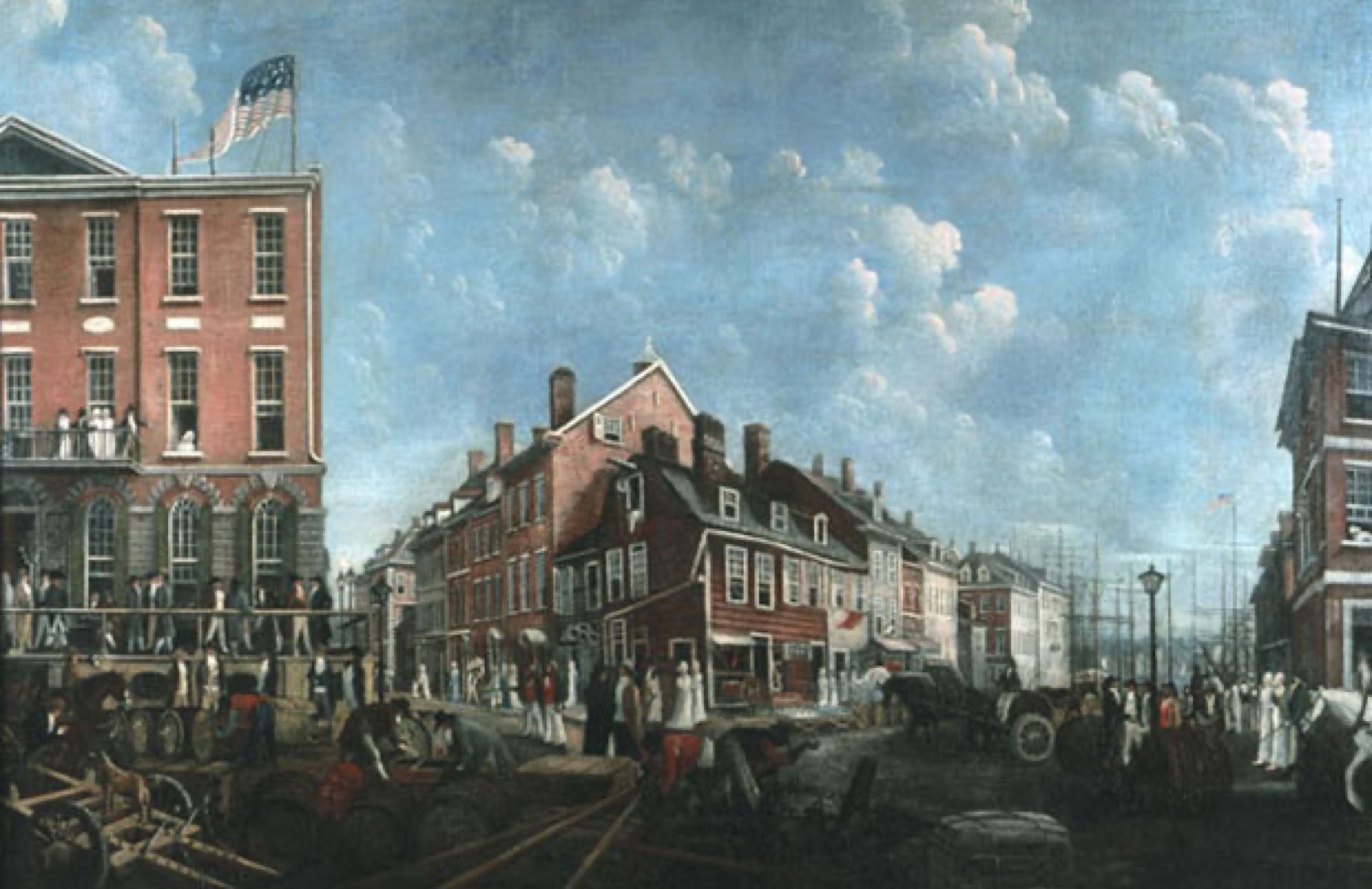
Francis Guy’s oil on linen painting Tontine Coffee House, New York City (c. 1797, 43 x 65 inches, New-York Historical Society, acquired through the Louis Durr Fund) is among the most important visual documents of early American commercial life. The large-format canvas depicts the bustling intersection of Wall and Water Streets — known as Coffee House Slip — with the Tontine Coffee House at the far left, clusters of merchants and laborers in the foreground, and the masts of East River shipping rising immediately behind, as analyzed by Caroline Gillaspie in her chapter “Coffee House Slip: Ecocriticism and Global Trade in Francis Guy’s Tontine Coffee House” (in Ecocriticism and the Anthropocene in Nineteenth-Century Art and Visual Culture, Routledge, 2020). Guy, a British-born silk dyer turned self-taught landscape painter (c. 1760–1820), was one of America’s earliest specialists in topographic urban views, later celebrated for his Brooklyn street scenes. In 1910, the Society of Iconophiles commissioned engraver Walter Monteith Aikman (1857–1939) to produce a copperplate engraving after Guy’s painting (plate 17 x 23 cm), copies of which entered the collections of the Library of Congress, Harvard Art Museums, and the Museum of the City of New York, ensuring wide scholarly circulation of the image. I. N. Phelps Stokes reproduced the composition in his monumental Iconography of Manhattan Island, 1498–1909 (Robert H. Dodd, 1915–1928), cementing its status as one of the canonical views of Federal-era lower Manhattan.
The Tontine Coffee House stood at the northwest corner of Wall Street and Water Street, a site that in the 1790s lay barely one block from the East River waterfront; subsequent landfill has since extended Manhattan’s shoreline eastward past Front Street to South Street, as documented in Robert Greenhalgh Albion’s The Rise of New York Port, 1815–1860 (Scribner’s, 1939). Deepwater wharves along the East River accommodated oceangoing vessels trading West Indian sugar, rum, coffee, and molasses, while counting houses and merchant warehouses lined Water and Front Streets, funneling commercial intelligence directly to the coffee house door. The Tontine stood diagonally across the intersection from the older Merchants’ Coffee House (southeast corner of Wall and Water), which had hosted New York’s merchant community since the 1770s; brokers frustrated by overcrowding there formed the Tontine Association in 1790 to build a dedicated rival establishment, as described in Edwin Burrows and Mike Wallace’s Pulitzer Prize-winning Gotham: A History of New York City to 1898 (Oxford University Press, 1999). Federal Hall, where George Washington took the presidential oath in 1789 and where the U.S. Customs Service collected tariff revenue — the federal government’s principal income source until the twentieth century — stood just two blocks west on Wall and Nassau Streets, reinforcing the corridor’s concentration of political and fiscal authority, as detailed by Charles Geisst in Wall Street: A History (Oxford University Press, 1997). Stuart Banner’s scholarship in “The Origin of the New York Stock Exchange, 1791–1860” (Journal of Legal Studies, vol. 27, 1998) argues that it was the self-regulatory culture incubated at sites like the Tontine that enabled New York’s brokers to consolidate trading power, eventually formalizing the New York Stock & Exchange Board in 1817. New York’s harbor geography — the sheltered East River anchorage, the network of slips penetrating the shoreline, and the short walk from dock to exchange floor — gave the Tontine a spatial advantage that no rival American port could match.
Just before the building’s completion, on May 17, 1792, twenty-four merchants signed the Buttonwood Agreement under a sycamore tree at 68 Wall Street, establishing foundational rules for securities trading in the wake of the Panic of 1792. When the Tontine Coffee House opened, stock trading moved to a room on the second floor, where it remained until 1817, when the traders formally constituted themselves as the New York Stock & Exchange Board — the direct precursor to the New York Stock Exchange. The building functioned much like Lloyd’s Coffee House in London: a hub for securities trading, insurance underwriting, maritime intelligence, and general commerce. Two ship logs were maintained “as at Lloyd’s of every ship’s arrival and clearance,” and a spyglass was kept to watch merchant ships arriving in the harbor. A contemporary observer described the scene as “filled with underwriters, brokers, merchants, traders, and politicians; selling, purchasing, trafficking, or insuring.”
The original building was demolished in 1855 and replaced by a larger structure, itself torn down in 1901. The Francis Guy oil painting of the Tontine Coffee House (c. 1797), now in the New-York Historical Society, is one of the most important visual records of early Wall Street.
Images will be added as the project develops. Photographs by Larry Ng and from research sources.