Royal Exchange
New York, USA · Established 1675
This site requires authorization to access.
To request access, contact
william.goetzmann@yale.edu
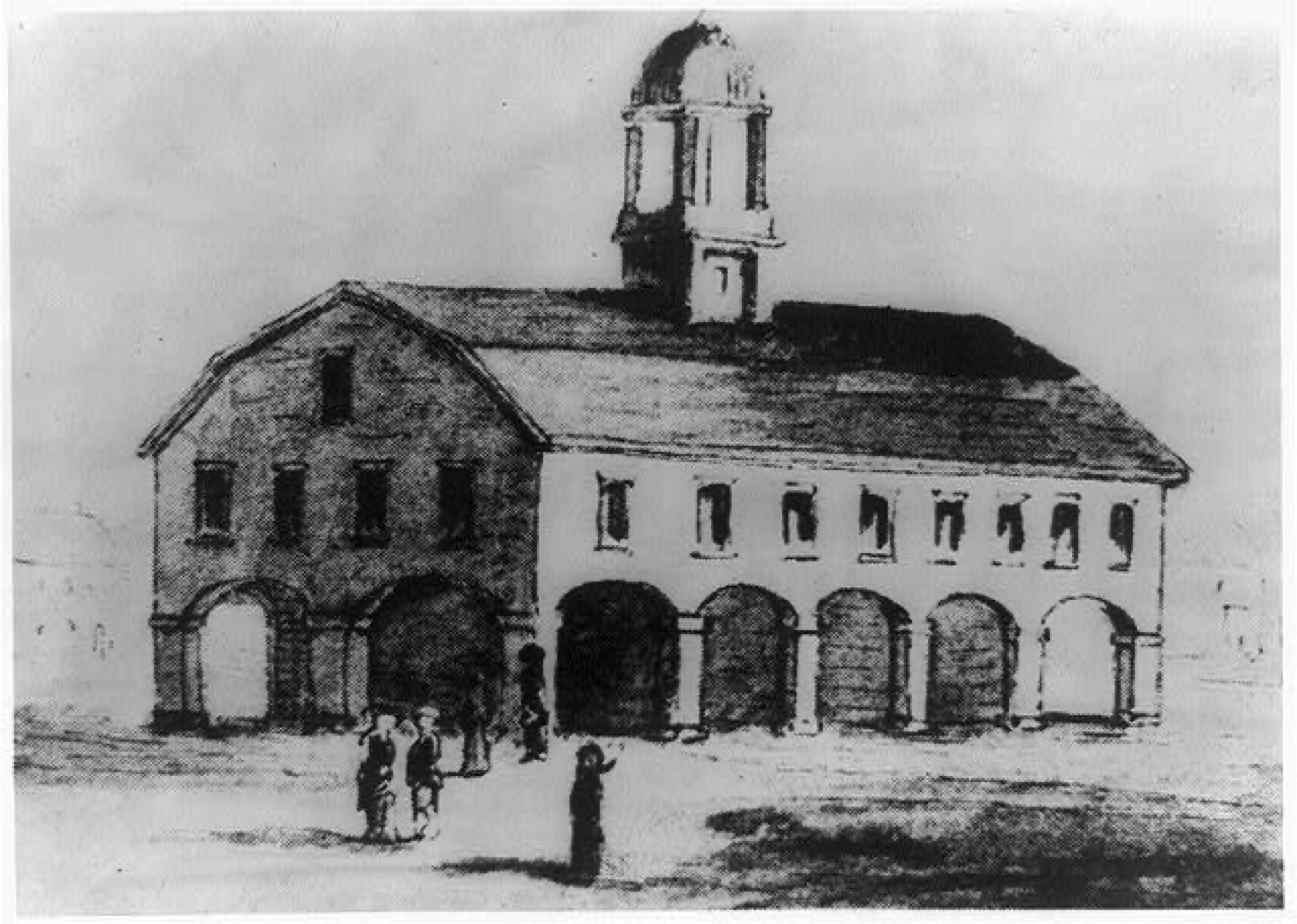
The Royal Exchange was built in 1675 as a one-story covered marketplace at the foot of Broad Street near Water Street in Lower Manhattan — one of the earliest purpose-built commercial structures in New York. It was substantially rebuilt in 1752 as a two-story market hall with an open arcade on the ground floor for merchant trade and an enclosed meeting hall above.
The best-known depiction of the Royal Exchange survives as a watercolor drawing once owned by the bibliophile and antiquarian William Loring Andrews, reproduced as a halftone print now catalogued in the Library of Congress Prints and Photographs Division (LC-USZ62-99273). The New-York Historical Society holds paired illustrations titled 'Royal Exchange, Broad Street, 1776' and 'Exchange at Foot of Broad Street, 1746,' documenting the building's appearance in two distinct periods. An inset view from Henry Popple's landmark 1727 map of the British Empire in America — one of the earliest cartographic depictions of colonial New York — shows the original 1675 exchange as a structure with a pyramidal roof supported by five columns, as described in I.N. Phelps Stokes's Iconography of Manhattan Island (1915-1928). The undated illustration captioned 'The first Merchant's Exchange. Erected 1752, Taken down, 1799,' held in the Duer's Old Yorker collection at the New York Public Library, provides the most detailed rendering of the rebuilt two-story structure and was itself based on an older engraving. Bernard Ratzer's celebrated Plan of the City of New York (surveyed 1766-1767), considered among the finest maps of any American colonial city, labels the Royal Exchange as item number 25 at the foot of Broad Street.
The Royal Exchange stood at the foot of Broad Street where it met Water Street, placing it at the commercial heart of colonial New York directly adjacent to the East River waterfront. Broad Street itself had been the Heere Gracht — the 'Gentlemen's Canal' — a Dutch waterway modeled on Amsterdam's canals that was filled in 1676, just one year after the original exchange was built, as documented in Nan A. Rothschild's archaeological study New York City Neighborhoods: The 18th Century (1990). This proximity to the wharves was no accident: as Edwin G. Burrows and Mike Wallace describe in Gotham: A History of New York City to 1898 (1999), New York's identity as a commercial port was shaped by its superb natural harbor, and the cluster of markets, coffeehouses, and taverns along the East River waterfront formed the infrastructure of colonial trade. The Exchange sat barely two blocks south of the old City Hall on Wall Street — later remodeled by Pierre Charles L'Enfant as Federal Hall — and roughly equidistant from Trinity Church (founded 1697) at the head of Wall Street and the site of the original Fort Amsterdam at the Battery. Russell Shorto, in The Island at the Center of the World (2004), emphasizes that the Dutch created in lower Manhattan a free-trade, cosmopolitan melting pot where merchants speaking multiple languages exchanged Hudson Valley flour, English woolens, Jamaican rum, and enslaved Africans. The Royal Exchange thus occupied the geographical and commercial nexus of a port city whose tight, irregular street plan — a living fossil of Dutch New Amsterdam — concentrated civic, mercantile, and maritime life within barely half a square mile at Manhattan's southern tip.
The building served multiple civic functions beyond commerce. The Chamber of Commerce of New York met on the second floor from 1770. After the Revolution, it housed the New York State Legislature (1785) and the Federal Court for the District of New York, which held its first session on November 3, 1789 — the first federal court to sit under the new Constitution, with Judge James Duane presiding. Most notably, the U.S. Supreme Court held its inaugural session there on February 2–10, 1790.
The New York Common Council voted to demolish the building on March 11, 1799, ending approximately 124 years of service as a commercial and governmental center in the colonial and early republican city.
Images will be added as the project develops. Photographs by Larry Ng and from research sources.